Swiss rental contract: the clauses to check before you sign
Before you sign
Check seven things in a Swiss rental contract before you sign: the term, the notice dates, which ancillary costs it names, the deposit, the small-repairs clause, the house rules and any rule on pets. Many standard forms go further than the law allows, and those clauses are void even after you sign. The rest of the lease still stands.
That last point changes how you read a lease. You can't negotiate much in a tight market, and you don't have to: a clause that breaks a mandatory rule simply doesn't apply to you. What you need is to know which clauses those are, so you don't pay what you don't owe and you do take seriously what binds you. We'll go through a lease in the order a standard Swiss form sets it out, with the rule behind each clause.
What a lease can't change
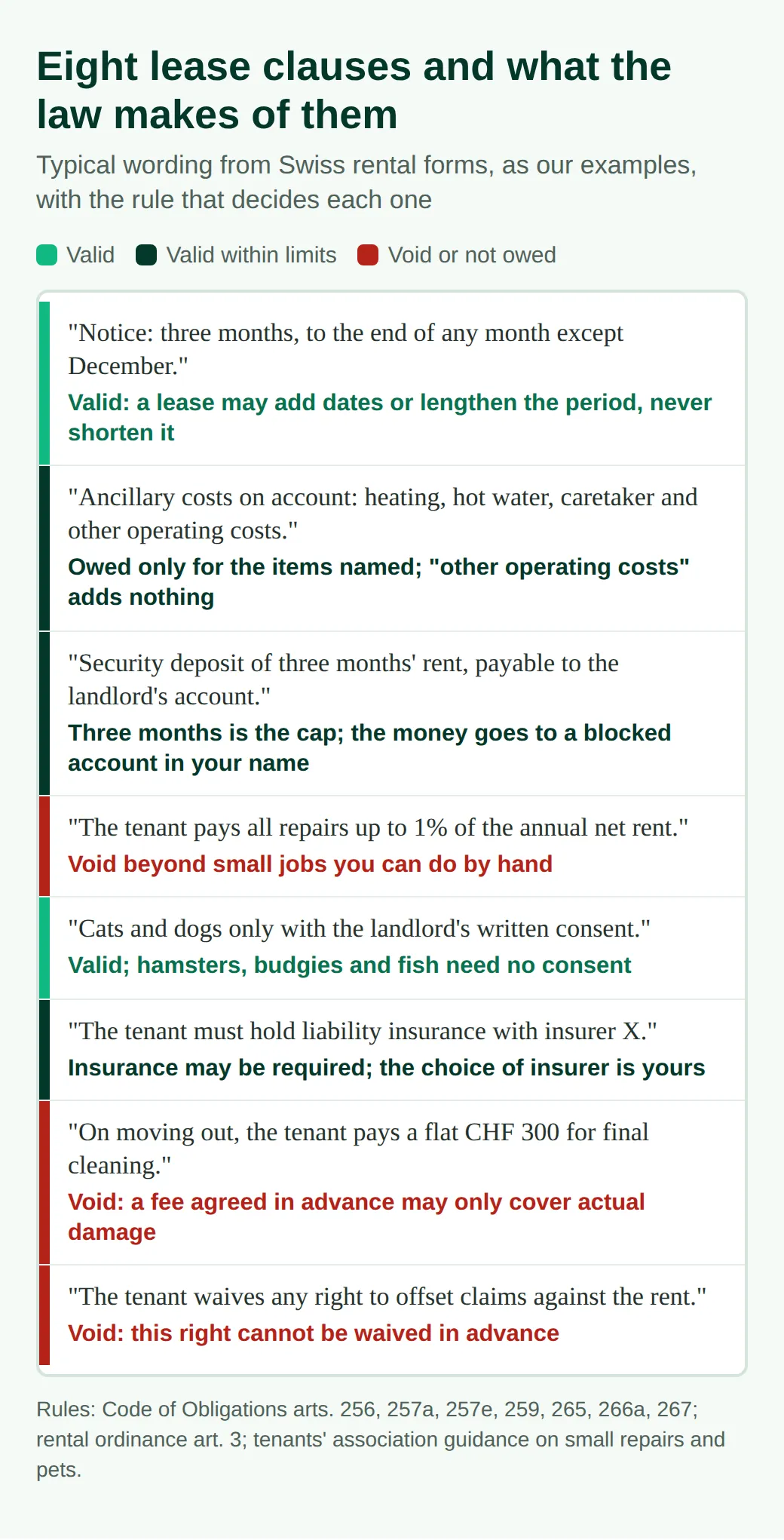
Swiss tenancy law sits in the Code of Obligations, articles 253 to 273c, and much of it is mandatory. Where a clause departs from a mandatory rule to your disadvantage, it is void, as the tenants' association puts it plainly: such clauses don't apply even if you sign them. The law spells this out in several places. A clause that shifts the landlord's duty to keep the flat in good repair onto you is void in any residential lease. So is a clause that makes you pay a fixed sum when you move out, a deal tying the lease to a purchase, and a waiver of your right to offset what the landlord owes you against the rent. You also can't sign away the protection against termination: any agreement to the contrary in that part of the law is void.
Two things are easy to miss before signing. First, the general terms that many agencies attach, often called AVB (Allgemeine Vertragsbedingungen), only apply if the lease itself mentions them, according to the same association page. Ask for them along with the house rules; they are part of what you sign. Second, the cantonal conciliation authority, the first stop for rental disputes, has a duty to advise tenants and landlords outside any dispute, and the rental ordinance names one moment in particular: before a lease is signed. If a clause worries you, that's where to ask.
With that in mind, start at the top of the form, where the lease says who signs and what you get.
Who signs and what you rent
The first lines name the parties and the property, and both matter more than they look. Everyone who signs is a tenant, and ch.ch, the federal information portal, notes that a group of people or an unmarried couple renting together are collectively responsible for the whole rent. If you're married, the portal advises naming your spouse in the lease too.
Then check the description of what you rent. The portal lists the attic, cellar and laundry room as parts that should be defined. A parking space is often on a separate contract, and that changes its notice: a separately rented space can be ended by either side with two weeks' notice to the end of a one-month rental period, while the flat keeps its three months.
Below the parties, the form turns to how long the lease runs.
Fixed term or open-ended?
Most Swiss leases are open-ended, ch.ch says, and end only when one side gives notice. A fixed-term lease ends on its last day without any notice; if you both carry on after that date without a new agreement, it becomes open-ended. Many open-ended forms add a minimum duration, such as "first possible termination date 31 March 2028". That holds against ordinary notice, but it doesn't trap you: the replacement-tenant route still works, as we explain in our guide to breaking a lease early.
The notice clause comes next. The legal minimum for a flat is three months, to a date fixed by local custom or, where there is none, to the end of a three-month period of the lease. The law lets the parties agree a longer period or other dates, not a shorter one. A form that says "end of any month except December" is therefore fine, and in practice it helps you. Which dates apply where you live is the subject of our post on termination dates by canton. For the contract, check one thing only: whether the lease names its own dates or refers to local custom, because dates written into the lease win.
Then comes the money.
The rent and the official form
A Swiss lease usually shows the net rent (Nettomiete) and the ancillary costs on separate lines, adding up to the gross rent you pay each month. The law makes rent due at the end of each month, unless agreed otherwise, and most forms do agree otherwise: rent payable in advance on the first. That clause is valid.
Two kinds of rent clause come with conditions. A rent tied to an index is valid only if the lease runs for at least five years and the index is the Swiss consumer price index. A staggered rent, rising by set steps, is valid only if the lease runs for at least three years, the rent goes up at most once a year and each step is fixed in francs. Since 1 October 2025, the landlord announces each agreed step in writing, at the earliest four months before it takes effect, under the rental ordinance. A staggered clause in a two-year lease, or one with steps in percent, fails those tests.
Is the rent itself fair? You have a right everywhere to be told what the previous tenant paid, so ask. In some cantons you don't have to: where housing is short, a canton can oblige landlords to hand every new tenant an official form showing the previous rent, along with the reference interest rate and consumer price index it was based on. The Federal Office for Housing keeps the list.
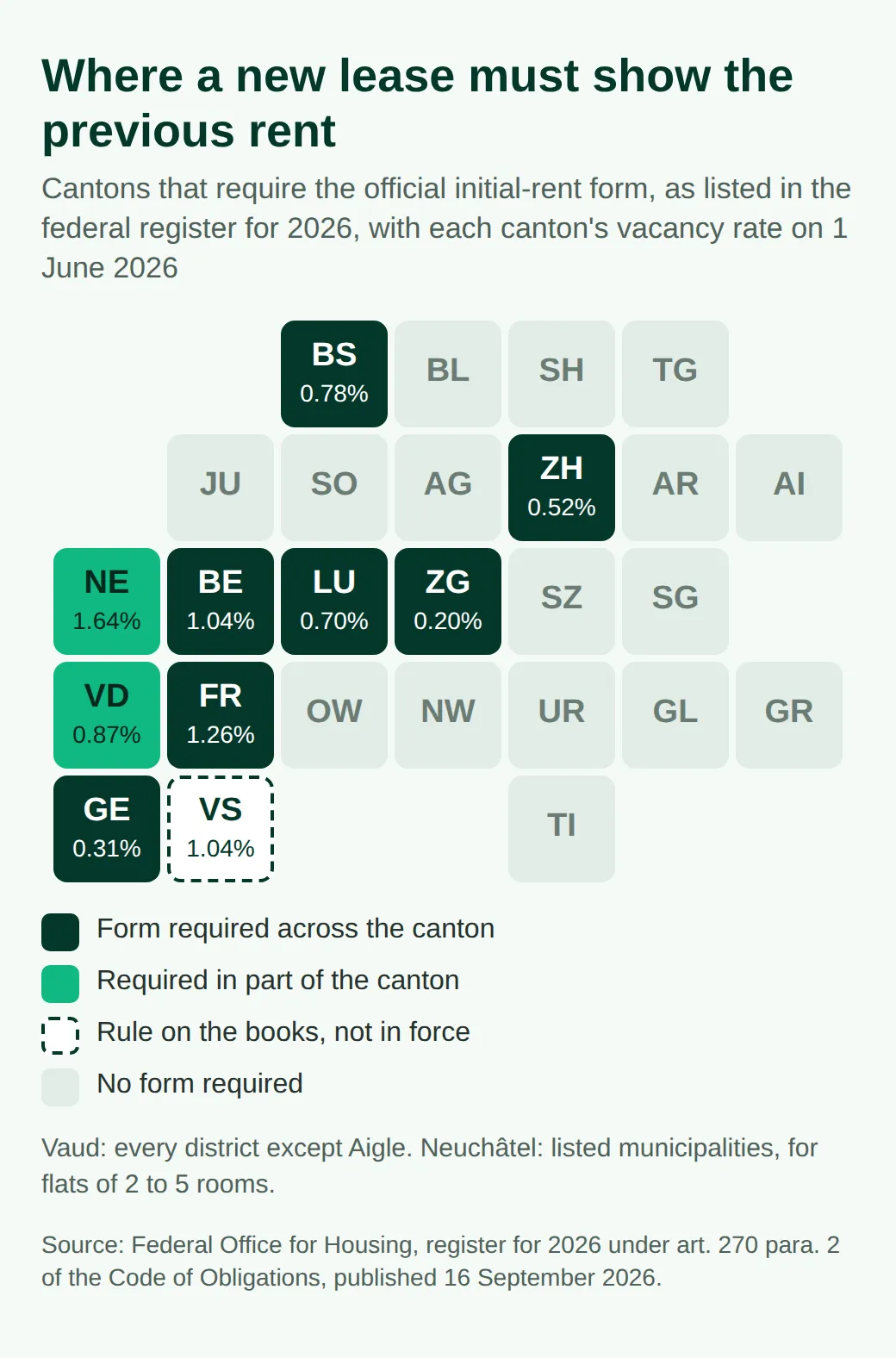
With or without the form, you can challenge an initial rent as unfair before the conciliation authority (Schlichtungsbehörde) within 30 days of moving in, on one of two grounds: you took the flat because of personal or family hardship or a tight local market, or the rent is well above what the previous tenant paid. The tenants' association adds what happens where the form is required and missing or incomplete: the agreed rent isn't valid, and the 30 days don't apply, so you can ask for the rent to be set later. Its page on initial rents suggests a challenge can make sense where the rent rose by more than 10% without a renovation, and recommends advice before you file. How your rent compares with others is a separate question; our average rents by city give a benchmark. Right under the rent, the form lists what you pay on top.
Ancillary costs: only what the lease names
You owe ancillary costs (Nebenkosten, charges) only where you have specifically agreed to pay them, and the Federal Supreme Court reads that strictly: you pay only the costs that the lease names clearly and precisely. A bare reference to standard terms isn't enough, the court held in 2009, unless those terms only spell out costs the lease itself already puts on you. Whatever the lease doesn't name is included in the rent, as ch.ch also says.
So read the list. Heating, hot water, the caretaker, waste and water are typical items. The catch-all "other operating costs" adds nothing you must pay, according to the tenants' association, which also lists what can never be passed on, whatever the lease says: taxes, building insurance premiums, mortgage interest, and repairs or investments. For heating, the ordinance itself excludes repairing and renewing the system.
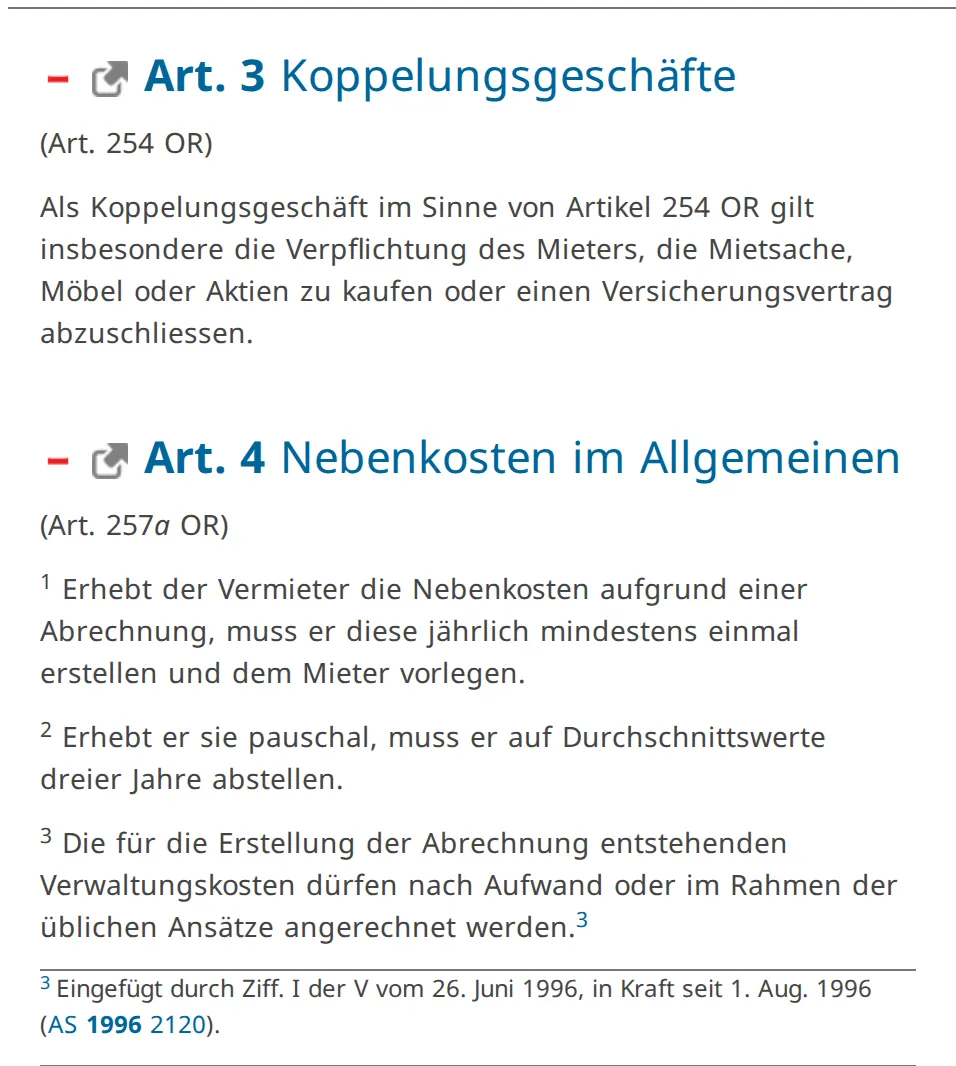
The lease will also say how you pay. With payments on account, you pay a monthly advance and the landlord must settle the real costs at least once a year. A flat rate means no annual statement, and the landlord must base it on three years of average costs:
Before you sign, ask what the costs came to in recent years. A low advance makes the rent look cheaper, and when it falls short of the real costs, you pay the difference with the statement, as the association explains. Once you live there, you can inspect the receipts behind the statement. The next clause is usually the one that costs the most on day one.
How much deposit can a landlord ask for?
At most three months' rent, and only if the lease asks for a deposit at all. That cap is in article 257e, which also says where the money goes: a savings or deposit account at a bank, in your name. The bank releases it only with both signatures, a final payment order or a court ruling. If a year passes after the lease ends and the landlord has brought no legal claim, you can ask the bank to pay it back on your own.
In practice that means you never hand cash to the landlord or pay into the landlord's own account. The tenants' association says you can refuse to pay until a blocked account in your name exists. It also advises against rent deposit insurance, sold as an alternative to a cash deposit: you pay a premium every year that you never get back, and if the landlord claims damage, the insurer pays and then asks you to repay it. The sample clause in the diagram above asks for the deposit "payable to the landlord's account": three months is fine, the account is not.
Further down the form sits the repair clause, and it deserves the slowest reading.
Small repairs and the 1% clause
You pay for small repairs, and only small ones. The law makes you fix defects that need minor cleaning or repairs as part of normal upkeep, at your own cost depending on local custom. The tenants' association describes that as work you can do easily by hand without special skills: oiling hinges, tightening a loose screw on a socket, clearing a sink trap. You also replace small worn parts sold in shops, such as a shower hose, an oven tray or a cooker hood filter, and a material limit of CHF 150 is widespread.
Some lease forms go much further. The clause the tenants' association singles out makes the tenant pay every repair up to 1% of the annual net rent; on a rent of CHF 24,000 a year, that would be CHF 240 per repair. The association calls such clauses invalid, because the landlord's duty to maintain the flat can't be shifted onto you in a residential lease. The same goes for clauses that make you pay for repairs to appliances such as the cooker or the bathroom fittings, and for clauses that oblige you to take out a service contract for the dishwasher, according to the association's answers on lease clauses. Its small-repairs page gives an example: a cooker controller replaced for CHF 100 is not yours to pay, because a technician had to do it.
If an invoice arrives anyway, the association advises rejecting it by registered letter. A short one does it:
Dear Sir or Madam,
I have received your invoice of [date] for CHF [amount] for the repair of the [appliance]. The repair needed a technician, so it is not a small repair that I owe under article 259 of the Code of Obligations. The clause in my lease that makes me pay repairs up to 1% of the annual rent is void under article 256. I will therefore not pay this invoice.
[Place, date, signature]
Report a defect in writing rather than calling a tradesperson yourself; then the bill goes where it belongs. The repair clause is often followed by the rules for daily life in the building.
Pets, smoking and house rules
On pets, the lease can say more than most people expect. Where it says nothing, keeping pets is generally allowed, the tenants' association says, unless you keep many or the animal is unusual and loud or dangerous, such as a parrot or a venomous snake. But most Swiss leases require the landlord's consent, and the landlord can refuse without giving a reason: the association cites a Federal Supreme Court ruling from February 1994 and a Zurich high court ruling from June 2015 to that effect. Small animals are the exception. Hamsters, guinea pigs, budgies and aquarium fish are allowed whatever the lease says, as long as you don't keep them in large numbers and nobody complains. If you have a dog or a cat, get written consent before you sign, not after you move in.
A ban on smoking inside the flat is a different case. The association considers it invalid as an intrusion into your private life, but notes that some conciliation authorities have decided otherwise, so the question is open. Either way, nicotine stains on walls and ceilings count as more than normal wear, and you pay for them when you leave.
House rules (Hausordnung, règlement de maison) bind you if the lease mentioned them when you signed, and they must be reasonable and proportionate. They usually set quiet times, laundry room slots and rules for shared spaces. Many places keep quiet from 10pm to 6am, ch.ch notes, often also over lunch and on Sundays. Rules that reach too far into your private life don't hold: the association gives the example of a short shower after 10pm, which you may take even if the rules forbid it, while a full bath at night is another matter.
Last, subletting. A lease can require the landlord's consent, but the landlord can only refuse on three grounds: you won't disclose the terms, the terms are unfair compared with your own lease, or the sublet causes the landlord major disadvantages. A blanket ban goes further than that. Clauses that sell you something on the side need a closer look still.
Insurance, furniture and other extras
A deal tied to the lease is void if the landlord makes the lease depend on it and it commits you to something not directly connected with using the flat. The ordinance, shown above, names typical cases: buying the flat, furniture or shares, or taking out an insurance contract. If you're told you'll only get the lease if you buy the previous tenant's furniture or sign up with a particular insurer, that condition doesn't bind you.
Liability insurance is a grey area. A lease may require you to have private liability insurance, because it covers damage to the flat, so the tenants' association treats that clause as valid. What the lease can't do is pick the insurer for you. Our guide to household and liability insurance covers what that policy should include.
Watch for fees as well. ASLOCA, the tenants' association of French-speaking Switzerland, wrote in 2020 that agencies often bill tenants CHF 150 to 200 for preparing the lease, although that cost is the landlord's, as the rental rules of Vaud also provide. The final group of clauses looks furthest ahead, to the day you leave.
Clauses about moving out
You owe a flat that matches its agreed use, cleaned, with any damage beyond normal wear paid for. Anything more agreed in advance is void: a clause making you pay compensation at the end of the lease is void except where the payment covers actual damage. A fixed sum agreed at signing for final cleaning, repainting or "handover costs" has nothing to do with damage, so on the wording of the article it falls under that rule. Normal wear is the landlord's cost, the tenants' association says in its handover tips, and for real damage you pay only the remaining value of the item, not the price of a new one.
Two more clauses belong here. You may not waive in advance the right to offset what the landlord owes you against what you owe. And if you want to change the flat, from a new floor to a fitted wardrobe, you need the landlord's written consent; the landlord can only make you restore the original state when you leave if that was also agreed in writing. If you plan changes, get both in the same letter.
Before the signing appointment
Ask for the whole lease before the appointment, with the general terms and the house rules, and read it at home with the rules above beside it. Mark what's void rather than arguing about it at the table; it won't bind you either way. Spend your effort on what does bind: get written consent for a pet or for changes you plan to make, and ask what the ancillary costs came to in recent years. If something still looks wrong, the conciliation authority will advise you before you sign.
In the cantons on the map, the form with the previous rent should come with the lease. Keep it: it's what a challenge of the rent rests on, and your 30 days start when you move in. In Geneva, where 0.31% of homes stood empty on 1 June 2026, that form comes with every new lease:
Common questions
Is a rental agreement valid if nothing was signed?
Usually, yes. Swiss law accepts an oral lease, and you keep all your rights as a tenant; rent receipts can prove that the lease exists. The exception is a landlord who sends you a written lease to sign after you agreed verbally: the tenants' association, citing a Federal Supreme Court ruling of 1980, says the lease then only comes about once you sign.
Can the landlord add a new ancillary cost after I have signed?
Not by simply sending a bill. Adding a new ancillary charge counts as a one-sided change to the lease, so the landlord must use the official form, give reasons and respect the rules for a rent increase. You then have 30 days to challenge it before the conciliation authority.
Do I get interest on my rent deposit?
The deposit sits in a savings account in your name, so any interest it earns is yours and is paid back with the deposit. The tenants' association says the interest itself is not blocked, but many banks treat it as blocked until the deposit is released.
Do the same rules apply to a luxury flat?
Mostly. The rent rules in articles 269 to 270e of the Code of Obligations don't apply to luxury flats and houses with six or more living rooms, not counting the kitchen. That removes the right to challenge the initial rent and the conditions on index-linked and stepped rents. The deposit cap, the notice rules and the void clauses still apply.
More from the blog
All posts
Average rent in Switzerland 2026: by city and room count
Swiss rent averaged CHF 1,485 a month in 2024. Official figures by city and room count, what new tenants pay, and the Geneva room-count trap.

Moving to Switzerland: customs on household goods in 2026
Your used belongings enter Switzerland free of duty and VAT. Form 18.44, the inventory, the two-year limit, cars, alcohol limits and pets, step by step.

Shared flat in Switzerland: leases, deposits and moving out
Main tenant or joint lease? How a Swiss shared flat works: subletting rooms, what you may charge, splitting the deposit and leaving without paying twice.