Termination dates for rent in Switzerland, canton by canton

When a lease can end
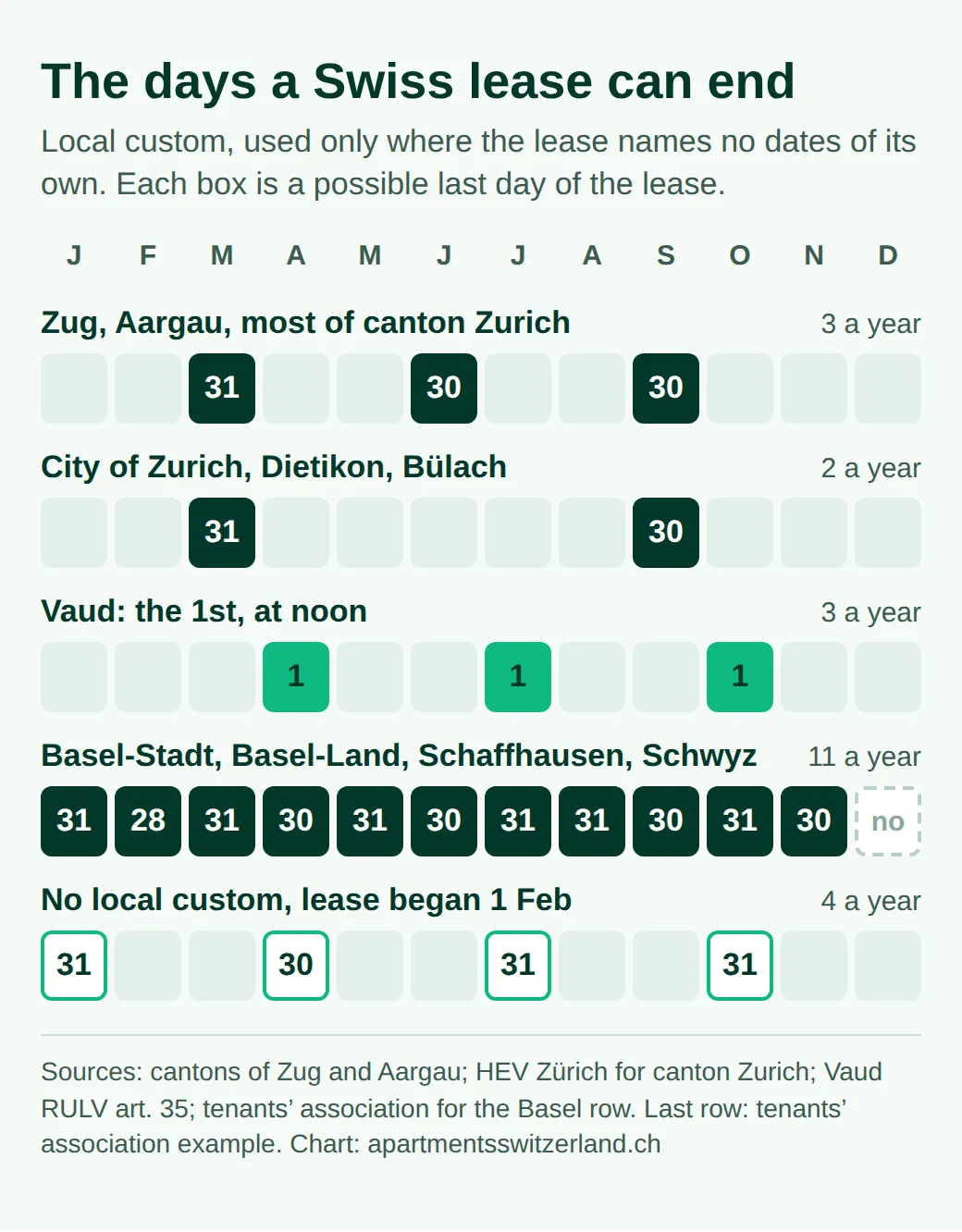
You can end a Swiss flat lease with at least three months' notice, and only on a termination date. Your lease names those dates. Where it doesn't, local custom sets them: 31 March, 30 June and 30 September in Zug and Aargau, only March and September in the city of Zurich, and any month end except December in Basel.
Two more rules decide whether your notice works. It counts from the day it reaches the other side, not the day you post it, and a landlord has to use an official form approved by the canton. Miss a date and the lease simply runs on to the next one. Skip the form, and a landlord hasn't given notice at all. Here's how each piece works, with the dates we could confirm in official and association sources.
Three words that decide your date
Swiss rental law works with three separate ideas, and most mistakes come from mixing them up. The Zurich courts define them on their page on ordinary notice:
- Termination date (Kündigungstermin): the day the lease ends.
- Notice period (Kündigungsfrist): the minimum time between the notice and that day. For a flat, three months at least.
- Deadline day (Kündigungstag): the last day your notice can arrive and still make that date.
The rule for flats is article 266c of the Code of Obligations: three months' notice, to a date fixed by local custom, or, where there is no custom, to the end of a three-month period of the lease. That's a floor. Your lease can ask for longer notice or name other dates, and then those apply, but it can't go below three months. More and more lease forms allow notice for the end of any month, the tenants' association notes, still with three months' notice. The law itself hasn't changed.
Missing the deadline doesn't make a notice worthless. A notice that arrives too late, or names a date the lease doesn't allow, takes effect on the next possible date. The association's fact sheet on a landlord's notice gives an example: a landlord gives notice for 30 May when the lease only allows the end of June, so the lease ends on 30 June. The price of a late letter is time. In Zug, the next date after 31 March is three months later. In the city of Zurich, it's six.
So start with your lease. Look for the clause on notice and see whether it names dates or refers to local custom (ortsübliche Termine in a German lease). If it names dates, those are yours. If it refers to local custom or says nothing, the canton's dates apply.
Termination dates by canton
These are the local dates we could confirm. They apply only where your lease names no dates of its own.
| Where | Lease can end on | Notice must arrive by | Source |
|---|---|---|---|
| Zug, Aargau | 31 March, 30 June, 30 September | 31 Dec, 31 Mar, 30 Jun | Zug, Aargau |
| Canton Zurich, most districts | 31 March, 30 June, 30 September | 31 Dec, 31 Mar, 30 Jun | HEV Zürich |
| City of Zurich, Dietikon and Bülach districts | 31 March, 30 September | 31 Dec, 30 Jun | HEV Zürich |
| Vaud | 1 April, 1 July, 1 October, at noon | 31 Dec, 31 Mar, 30 Jun | Vaud RULV, art. 35 |
| Basel-Stadt, Basel-Landschaft, Schaffhausen, Schwyz | End of any month except December | End of the month, three months before | Tenants' association |
The Zurich dates come from the homeowners' association HEV Zürich, and the Basel row from the tenants' association, so they describe practice rather than a law. The Basel row matches what the canton does as a landlord: Immobilien Basel-Stadt lets its tenants give notice for any month end except 31 December. Vaud is the odd one out. Its rental rules and customs (RULV, the version dated 14 November 2025) set 1 April, 1 July and 1 October at noon, and on that day you hand back the flat at noon too. The City of Lausanne's page for tenants spells out the deadline that follows: with three months' notice for 1 April, your letter has to reach the landlord by 31 December.
For Bern, Geneva, Lucerne, St. Gallen, Ticino and the other cantons, we found no official list. The canton of Bern's page for tenants only says local dates apply where the lease is silent. There, ask the rental conciliation authority for your district (Schlichtungsbehörde, autorité de conciliation, autorità di conciliazione), which the tenants' association names as the place where local dates are recorded. If a place has no custom at all, the fallback in the law applies: the end of each three-month period, counted from the day your lease began. In the association's example, a lease that began on 1 February can end on 30 April, 31 July, 31 October or 31 January.
Whichever row is yours, the deadline is about arrival, and that's where most late notices go wrong.
When does a notice count as received?
On the day it reaches the other side, or could have. The Federal Supreme Court applies the strict version of the receipt rule to every termination: a notice counts as received as soon as it lands where the addressee can get at it, whether or not they read it (BGE 137 III 208, in French). For a registered letter the postman can't hand over, that's the first day it can be collected at the post office, as a rule the day after the pickup slip.
For your own letter, the tenants' association spells out what follows in its fact sheet on giving notice. The letter has to arrive by the last day before the notice period starts, during business hours. If that day is a Saturday or a public holiday, it has to arrive the day before. And to be safe, post it by registered mail at least three working days ahead.
Here's how that plays out around the turn of 2027. Say you rent in Basel and want to leave on 31 January 2027. Three months back is 31 October 2026, a Saturday, so your letter has to be with the landlord on Friday 30 October, and you should post it by Tuesday 27 October at the latest. If you're aiming for 31 March 2027 in Zug or Zurich, the deadline day is Thursday 31 December, in the middle of the holidays, so post well before Christmas.
An email doesn't count. The law asks for notice in writing, and in Swiss law that means signed by hand. The only equivalent is an authenticated electronic signature, which few people have. Everyone on the lease signs, and if the flat is a married couple's or registered partners' home, the other partner has to agree expressly, even if they never signed the lease.
The same receipt rule binds your landlord, who also faces a requirement you never do: the form.
The landlord's official form
A landlord must give notice on a form approved by the canton, under article 266l. A letter, however formal, isn't enough. The form exists to tell you how to defend yourself. The federal rental ordinance says it must name the flat, give the date the lease ends, state that the landlord has to give reasons if you ask, set out when you can contest the notice or ask for more time, and list the conciliation authorities.
Each canton issues its own. In canton Zurich, the form comes from the Directorate of Justice and Home Affairs, the Zurich courts say. Basel-Stadt's conciliation office publishes its form as a PDF, and Zug requires its own as well. A landlord or agency can use its own design once the canton has approved it. In Bern, that's the job of the general secretariat of the cantonal high court, according to the canton's page for landlords.
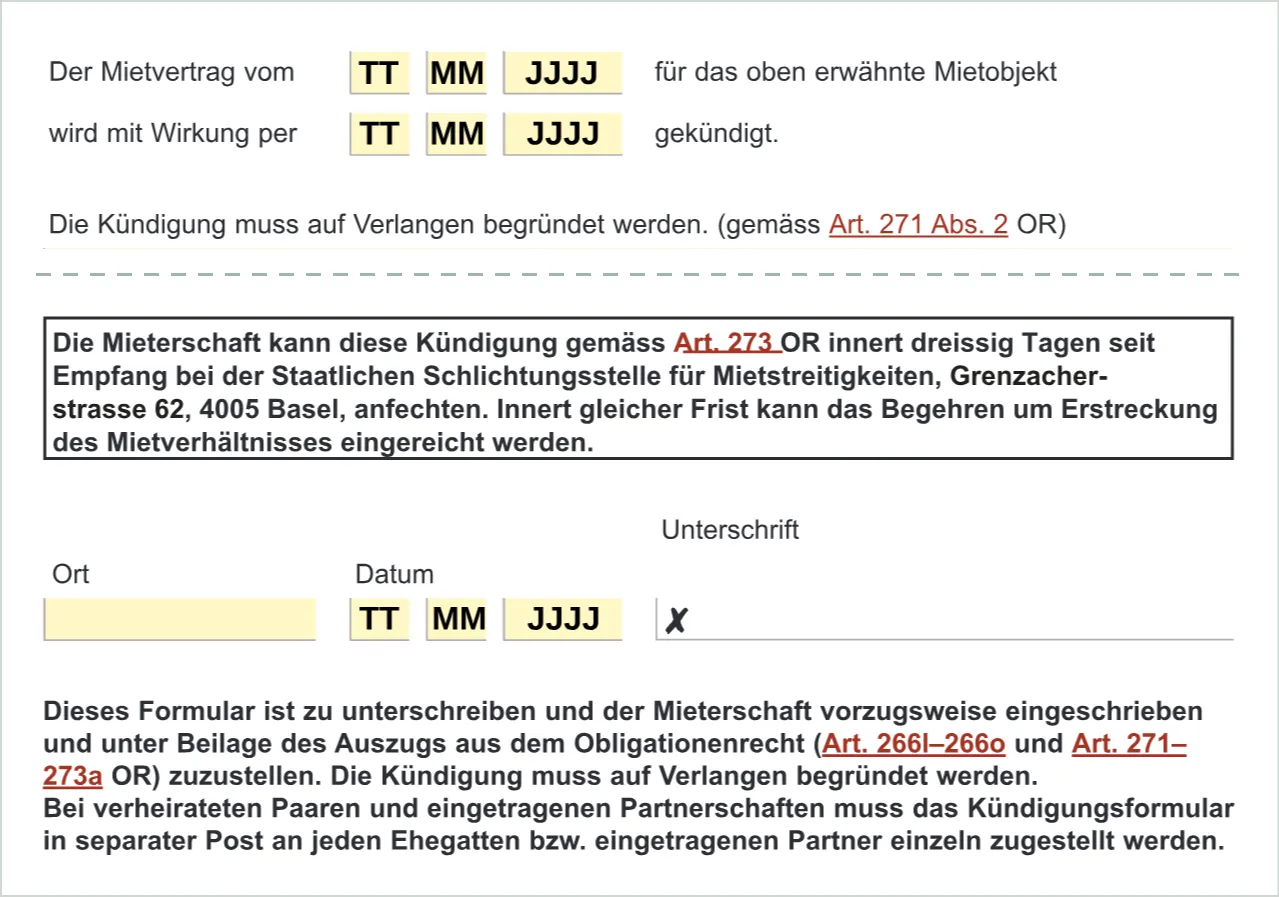
Two rules sit next to the form. If you're married or in a registered partnership and the flat is your family home, the landlord has to send the notice to each of you in a separate envelope, even if only one of you signed the lease. And every tenant on the lease has to be addressed.
Break any of these and the notice is void. Legally, nothing happened, and the lease runs on. That's different from a notice that is merely late, which still works for the next date. The Zurich courts list other void notices, such as one for only part of what you rent, like the cellar, or one tied to a condition the other side can't control. They still advise you to protest in writing and to go to the conciliation authority within 30 days, so nobody can claim later that you accepted it.
One recent change leaves this untouched. Since 1 October 2025, a landlord may sign a rent increase form with a printed signature, under article 269d. The law makes no such exception for a termination, so it stays under the general rule: written means signed by hand.
If you receive notice, the clock starts at the post office
You have 30 days from receipt to contest the notice at the conciliation authority, or to ask for the lease to be extended (article 273). Receipt works as above, and here it can hurt. In a 2016 ruling, the Federal Supreme Court held that the 30 days run from the first day the letter could be collected, as a rule the day after the pickup slip, not from the seventh day of the collection period, and that the tenant carries the risk of being away. The tenants in that case filed too late, and their challenge failed.
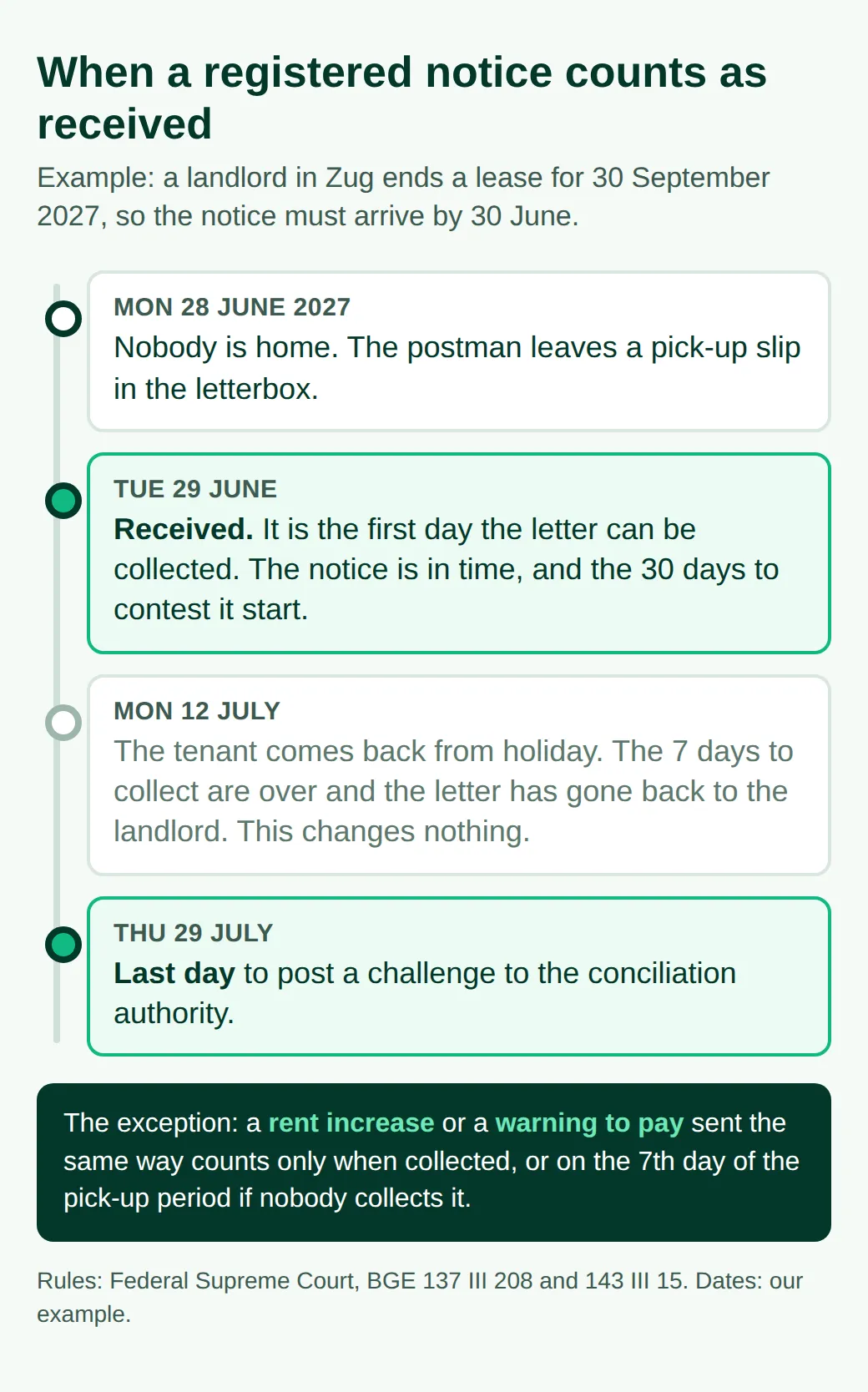
Rent increases and warnings to pay are the exception. They count only when collected, or on the seventh day if nobody collects them, because the court wants you to have the full time to think or to pay. A termination gets no such grace, so if you'll be away for weeks, arrange for someone to check your letterbox.
Within those 30 days you can ask for the reasons, which the landlord must give on request. You can contest a notice that breaks good faith, for instance one given because you claimed your rights under the lease. Or you can ask for more time: an extension can add up to four years in total for a flat. Once you have one, you can usually leave early, with one month's notice to the end of any month if the extension is a year or less (article 272d). The conciliation procedure itself costs nothing: federal procedure law charges no court costs at this stage in disputes over renting a home, and Geneva's conciliation commission says the same of its own.
One notice ignores the local dates altogether. If you fall behind on rent, the landlord can set you a deadline of at least 30 days to pay, and if you don't, end the lease with 30 days' notice to the end of any month (article 257d). The canton of Bern's page on contesting a notice adds that no extension is possible in that case.
When none of the dates fit
You still have two ways out, and neither needs a termination date. You can propose a replacement tenant who can pay the rent and will take over your lease on the same terms, and your rent stops when they take over; our guide to leaving a lease early covers how. Or you agree an end date with the landlord, in writing and signed by both of you. Without either, moving out early means paying rent until the lease's next possible end date.
Before you post your letter
Find your date in this order: your lease, then local custom, then the three-month fallback from the day your lease began. Count back three months to the deadline day, and move it to the working day before if it falls on a weekend or holiday. Post the letter by registered mail a few working days ahead, signed by everyone on the lease, and keep the post office receipt and a printout of the tracking.
If you're moving within the same city, line the two leases up. In the city of Zurich, where a lease that names no dates can end only on 31 March or 30 September, a new one starting on 1 April or 1 October saves you from paying two rents at once.
Common questions
Can I give notice before my lease has even started?
Yes, but the notice period cannot start before the lease does. The tenants' association gives the example of a lease starting in early December: a notice sent in October ends it at the end of February at the earliest. A replacement tenant who takes the flat from the start date lets you walk away without paying.
Does a fixed-term lease need notice?
No. A lease agreed for a fixed period ends on its last day without any notice. If you both carry on after that day without a new agreement, it becomes an open-ended lease, and the normal notice period and termination dates apply from then on.
What happens to a lease when the tenant dies?
It does not end by itself; the heirs have to give notice. They can use the legal three months to the next legal termination date, even if the lease would run longer. Where the lease allows faster dates than local custom, for example in the city of Zurich with only two local dates a year, they can use the lease's dates instead.
Can my landlord end the lease because I asked for a lower rent?
They can send the notice, but you can challenge it. A notice given because you asserted rights under the lease in good faith is open to challenge, and so is one sent within three years of a rent dispute the landlord largely lost or settled. You still have to act within 30 days of receiving it.
More from the blog
All posts
Average rent in Switzerland 2026: by city and room count
Swiss rent averaged CHF 1,485 a month in 2024. Official figures by city and room count, what new tenants pay, and the Geneva room-count trap.

Moving to Switzerland: customs on household goods in 2026
Your used belongings enter Switzerland free of duty and VAT. Form 18.44, the inventory, the two-year limit, cars, alcohol limits and pets, step by step.

Shared flat in Switzerland: leases, deposits and moving out
Main tenant or joint lease? How a Swiss shared flat works: subletting rooms, what you may charge, splitting the deposit and leaving without paying twice.