Tenant insurance in Switzerland: what it covers and costs
The short answer
Tenant insurance in Switzerland means two policies. Private liability insurance pays for damage you cause to others, including your landlord's flat. Household contents insurance pays for your own belongings after fire, water, storms or theft. Neither is required by federal law, but most landlords ask for liability cover, Vaud requires it in every lease, and at least three cantons make contents cover compulsory. Together they cost roughly CHF 150 to 350 a year.
That figure comes from real quotes: we ran one tenant through an insurer's online calculator in six towns and at three ages, checked the canton of Vaud's own premium simulator and read the terms that decide what gets paid. The surprises sit in the small print: what counts as wear and tear, who pays for a lost key, and how a cheap policy can still leave you paying half a claim.
Two policies, two different jobs
Liability insurance looks outward and contents insurance looks inward. In German they're the Privathaftpflichtversicherung and the Hausratversicherung; in French, responsabilité civile and assurance ménage. Insurers usually sell them as a pair, but the federal portal ch.ch points out that you can take each one from a different insurer.
Liability pays when you injure someone or damage their property: you break a friend's glasses, your washing machine floods the flat below, your child draws on the landlord's wall. For a tenant, the landlord is simply one more third party. ch.ch puts the usual sums insured at CHF 3 million to CHF 20 million, with a deductible between zero and CHF 5,000.
Contents pays for the things you own when they are destroyed, damaged or stolen: furniture, clothes, a laptop, a bike in the cellar. The standard perils are fire, natural hazards, water and theft. It pays nothing towards damage you do to others.
The building itself is the landlord's to insure, and some damage is simply yours to carry. Here is how the usual cases split:
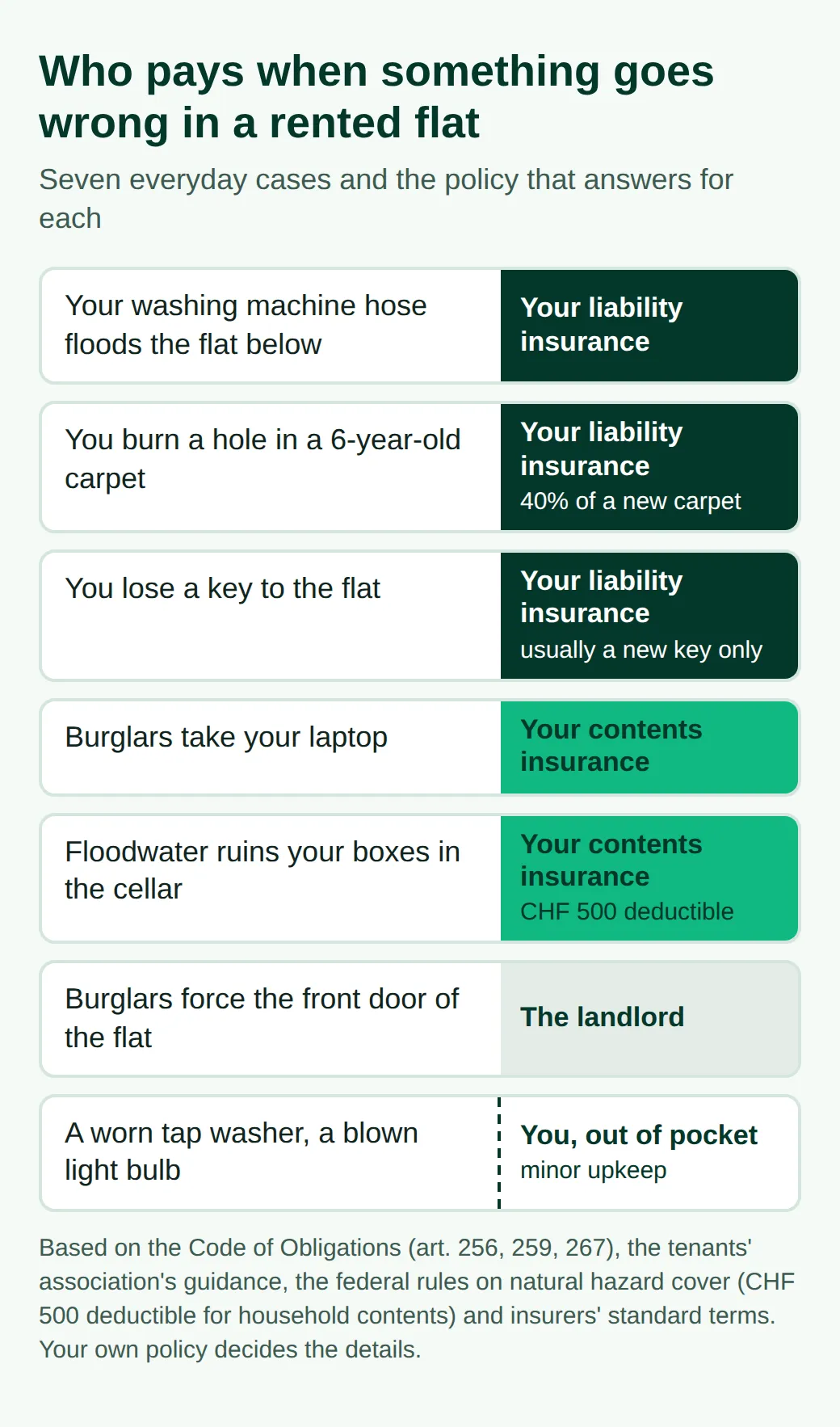
The forced front door surprises most people. The tenants' association of German-speaking Switzerland (the MV) says in its answers on defects and damage that break-in damage to the building is the landlord's to fix under article 256 of the Code of Obligations, even though contents policies often pay for it anyway. What the burglar takes from you is your contents insurer's business. With the two jobs clear, the next question is which of them you can be made to buy.
When can a landlord require liability insurance?
In most of Switzerland, whenever the lease says so. No federal law obliges a tenant to hold liability insurance, but ch.ch is blunt about practice: without it, "you may struggle to rent an apartment". Many landlords make it a condition when you apply, as Allianz notes in its guide for tenants.
Vaud goes further. Its rental rules, the Règles et usages locatifs (RULV), apply to every lease signed in the canton, and the Federal Council renewed their binding force from 1 July 2026 to 30 June 2032. Article 5 of the current text says that landlord and tenant must both be insured for liability in connection with the lease, for the whole time it runs. So in Lausanne, Nyon or Montreux the requirement isn't a landlord's preference you can negotiate away.
One catch matters wherever you rent. A lease can ask you to hold insurance, but it can't make your insurer pay for more than the law makes you owe. Simpego's general terms, for example, exclude liability you take on by contract beyond your legal liability. A clause saying you must repaint at the end of the lease is void anyway: the MV notes that upkeep is the landlord's job under article 256 and can't be shifted to you. Your policy won't fund it, and you don't owe it.
If you are a member of the MV, there's a cheap extra. Its collective rental-damage insurance costs CHF 10 a year on top of the membership fee and has no deductible. It covers only damage to the flat named in your membership, and if you already have private liability insurance, that policy pays first and the MV's covers its deductible. Claims have to be reported within 14 days. That's liability. Contents insurance is a different story, because in four cantons the law decides for you.
Where contents insurance is compulsory
In Vaud, Fribourg and Nidwalden, cantonal law makes you insure your belongings against fire and natural hazards, and insurers such as Allianz list Jura as the fourth canton. The rules differ in who you buy from.
- Vaud: you insure fire and natural hazards with the cantonal insurer, the ECA, whether you own, rent, sublet or share a flat, as its flyer spells out in French and English. The premium is CHF 0.50 per CHF 1,000 insured, plus federal stamp duty. Water damage and theft still need a private policy.
- Fribourg: a 1966 law requires your belongings to be insured against fire, explosion, lightning and natural hazards, with any licensed private insurer. The commune checks, and ignoring a formal reminder can cost a fine of up to CHF 500.
- Nidwalden: the cantonal Nidwaldner Sachversicherung states that contents insurance against fire and natural hazards is compulsory in the canton, and sells that cover itself.
- Jura: insurers list it too, but the canton's own law text wasn't available online when we checked, so ask the commune when you register.
In practice the Vaud split shows up in your quotes. When we priced a flat in Lausanne, the private insurer's contents cover listed only water and theft, because fire and natural hazards belong to the ECA. In Fribourg and Delémont the same calculator included fire as usual. If you move to Vaud from another canton, expect two bills for your belongings, and tell the ECA about any later move within the canton within two months, or a claim on the moved items can be cut by up to 10%, according to its information for policyholders.
What liability insurance pays when you move out
Less than you'd think, and that's mostly good news. The law only makes you hand the flat back in the state that follows from normal use. Wear and tear is already in the rent. You owe something only for damage beyond it, and then only the time value of the damaged item, never the price of a new one.
The time value comes from the joint lifespan table that the MV and the homeowners' association drew up together. The MV's online extract gives its own example: a fitted carpet of medium quality lasts 10 years, so if a 6-year-old one has to be replaced because of burn marks and candle wax, you pay 40% of the new carpet. Once an item's lifespan has run out, you pay nothing for it. Your liability insurer pays on the same basis, minus your deductible, which is why a claim at move-out often comes out smaller than the first invoice the landlord sends.
What it won't pay is just as predictable. Simpego's terms exclude rental damage that counts as minor upkeep and damage from deliberate changes, naming dowel and nail holes, along with restoring the flat to its original state. Minor upkeep is the small cleaning and repairs article 259 leaves to tenants, such as a tap washer or a light bulb. Damage that builds up slowly, from damp or smoke for example, is excluded as well. The MV adds two points that protect you either way: don't repaint or repair excess wear yourself before you leave, because then you pay the full price instead of the time value; and, in its advice on handing back a flat, don't sign a handover report that makes you accept costs. The landlord has to report defects to you straight away, and the MV reads that as within a week at the latest; otherwise the landlord loses the claim for anything visible at the handover. The same applies whether you leave on time or break the lease early.
A lost key
Losing a key rarely means a new lock system. The MV says you normally pay only for a new key, unless there's a real risk the key could be misused, for instance if you lost it near the building with your address attached. Even then the lock system is valued at its age, with a lifespan of 20 years, and the MV adds that private liability insurance usually covers the cost. Vaud's rules (RULV, article 37) are stricter in wording but similar in effect: you replace the lost keys, and pay for a new cylinder on the flat door only if it is a security lock.
Broken glass
Glass is where liability and contents overlap, so check both. In Geneva buildings that fall under the cantonal housing laws (LGL and LGZD), the cantonal rental rules (article 28) list replacing broken window panes among the tenant's minor upkeep, exactly the kind of cost a liability policy excludes. The answer there is the glass cover in a contents policy, which at Simpego includes the flat's windows and a glass-ceramic hob, but pays only where no other policy, such as the landlord's, covers the glass. In our Zurich quote it was part of the basic package with a CHF 500 deductible, and dropping it saved only CHF 13.70 a year. Glass, keys and carpets are the everyday claims. A fire is the rare one, and that's where the sum insured decides everything.
How much to insure your belongings for
Insure the cost of replacing everything new, not what you paid or could sell it for. Getting this wrong costs you twice: under article 51a of the Insurance Contract Act, if your sum insured is below the replacement value, the insurer pays only in that proportion, unless the policy says otherwise. Insure CHF 40,000 of belongings that would cost CHF 80,000 to replace, and a CHF 10,000 water damage claim pays CHF 5,000.
Most people underestimate. The ECA's premium simulator gives a useful official benchmark, because it estimates a household's value from the flat's size, the number of people and how well it's furnished. These are its figures for flats:
| Flat and household | Simple | Standard | Superior |
|---|---|---|---|
| 1.5 rooms, 1 person | CHF 45,000 | CHF 54,000 | CHF 71,000 |
| 2.5 rooms, 1 person | CHF 62,000 | CHF 74,000 | CHF 96,000 |
| 3.5 rooms, 2 people | CHF 92,000 | CHF 111,000 | CHF 145,000 |
| 4.5 rooms, 3 people | CHF 123,000 | CHF 148,000 | CHF 193,000 |
| 5.5 rooms, 4 people | CHF 148,000 | CHF 177,000 | CHF 230,000 |
Even a single person in a studio-sized flat reaches CHF 45,000 on the most modest setting. Walk through the flat and price what you'd need to buy again after a fire, from the sofa to the kitchen things, and raise the sum when you buy something big. Cash, jewellery and art often carry their own limits. The sum insured also drives the premium, so this is the moment to look at what cover costs.
What tenant insurance costs in 2026
For one person in a three-room flat, about CHF 180 to 230 a year for a basic package of both policies in our quotes, the ECA's share in Vaud included. We priced it in Simpego's online calculator for cover starting on 1 December 2026: a tenant in a block of flats, three rooms, average furnishing, born in 1991. The calculator suggested insuring the belongings for CHF 79,000. Its cheapest package came to CHF 226.50 a year in Zurich, with liability of CHF 3 million (CHF 600 deductible) and contents with a CHF 500 deductible. Then we changed one thing at a time:
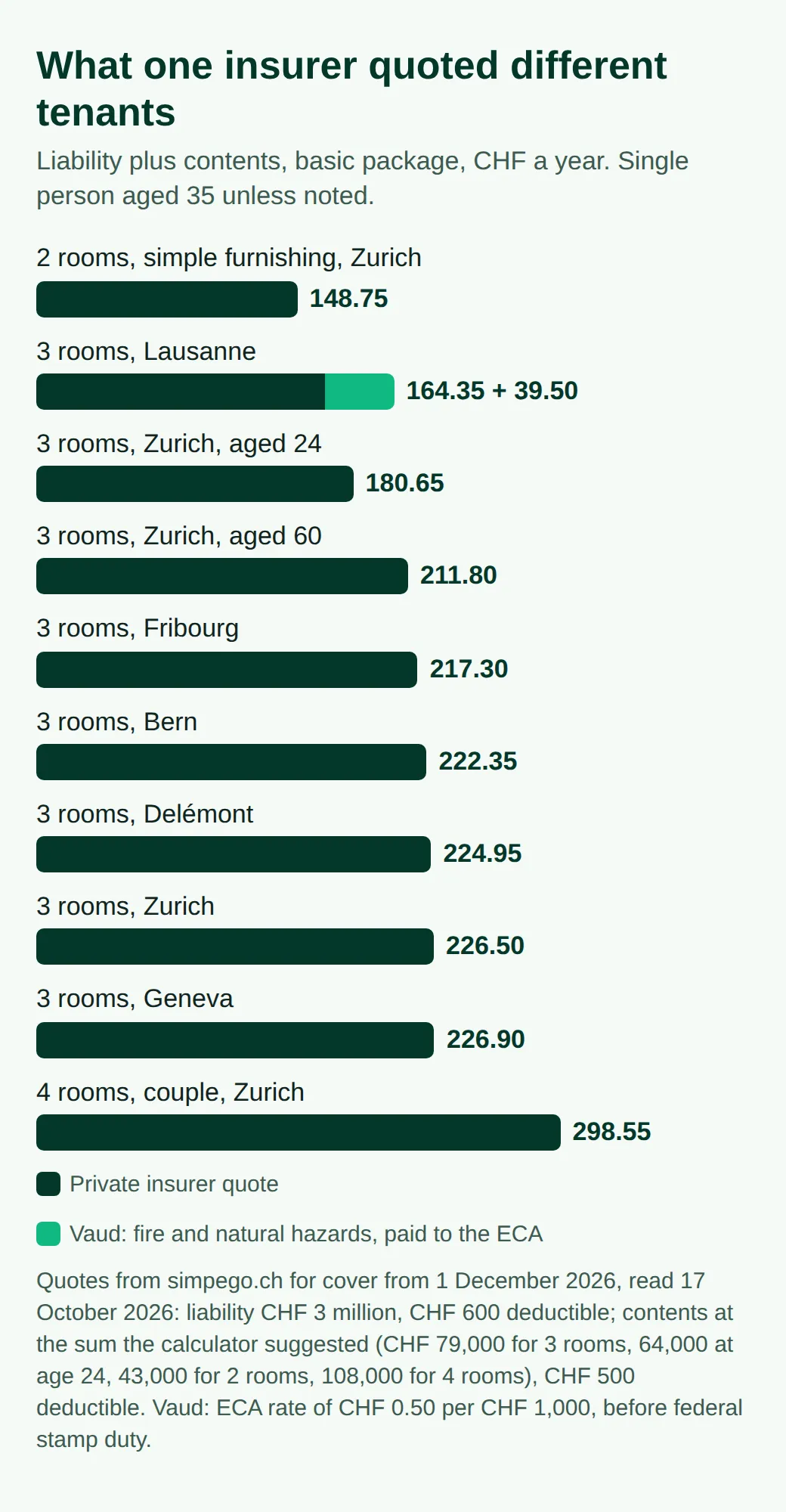
Three things stand out. Location moves the price less than you might expect: Bern, Geneva, Delémont and Zurich are within CHF 5 of each other. Age matters more, and not in a straight line: at 24 the quote was CHF 46 lower than at 35, partly because the calculator suggested insuring only CHF 64,000 of belongings. And Vaud only looks cheap until you add the ECA's CHF 39.50 for fire and natural hazards on the same CHF 79,000, plus federal stamp duty.
One insurer is one data point, so here is a second. In a test by the consumer programme Kassensturz in March 2024, eleven insurers priced a single tenant with CHF 72,000 of belongings and CHF 5 million of liability. The cheapest asked CHF 192 a year and the dearest almost CHF 350. Our quotes sit inside that range, and the spread is the reason to compare at least three offers on identical terms.
Splitting the package showed something odd. In the same calculator, liability alone came to CHF 62.20 and contents alone to CHF 136.25, together less than the CHF 226.50 for both. We can't tell you why, but it's worth asking for each policy's price on its own before you accept a bundle.
The bigger packages cost far more: CHF 572.75 for the middle one and CHF 1,020.25 for the top one in Zurich, mostly for lower deductibles, theft away from home and assistance services. Set against a month's rent in a Swiss city, even the basic package is a small line in your budget. Only some of the add-ons earn their price.
The add-ons worth paying for
Two are, for most tenants, and both come down to how claims get cut.
Gross negligence. Under article 14 of the Insurance Contract Act, an insurer may reduce what it pays if you caused the damage through gross negligence, in proportion to your fault. Simpego's terms define that, in the Federal Supreme Court's words, as breaking an elementary duty of care that any reasonable person in your place would have seen. Insurers sell a waiver of that right as an option, and Simpego's middle and top packages include it. Added to our basic Zurich quote, it cost CHF 23.90 a year and applied to both policies.
Theft away from home. Burglary from your flat is standard; a bike stolen from the station or a bag taken from a café is "simple theft away from home", and the basic package we priced didn't include it. The middle package covered it up to CHF 3,000.
Natural hazards need no add-on, but they come with fixed rules. Any insurer covering your contents against fire must cover natural hazards too, on uniform terms set in the insurance supervision ordinance: floods, storms of at least 75 km/h, hail, avalanches, snow pressure, rockfall and landslides, with a fixed deductible of CHF 500 per event for household contents. Earthquakes are excluded from that cover and need a separate option, which appeared only in the middle and top packages of our quote. Water backing up from the sewers is not a natural hazard either, so check that your water cover includes it. Once you've chosen, the next question is how long you're tied in.
Signing, switching and leaving
You can change your mind within 14 days of signing, in writing or any other form that leaves a text trace, under article 2a of the Insurance Contract Act. After that, a contract signed for longer can still be ended at the end of its third year, or any year after, with three months' notice (article 35a). After a partial loss, both you and the insurer can withdraw from the contract, at the latest when the claim is paid. Simpego's calculator also offers a right to cancel any day as an option.
Moving within Switzerland doesn't end your policies, but report the new address. At Simpego, cover continues at the old address for up to six months and starts at the new one from the day you register with the commune. Moving abroad is different: Simpego's terms end liability and contents cover on the day you deregister, and the ECA stops covering your furniture the day it leaves Switzerland.
Before you sign your next lease
Get your liability insurance in place before you apply, because many landlords ask for it and in Vaud the lease requires it. Price the contents cover on the replacement value of everything you own, using the ECA's figures as a benchmark, and ask for liability and contents quoted separately as well as together. Read three lines of the terms before you buy: the gross negligence clause, the deductible for rental damage, and whether damage to a furnished flat's furniture is covered. If you join the tenants' association, add its CHF 10 rental-damage cover to wipe out your deductible on the claim you're most likely to make, the one at move-out.
Common questions
Do flatmates need their own insurance?
It depends on the policy, so ask before you rely on someone else's. Simpego's contents cover includes everyone living in the household, but the ECA in Vaud covers only the policyholder's family and people expressly named in the policy. For liability, Simpego sells a single policy and a whole-household one, and only the second covers a flatmate.
Am I covered if I damage the furniture in a furnished flat?
Not always. Simpego's terms, for example, exclude damage to rented furniture in a furnished flat that is your permanent home. If you rent furnished, ask the insurer in writing whether damage to the landlord's furniture is covered, and choose a policy that includes it.
Can a rental deposit replace liability insurance?
No. A deposit of up to three months' rent is your own money, held in a bank account in your name, which the landlord can claim for damage you owe. Liability insurance pays that damage for you. Without it, a large claim comes out of your deposit first and then out of your pocket.
Does my liability insurance cover my dog or cat?
Usually yes. The federal portal ch.ch says damage caused by your animals is generally included in personal liability insurance. For dogs, most cantons go further and make liability insurance compulsory.
More from the blog
All posts
How to register your new address in Switzerland in 2026
Register at your new commune within 14 days (8 in Vaud). What that one report updates on its own, and who still needs to hear from you directly.

Moving to Switzerland: customs on household goods in 2026
Your used belongings enter Switzerland free of duty and VAT. Form 18.44, the inventory, the two-year limit, cars, alcohol limits and pets, step by step.
Shared flat in Switzerland: leases, deposits and moving out
Main tenant or joint lease? How a Swiss shared flat works: subletting rooms, what you may charge, splitting the deposit and leaving without paying twice.