Average rent in Switzerland 2026: by city and room count
The numbers first
The average net rent in Switzerland was CHF 1,485 a month in 2024, according to the Federal Statistical Office: CHF 1,446 for a 3-room flat and CHF 1,708 for 4 rooms. In the ten largest cities, a 3-room flat averaged from CHF 1,095 in Biel to CHF 1,761 in Zurich over 2022 to 2024. If you are signing a new lease, expect to pay more than that.
The reason is that an average covers everyone: the couple who signed a lease a year ago, the pensioner on a lease from 1998 and the cooperative member paying cost rent. Across Switzerland, households that had moved into a 3-room flat less than two years earlier paid CHF 1,567 on average in 2024. In Zurich it was CHF 2,125. Below you'll find the official numbers by city and size, then the ones that fit your situation: a new lease, a private landlord, and net or gross rent. They come from the people who collect them: the Federal Statistical Office (BFS), Statistik Stadt Zürich, Geneva's statistics office and Statistik Stadt Bern. Each carries its date.
What is the average rent in Switzerland?
CHF 1,485 a month, net, in 2024. That's up from CHF 1,451 in 2023 and CHF 1,412 in 2022, according to the BFS table of average rent by canton and room count. The figure comes from the structure survey, which asks a sample of households every year about their home and what they pay for it. Net means the rent alone, without service charges and heating, and the count includes rented and cooperative flats.
The number depends a lot on size, so here it is by room count. The two right-hand columns split tenants by how long they have lived in the flat, from the BFS table on rent by length of occupancy:
| Size | All tenants, 2024 | Moved in less than 2 years ago | Lived there 21 years or more |
|---|---|---|---|
| 1 room | CHF 902 | CHF 948 | CHF 743 |
| 2 rooms | CHF 1,217 | CHF 1,305 | CHF 970 |
| 3 rooms | CHF 1,446 | CHF 1,567 | CHF 1,159 |
| 4 rooms | CHF 1,708 | CHF 1,871 | CHF 1,355 |
| 5 rooms | CHF 2,068 | CHF 2,248 | CHF 1,677 |
| 6 rooms or more | CHF 2,578 | CHF 2,702 | CHF 2,208 |
By canton, Zug is the most expensive at CHF 2,024 for an average flat, followed by Zurich (1,768) and Schwyz (1,719). Jura is the cheapest at CHF 999, then Neuchâtel (1,091) and Uri (1,219). A canton mixes its city with its villages, though, and most people searching for "average rent" have a city in mind.
Average rent by city and size
For cities, the BFS pools three survey years so that each cell rests on enough answers. Its newest table on rent in the ten largest cities covers 2022 to 2024 and puts the big cities side by side:
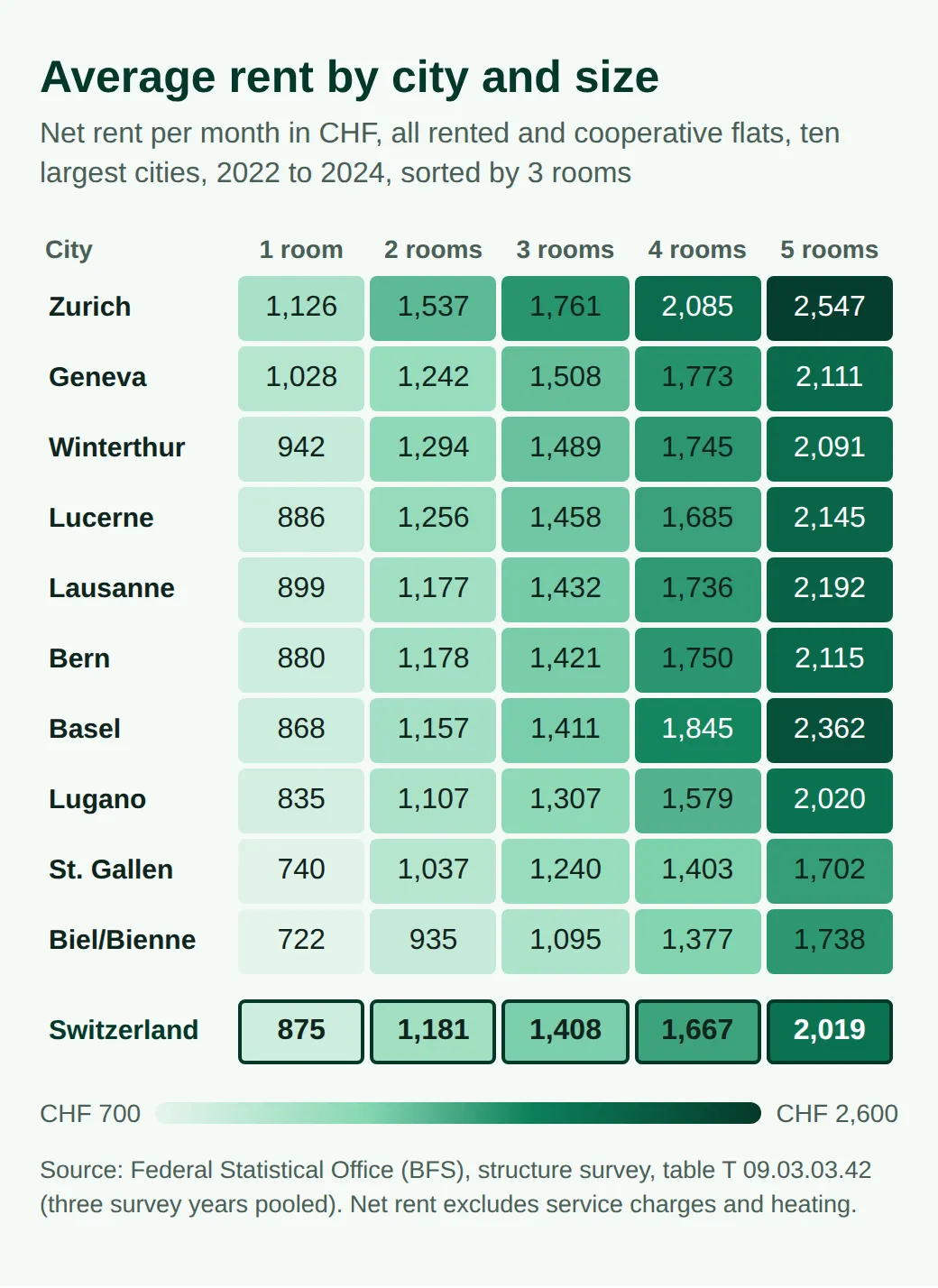
Zurich is the most expensive city at every size up to 5 rooms: CHF 1,537 for 2 rooms, CHF 2,085 for 4. Below it the order shifts. Geneva comes second for 1 and 3 rooms, but for 4 and 5 rooms Basel overtakes it, at CHF 1,845 and CHF 2,362. Winterthur, a short train ride from Zurich, costs more than Bern, Basel or Lausanne for a 2- or 3-room flat. At the cheap end sit St. Gallen and Biel, where a 3-room flat averaged CHF 1,240 and CHF 1,095.
These are still averages over everyone who rents, which is the catch. The next chart shows how far a recent tenant sits from them.
Why new tenants pay more than the average
A household that has just moved in pays clearly more than one that has stayed for years. The BFS says it plainly on its page about rented dwellings: the longer households rent their homes, the lower the rents, and newly built flats cost the most. Its example is a new 4-room flat at CHF 2,304 a month against CHF 1,838 for an older 4-room flat let within the last two years.
The gap differs by city. It's widest in Zurich, where only 0.5% of dwellings in the wider city area stood empty in June 2026, and narrowest in Basel, which had the most empty flats of these five (0.8%), according to the BFS vacancy table for the largest agglomerations:
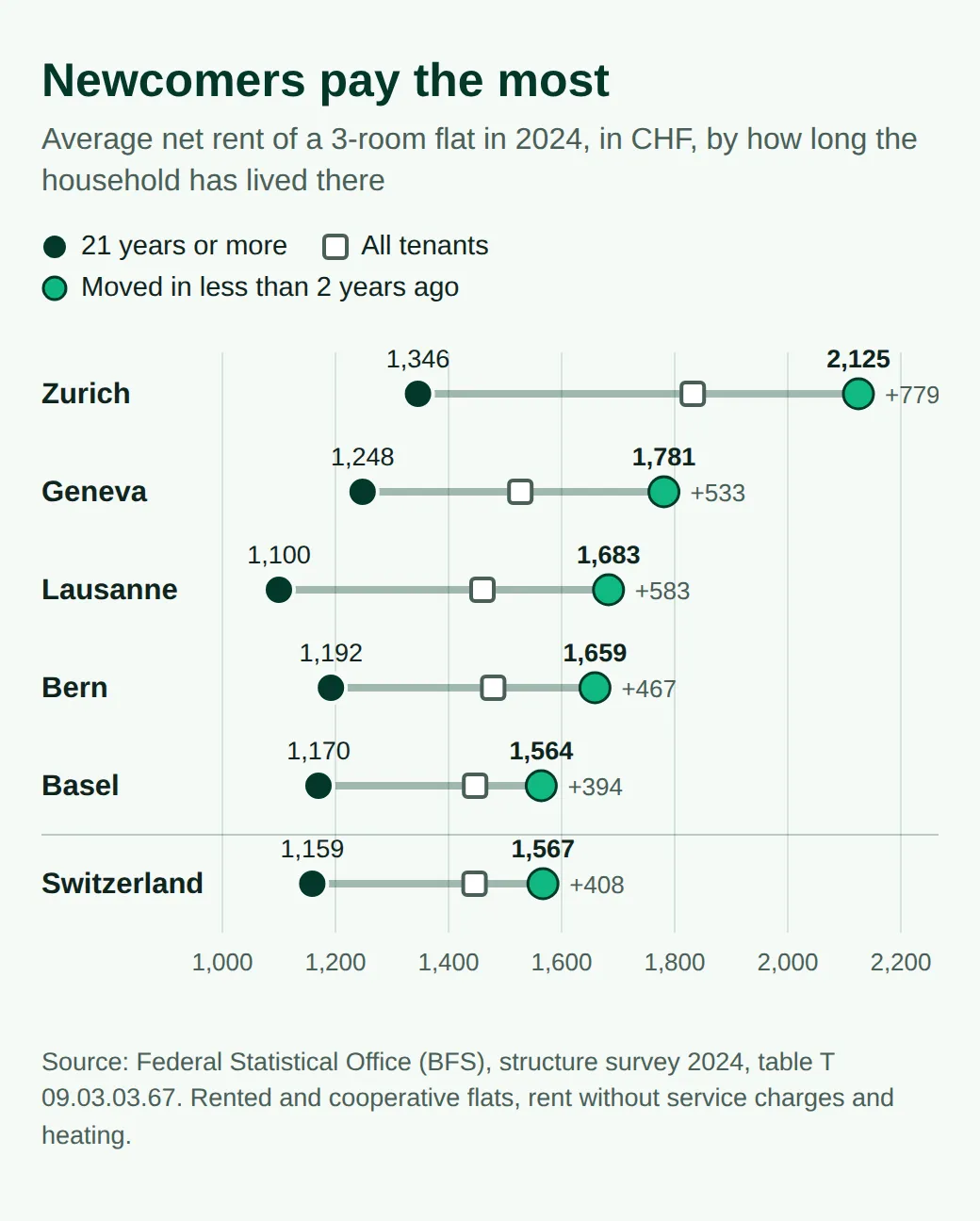
In Zurich, households that had moved into a 3-room flat less than two years earlier paid CHF 2,125 on average in 2024: CHF 779 more than those who had lived in theirs for 21 years or more, and CHF 293 above the city's overall average. In Lausanne the difference between the newest and the oldest leases was CHF 583, in Basel CHF 394. So when you budget for a move, the column that matters is the newcomers' one, and in the two tightest markets even that one needs a closer look.
Zurich: private flats, cooperatives and new leases
A privately let 3-room flat in the city of Zurich had a median net rent of CHF 1,950 in April 2026, and one let within the last two years CHF 2,250. Those are the latest figures from the city's own rent survey, run by Statistik Stadt Zürich every two years. They are medians: half the flats cost more, half cost less.
What makes the Zurich survey useful is that it separates non-profit housing from the rest. Non-profit flats belong to the city, to cooperatives or to foundations and are let at cost, so mixing them in pulls every average down. Here are the April 2026 medians, net, from the survey table:
| Size | Private flats, all leases | Private flats, let in the last 2 years | Non-profit flats |
|---|---|---|---|
| 2 rooms | CHF 1,670 | CHF 1,834 | CHF 964 |
| 3 rooms | CHF 1,950 | CHF 2,250 | CHF 1,066 |
| 4 rooms | CHF 2,434 | CHF 2,690 | CHF 1,449 |
New buildings are a level above. A privately let 3-room flat in a building less than two years old had a median of CHF 3,183, and a 4-room one CHF 4,032. Spread matters too: the middle half of all privately let 3-room flats cost between CHF 1,550 and CHF 2,525. By district, the median for that flat ran from CHF 1,576 in Kreis 12, in the north-east of the city, to CHF 2,855 in Kreis 1, the old town.
If you're looking on the open market, the private columns are the ones to compare with. If a 3-room listing in the city asks for CHF 2,300 net, it's close to the median for a new private lease, not an outlier. Geneva's figures need a different kind of care.
Geneva: count the kitchen first
In Geneva, a flat's size on the lease includes the kitchen. The canton's statistics office, OCSTAT, says so in its method notes: the number of rooms it uses is the one on the Geneva lease, "la cuisine est donc comprise", and half-rooms are left out. The federal building register works the other way. Its catalogue of attributes counts living rooms and bedrooms only, and lists kitchens, bathrooms, corridors and half-rooms as not counted.
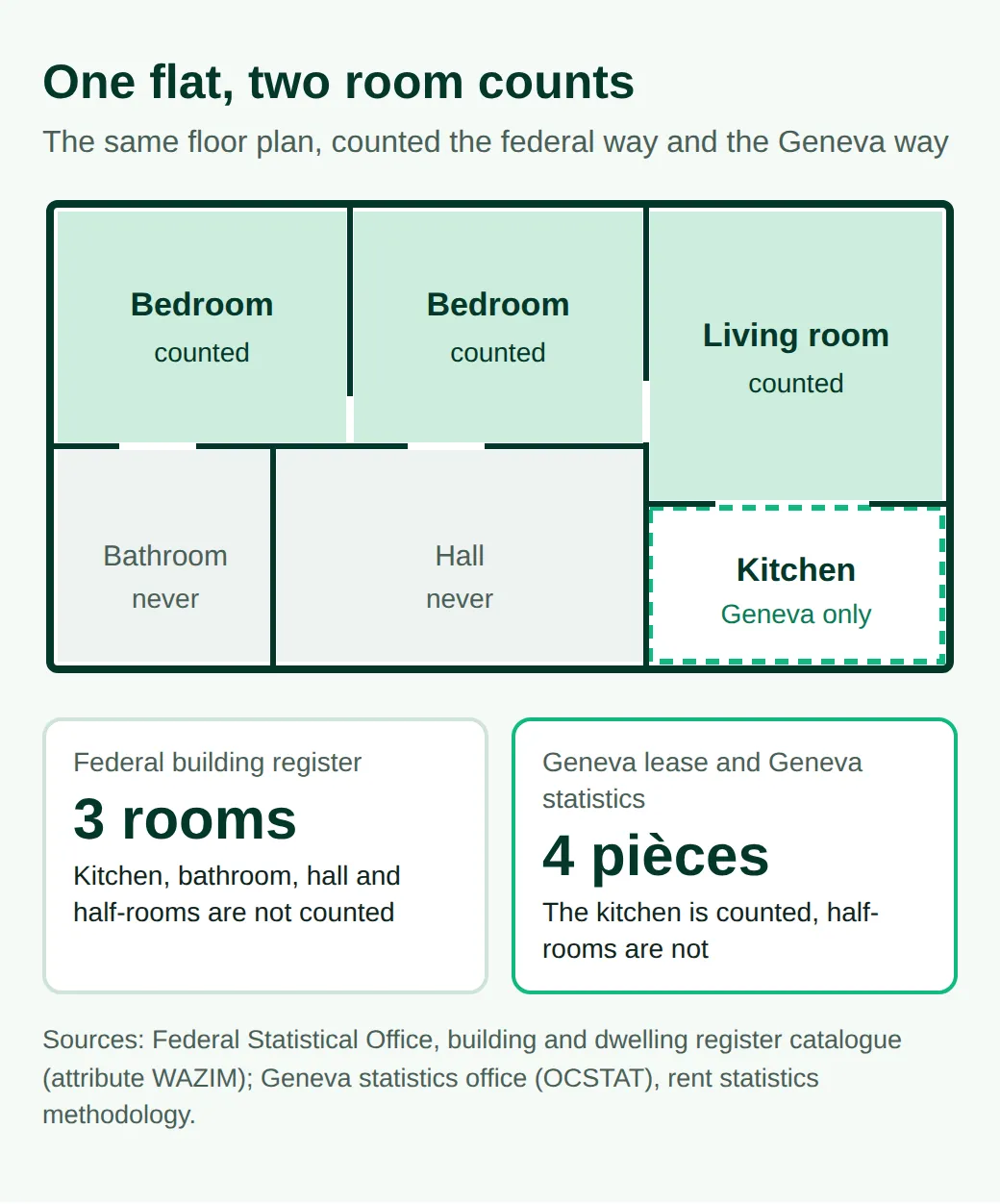
So when you compare Geneva with the rest of the country, set a Geneva 4 pièces next to a 3-room flat elsewhere. With that in mind, here are OCSTAT's rent tables for May 2025, the latest with rent levels, net and without any garage. For freely let flats in the city of Geneva, the average was CHF 1,420 for 3 pièces, CHF 1,744 for 4 and CHF 2,143 for 5. Across the canton, freely let flats that changed tenant in the previous twelve months averaged CHF 1,626 for 3 pièces, CHF 2,006 for 4 and CHF 2,496 for 5. That second set is the one to hold a listing against, with one adjustment: OCSTAT's count for May 2026 found rents of freely let flats up 1.3% in a year, and 7.9% where the tenant had changed.
Geneva also has a large regulated sector. Across the canton, controlled or subsidised flats averaged CHF 1,325 for 4 pièces, but those are regulated flats, not the open market. And there is little to choose from: on 1 June 2026 only 0.31% of the canton's dwellings stood empty, the second-lowest share in the country after Zug, according to the BFS vacancy count (in German; its tables list every canton).
Bern, Basel, Lausanne, Lugano and the rest
In the city of Bern, the average net rent of a 3-room flat was CHF 1,338 in November 2025, according to Statistik Stadt Bern. Its survey gives CHF 809 for 1 room, CHF 1,125 for 2, CHF 1,666 for 4 and CHF 2,090 for 5, and the office stresses that these are rents from running leases, some of them years old, not the prices of flats on the market. The federal survey shows the newcomer price: in 2024, households new to a 3-room flat in Bern paid CHF 1,659 on average, and for 4 rooms CHF 2,043.
Basel is cheap for small flats and dear for large ones. A 3-room flat let in the last two years averaged CHF 1,564 in 2024, close to the national figure, but a 4-room one CHF 2,208, about the same as in Geneva in the federal figures (CHF 2,218). Lausanne's recent tenants paid CHF 1,683 for 3 rooms and CHF 2,141 for 4, while those who had stayed 21 years or more paid CHF 1,100 and CHF 1,421.
South of the Alps, rents are lower and flats easier to find. Lugano's 3-room average was CHF 1,307 over 2022 to 2024, and the canton of Ticino averaged CHF 1,245 for a flat of any size in 2024. On 1 June 2026, 1.78% of dwellings in Ticino stood empty, nearly twice the national rate and the highest of the country's seven large regions. For the other cities in the grid above (Winterthur, Lucerne, St. Gallen and Biel), the pooled federal figures are the newest official city numbers we found. One thing all of these figures leave out is the second part of your monthly bill.
Net rent, gross rent and what you actually pay
Every figure so far is net rent. On top of it you pay service charges for heating, hot water, stairwell cleaning and the like, and Swiss listings show them in different ways. A German listing may give the net rent (Nettomiete) and the charges (Nebenkosten) separately, or only a gross figure (Bruttomiete). In French you'll see loyer net and charges.
Of the sources here, only Zurich's survey gives both at once. For a privately let 3-room flat in April 2026, the median gross rent was CHF 2,170, CHF 220 above the net median. For a new private lease of that size it was CHF 2,450 gross against CHF 2,250 net. So before comparing a listing with any table here, take the charges off, or add something like that difference to the table figure. Then you're comparing like with like, which matters all the more in a tight market.
Where rents are heading
Flats are getting scarcer. On 1 June 2026, 0.93% of all dwellings in Switzerland stood empty, below 1% and the sixth fall in a row, the BFS reported. Of the seven large regions, only Zurich saw a slight rise, to 0.52%, and in Zug the share was 0.20%. Fewer empty flats tend to mean higher prices for new leases, which is the gap you saw above.
For running leases, the number to watch is the reference interest rate, which the Federal Office for Housing publishes four times a year. It has been 1.25% since 2 September 2025, was confirmed on 1 September 2026, and the next announcement is due on 1 December 2026. Rents in existing leases have still been rising: the city of Bern's rent index climbed 1.4% in the year to November 2025. When your own lease is the one changing, that's a topic of its own. Here, the question is what to make of a price you're offered.
How to use these numbers before you sign
Pick the figure that matches your situation, not the headline one. If you're signing a new lease with a private landlord, the national average of CHF 1,485 says little. Use the newcomers' figure for your city and size, and in Zurich the private new-lease median. Check whether the listing counts the kitchen if it's in Geneva, and take the charges off before you compare.
Take a 3-room flat in the city of Zurich advertised at CHF 2,600 net. Against the overall city average of CHF 1,832 from the federal survey it looks steep. Against the April 2026 median for a new private lease, CHF 2,250, it's CHF 350 above the middle, and still inside the middle half of new private leases, which ran from CHF 1,808 to CHF 2,791. If it's in a building finished in the last two years, it's below that segment's median of CHF 3,183. That's a price to weigh against the flat itself, not one to dismiss on sight.
If you're leaving a flat to move, the date you can end your current lease matters as much as the new rent; our guide to termination dates by canton has them. And once you've settled on a city and a size, hold each listing against the matching figure here before you book a viewing.
Common questions
Why is the median rent lower than the average rent?
Because a small number of very expensive flats pull the average up, while the median is simply the rent in the middle. In the city of Zurich in April 2026, a privately let 3-room flat had a median net rent of CHF 1,950 and an average of CHF 2,091. The median is the better guide to what a typical flat costs.
Are cooperative flats included in the average rent?
In the federal figures, yes: the Federal Statistical Office counts rented and cooperative flats together. Cooperatives pull the average down. In 2024 cooperative members paid CHF 1,274 a month on average across Switzerland, against CHF 1,495 for ordinary tenants.
Is a 3.5-room flat counted as 3 or 4 rooms?
In the official statistics it usually ends up with the smaller number. The federal building register does not count half-rooms, and Geneva's rent statistics put a 3.5-pièces flat with the 3-pièces ones. Remember that Geneva also counts the kitchen, so its 3 pièces is a smaller flat than a 3-room flat in Bern.
How often are these rent figures updated?
The federal structure survey runs every year, and its ten-city table pools three survey years. Zurich's own rent survey runs every two years with April as its reference month. Geneva publishes its rent statistics each year with May as the reference month, and the city of Bern surveys rents every November.
More from the blog
All posts
Swiss rental contract: the clauses to check before you sign
Term, notice, ancillary costs, deposit, small repairs, pets and house rules: what a Swiss rental contract may say, and which clauses are void by law.

Termination dates for rent in Switzerland, canton by canton
When a Swiss lease can end: the usual termination dates by canton, how three months' notice works, the landlord's official form and when a letter counts.
Moving to Switzerland: customs on household goods in 2026
Your used belongings enter Switzerland free of duty and VAT. Form 18.44, the inventory, the two-year limit, cars, alcohol limits and pets, step by step.