Moving to Switzerland: customs on household goods in 2026
Before the truck leaves
Your used belongings cross into Switzerland free of customs duty and VAT if you are moving your home here, have used them yourself abroad for at least six months, and will keep using them. You claim this on Form 18.44, with an inventory, at a customs office for commercial goods during its opening hours. Anything newer pays VAT.
Most moving guides stop there. What they skip is where moves actually go wrong: the shipment you forgot to announce, the car that should have been declared at the first border crossing, the case of wine that pushes you over a limit, the newcomer from the UK who assumed the EU rules covered them. We went through the forms and pages of the Federal Office for Customs and Border Security (BAZG in German, FOCBS in its own English) and the customs ordinance itself. Here is the checklist, in the order you'll need it.
What counts as removal goods?
Removal goods (Übersiedlungsgut on the German form) are the things you used in your old life and bring into your new one. The Customs Ordinance, article 14 sets three conditions. You move your legal home, your domicile, from abroad to Switzerland. Each item has been used by you, for your personal life or your work, for at least six months abroad. And it is meant for your own continued use here.
The six months is about use, not ownership. A sofa you've sat on for three years qualifies; a sofa you bought last month and shipped straight from the shop does not, even if it ends up in the same truck. The customs FAQ on removal goods gives the example plainly: a purchase made less than six months before the move is taxed.
The same article also covers food stocks and tobacco "of the usual type and quantity", and alcohol up to fixed limits, which we come to below. Some people get the same treatment without being typical newcomers:
- Anyone coming back after at least a year abroad who never gave up their Swiss domicile, a Swiss citizen returning from a posting, for example.
- Students, who can bring household goods, personal effects and study materials duty-free without moving their domicile at all.
- People who keep their home abroad but rent or buy a flat here purely for their own use. Their used furniture and belongings qualify, though vehicles and animals don't.
Because removal goods are free of duty under the Customs Act, the VAT Act exempts them from import VAT too. That second exemption is the one worth money.
Do you pay duty or VAT on newer things?
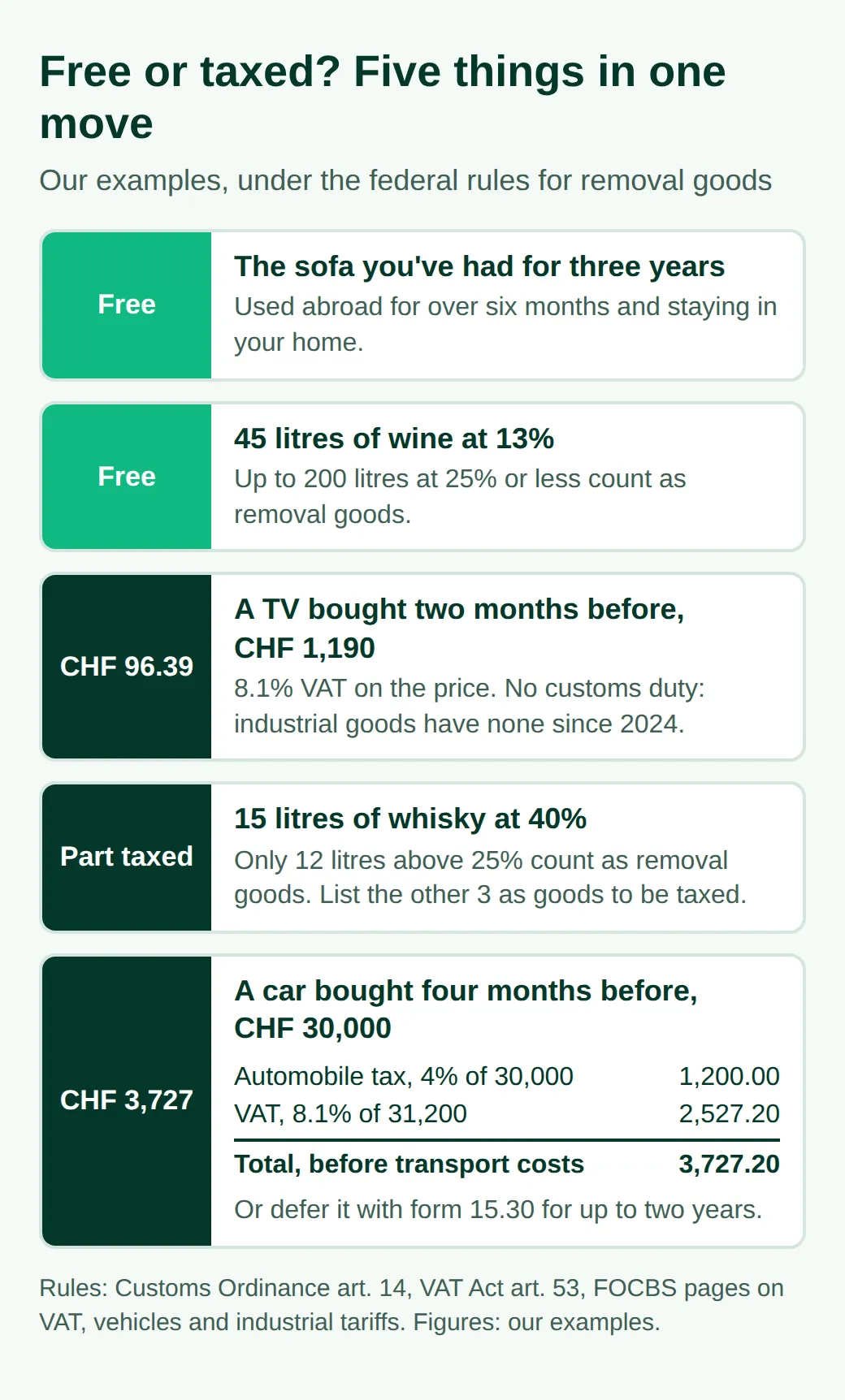
On goods that don't qualify, you pay VAT, and usually nothing else. Swiss import VAT is 8.1%, or 2.6% on food, books, magazines and medicines, calculated on what you paid. Customs duty is mostly gone: Switzerland abolished its industrial tariffs on 1 January 2024, for everything in chapters 25 to 97 of the tariff. Furniture, appliances, electronics, clothes and cars all sit in those chapters. Duty still applies to farm products, which is why meat, butter and alcohol keep their own rules.
So the new television you bought before the move costs you 8.1% of its price at the border, not a customs bill on top. The car is the exception, with a 4% automobile tax added. Here is how five ordinary items come out:
Keep the receipts for anything new. The FAQ says they make the taxation easier, and VAT is worked out from them. If you paid VAT abroad on something you are now exporting, the Swiss customs office won't refund it; the FOCBS allowance sheet tells you to ask the seller or a refund company. Ask before you buy, while the shop still has your paperwork.
The papers: Form 18.44, the inventory and your lease
You need four things at the border: the form, the inventory, proof that you're moving, and proof of where you'll live. Form 18.44 is a four-page PDF: the rules in German and English, then the application itself, twice. A downloaded or photocopied form is fine, the notes say, as long as it carries your original signature and you hand it in in duplicate. The English text is a courtesy translation; the German one is the legal version.
The form lists what goes with it:
- A list of the goods, with anything still to come on a separate list.
- Your Swiss residence permit, unless you are a citizen of the EU-27 or an EFTA state.
- The foreign registration papers of any vehicle.
- Proof that you have rented or bought a house or flat in Switzerland.
That last line makes your lease a customs document. EU and EFTA citizens prove the move with an employment contract, the lease or the confirmation that they deregistered at home, and the customs office can ask for any of these from anyone. In practice, sign the lease before you book the truck, and carry a copy. If you're still looking, these are the flats on our Basel board, a short drive from both the German and the French border:
British readers should read point 2 twice. The form defines the EU-27 as of 1 February 2020, the first day after the United Kingdom left, so a UK citizen falls under the rule for everyone else, whatever older moving guides say. Bring your Swiss permit, or the canton's assurance that one will be issued. The customs FAQ does say the permit is not an absolute requirement: what counts is proof that you really moved, and an employment contract, the lease and your deregistration abroad may be enough. The customs office decides.
If papers are missing on the day, the goods still come in. Customs clears them provisionally against a deposit for the duties. You then have six months to hand in what was missing, and the deposit comes back minus a handling fee, whose amount the FAQ doesn't give.
How to write the inventory
Plain paper will do. The FAQ asks for boxes counted by content, "xx boxes of books, xx boxes of clothes", and for bulky, valuable or restricted items one by one: furniture, large appliances, art, alcohol, weapons. The customs office's own list of relocation goods adds the make for appliances and instruments, and the artist or origin for pictures and antiques where you know it. Whatever doesn't meet the conditions goes at the bottom, under its own heading, with its value. A short extract might look like this:
Inventory of household effects, moving from Lyon to Bern
- 1 sofa, three-seat, fabric
- 1 upright piano, Yamaha
- 1 washing machine, Bosch
- 14 boxes of books, 9 boxes of clothes, 6 boxes of kitchenware
- Wine: 60 bottles of 0.75 l (45 l), 13% vol.
Goods to be taxed: 1 television, bought 2 August 2026, CHF 1,190, receipt attached
For the weight and value on the form, a rough estimate is enough. The FAQ suggests the sum your goods are insured for, and the removals company can usually tell you the weight. That insured value is worth keeping handy anyway: it is the figure your Swiss household contents insurance will ask for.
Timing it with your permit and your lease
Removal goods are cleared only on working days, during the hours an office handles commercial goods, and at an office that does. The FAQ says that means Monday to Friday, with only some large offices open on Saturday mornings. Check the FOCBS directory of customs offices and opening hours for your crossing before you fix the date with the movers. At the border, your truck or van takes the lane for heavy goods vehicles, not the car lane.
You don't need to book or announce the move. The often-repeated tip to email your papers two days ahead is real but narrow: the procedure page offers that preliminary check only at three offices in Ticino, Stabio-Confine, Vedeggio and Chiasso-Strada, and you must then cross at the office you wrote to.
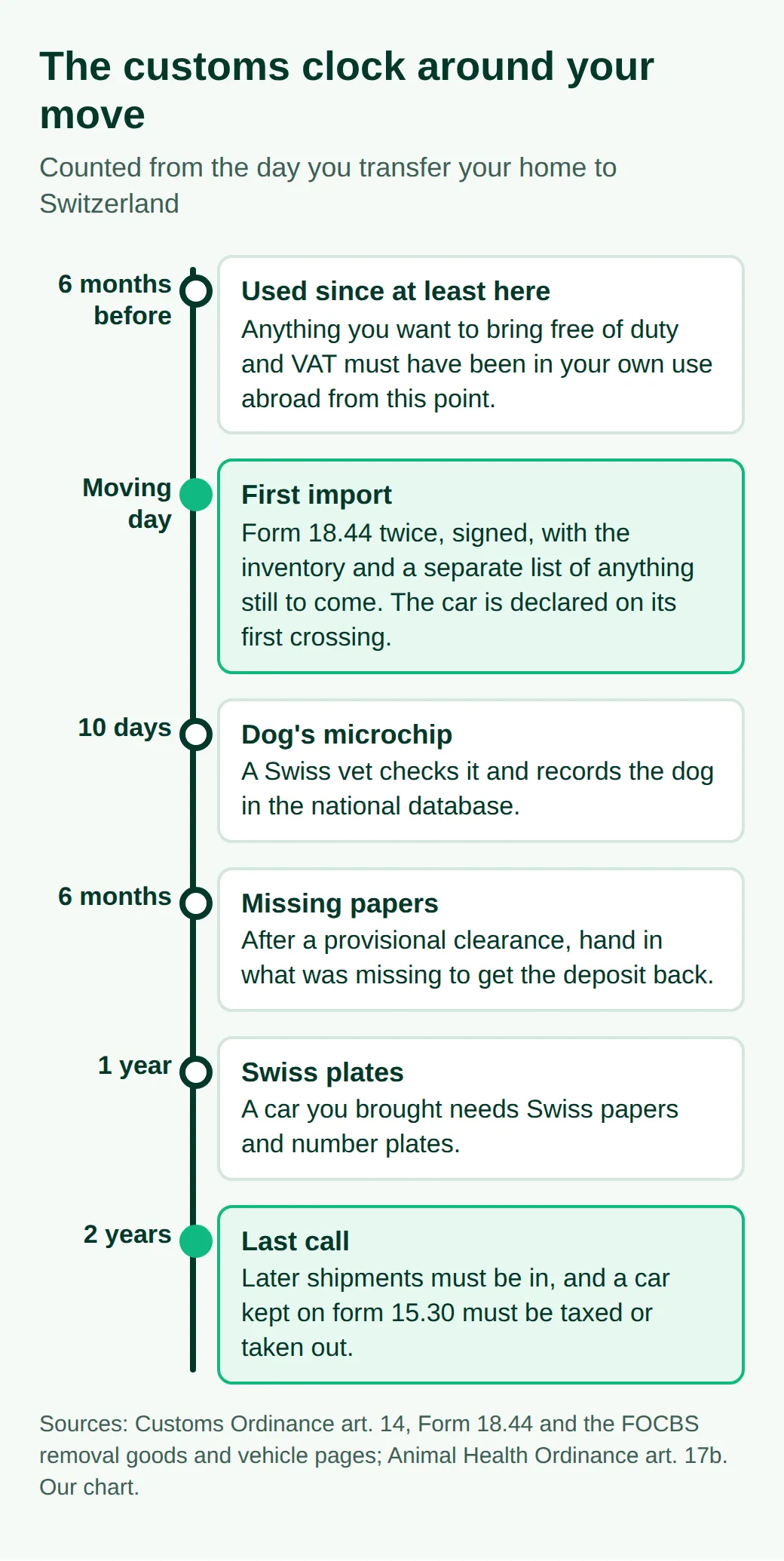
Form 18.44 asks for the date your domicile legally moved to Switzerland, and the customs clock runs from that date:
Registering with your new commune is a separate duty with its own short deadline, and customs doesn't do it for you. Our guide to registering your address covers that office and what it passes on.
Goods sent ahead or after
Not everything fits in one truck, and the rules allow for that, with one condition people miss: you announce the later shipments at the first crossing. The form has a box for a partial import and a line for the date the next consignment is expected, and the later goods go on their own list. The FAQ puts it this way:
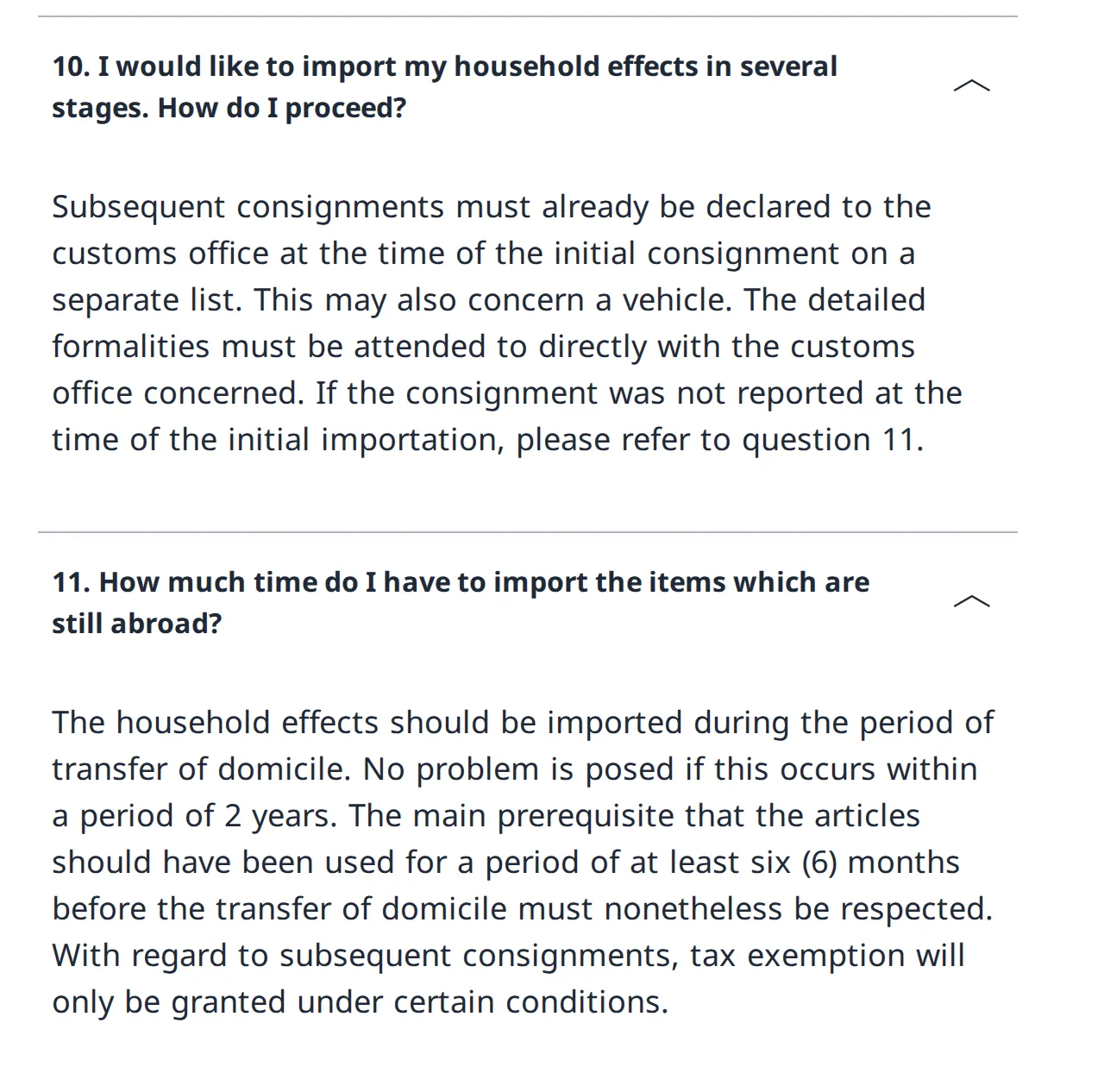
The outer limit is two years from the date you moved your domicile, and Form 18.44 says so in as many words. If something outside your control blocks a shipment, the exemption can still be granted once the obstacle is gone, within three months of that.
A shipment that is announced late, or not at all, gets the exemption "only under certain conditions", which is to say at the customs office's discretion. Write the list even if you only suspect that some boxes will stay behind with family.
The opposite case, goods arriving before your paperwork is complete, is covered by the same provisional clearance as missing papers. If a container reaches the border before you have every document, customs can take a deposit and release the goods, and you complete the file within six months. Ask the shipping company which office will clear it, and send them the signed form in advance.
Your car: declare it at the first crossing
A car you have driven for at least six months abroad is a removal good like any other, and comes in free of the 4% automobile tax and VAT. But it has to be declared when it first crosses the border in connection with your move, at a staffed office during the hours for commercial goods, with the car present. The vehicle FAQ calls the idea that you have a year to clear it "incorrect". The year is for something else: Swiss registration papers and plates, which you must have within one year of the move.
If you drive in on a weekend, ask the border post for a temporary certificate, form 15.25. It gives you two working days to clear the car at an office for commercial goods. If you missed the declaration altogether, the FOCBS says to do it retroactively, immediately.
After clearance, you get form 13.20 A, which the cantonal vehicle licensing office wants when you register the car. Two edge cases are simpler than people fear. A leased car makes no difference to customs, though it can affect the plates. A car registered to your parent or employer needs a signed statement from them saying who used it, since when and why.
A car you have had for less than six months is taxed: 4% automobile tax on its value, then 8.1% VAT on the value plus that tax and the transport costs, according to the FOCBS page on importing vehicles. On a CHF 30,000 car that is about CHF 3,727 before transport costs. A car this new can also owe a CO2 penalty before its first Swiss registration if its emissions are above the target value. The FOCBS vehicle factsheet says the rule leaves out cars registered abroad more than twelve months before you declare them, and those registered more than six months before with over 5,000 km. The Federal Office of Energy collects it later, not the border post.
You can delay the import taxes with form 15.30, if customs grants it, which lets you use the car untaxed for up to two years from your first entry. You still need Swiss plates after one year, and when the two years end you pay or export.
Your foreign licence is a separate clock: the same factsheet says you need a Swiss one after 12 months of living here. And the car will need somewhere to stand. If your lease doesn't include a space, you can rent one separately; in Geneva, for example:
Alcohol, tobacco and food
Removal goods have their own allowances, far above what a traveller may bring. Article 14 lets you import, as part of the move, up to 200 litres of drinks up to 25% alcohol and up to 12 litres above 25%, plus food stocks and tobacco "of the usual type and quantity". Wine and beer fall in the first group, spirits such as whisky or gin in the second.
Notice where the line sits. The travellers' allowance splits at 18% (5 litres below, 1 litre above, 250 cigarettes), while the removal rule splits at 25%. A fortified wine at 20% falls in the one-litre band on a shopping trip, but counts with the wine on moving day. Put every bottle on the inventory by type and quantity. What goes over the limits belongs under goods to be taxed. The FOCBS removal pages give no rate for that excess, so the customs office works out the duty and alcohol tax at the border.
"Usual quantity" has no number. A cupboard of pantry staples and a few cartons of cigarettes fit the idea of a household; a pallet of olive oil does not.
Pets: the vet's rules come first
Animals count as removal goods, so they go on the inventory and come in duty-free on the same conditions. Whether they may enter at all is a veterinary question, run by the Federal Food Safety and Veterinary Office (FSVO).
From an EU country, a dog, cat or ferret needs three things: a microchip, a valid rabies vaccination and a recognised pet passport. The first vaccination can be given from 12 weeks of age and only counts 21 days later, so book the vet early. A puppy under 16 weeks that hasn't finished its vaccinations needs a special owner declaration. From outside the EU, it depends on the rabies risk in the country you're leaving. From a high-risk country the animal also needs a blood test confirming the vaccine worked, with long waiting times, and animals under seven months can't enter from such countries at all. The FSVO's entry check tells you which case you're in.
Three limits catch people out. A private vehicle may carry at most five dogs, cats or ferrets under the pet rules. Dogs with docked ears or tails may not be imported. And an animal flown in as freight, without you on the plane, can only land at Zurich or Geneva.
Once a dog is here, the Animal Health Ordinance gives you ten days to have a Swiss vet check its microchip, and the vet records it in the national dog database. Horses from the EU and Norway need their equine passport and an import certificate with the moving papers.
Weapons, ivory and other restricted items
Being removal goods doesn't lift a ban. Form 18.44 reserves every import restriction, from animal disease to security, and the FAQ names the ones that come up in moves. For weapons, ask the Federal Police, fedpol, about the formalities before you ship them, and put each one on the inventory with type, make and serial number. Anything made of ivory, a piano with ivory keys included, and stuffed animals fall under the species protection rules, so ask the FSVO first. House plants, the FAQ says, face no particular restrictions.
The form also warns that claiming the exemption without meeting the conditions is an offence. Listing a new laptop as three years old saves 8.1% and risks considerably more.
Before you book the truck
Work backwards from the date you get the keys. Sign the lease and keep a copy for the border; if you're not from the EU or EFTA, have your permit or the canton's assurance with it. Check that the office on your route clears commercial goods on your day, and pick a weekday. Write the inventory as you pack, with a separate list for anything that will follow, and the receipts for whatever is new. Print Form 18.44 twice, sign both copies by hand, and give a set to the driver if you won't be there.
If there's a car, plan its first crossing as carefully as the truck's. If there's a pet, start with the FSVO entry check months ahead, not weeks.
Once everything is through, the next round of paperwork is Swiss rather than customs: registration at the commune, insurance and the rest, which our registration guide takes from there. And before you sign that lease, our guide to the Swiss rental contract shows which clauses to check.
Common questions
Do I need a removals company to clear customs for me?
No. You can drive your own van to a customs office for commercial goods and clear the goods yourself with Form 18.44 and the inventory. If you won't be at the border, sign the form and give it with the other documents to whoever drives the goods, and they present it for you.
I'm marrying someone who already lives in Switzerland. Do the same rules apply?
There is a better rule for you. Household goods, wedding gifts and even newly bought items and a vehicle can come in duty-free as a wedding trousseau, declared on Form 18.45 within six months after the wedding. Registered partnerships count the same way. A couple who married less than six months before moving here together must import within three months of the move.
Can I furnish a holiday flat in Switzerland without moving here?
Yes, if you rent or buy it only for your own use. Furniture and personal belongings you have used for at least six months can then come in duty-free, close to the date of the lease or purchase. Vehicles and animals are excluded from this rule.
I'm coming to Switzerland to study. Does the six-month rule apply?
Not in the same way. Students can bring household goods, personal effects and study materials duty-free even if they don't move their legal home to Switzerland. A car is a different matter: with form 15.30 you can use it uncleared for up to two years, and the cantonal vehicle office tells you whether it needs Swiss plates.
Do I need a motorway sticker for the moving van?
Yes, if it weighs up to 3.5 tonnes and you use Swiss motorways. The vignette costs CHF 40 and runs from 1 December of the previous year to 31 January of the following one. A heavier truck pays the heavy vehicle charge instead and may not drive at night between 10 p.m. and 5 a.m. or on Sundays and public holidays.
More from the blog
All posts
Shared flat in Switzerland: leases, deposits and moving out
Main tenant or joint lease? How a Swiss shared flat works: subletting rooms, what you may charge, splitting the deposit and leaving without paying twice.
How to register your new address in Switzerland in 2026
Register at your new commune within 14 days (8 in Vaud). What that one report updates on its own, and who still needs to hear from you directly.

Swiss rental contract: the clauses to check before you sign
Term, notice, ancillary costs, deposit, small repairs, pets and house rules: what a Swiss rental contract may say, and which clauses are void by law.