How to break a lease in Switzerland without paying twice

The short answer
You can leave a Swiss flat early if you propose a replacement tenant who can pay the rent, whom the landlord has no good reason to refuse, and who takes over your lease on the same terms. Your rent stops the day they take over. Without one, you pay until the next date your lease could have ended.
That last sentence is where the money is. Take Sam, who rents a 3.5-room flat in the city of Zurich for CHF 2,400 a month, service charges included. In mid-October Sam accepts a job in Lausanne that starts on 1 December and wants to hand back the keys on 30 November. The lease names no end dates of its own, so the local ones apply, and in the city of Zurich those are 31 March and 30 September. With an ordinary notice (the normal three-month kind), Sam would pay four months' rent on an empty flat, CHF 9,600, on top of a new rent in Lausanne. With a replacement tenant from 1 December, Sam pays nothing extra. We'll follow Sam's case through each step.
How much notice do you have to give?
Three months, to a fixed end date. The Code of Obligations sets that as the minimum for flats: three months' notice, ending on a date fixed by local custom, or at the end of a three-month period of the lease where there is no custom. Your lease can ask for more, a longer period or other dates, but never for less. A notice that misses its deadline isn't void, either. It counts for the next possible date, which can be months later.
So read your lease before anything else. Dates written into it beat local custom, and the tenants' association of German-speaking Switzerland notes that more and more lease forms now allow notice for the end of any month. Only where the lease is silent, or refers to local custom, do the local dates apply. These are the ones we found in official or association sources:
| Where | Usual end dates | Source |
|---|---|---|
| Zug | 31 March, 30 June, 30 September | Canton of Zug |
| Aargau | 31 March, 30 June, 30 September | Canton of Aargau |
| Vaud | 1 April, 1 July, 1 October, at noon | Vaud rental rules, art. 35 |
| City of Zurich, districts of Dietikon and Bülach | 31 March, 30 September | Zurich homeowners' association |
| Rest of canton Zurich | 31 March, 30 June, 30 September | Zurich homeowners' association |
| Basel-Stadt, Basel-Landschaft, Schaffhausen, Schwyz | End of any month except December | German-speaking tenants' association |
For Geneva, Bern, Lucerne, Ticino and St. Gallen we found no published list; the canton of Bern, for one, only says that local dates apply. The rental conciliation authority of your district (Schlichtungsbehörde in German, autorité de conciliation in French) can tell you which dates hold where you live, and that's where the tenants' association sends people too.
For Sam, all of this boils down to one hard deadline. The lease can end on 31 March 2027 only if the notice reaches the landlord before the three months start, so by 31 December 2026 at the latest. A letter that arrives on 2 January counts for 30 September instead, six months later.
Your letter counts when it arrives
What matters is the day the landlord receives your notice, not the postmark. If the postman can't hand over a registered letter and leaves a pickup slip, the Federal Supreme Court counts it as received on the first day the landlord could collect it, which as a rule is the day after the slip. The canton of Bern gives an example on the page above: a notice posted on 31 March that reaches the landlord on 1 April ends the lease at the end of July, not June. The tenants' association advises posting at least three working days before the deadline, in its fact sheet on giving notice.
The letter itself has a few rules, and missing one can cost you a termination date:
- It's on paper and signed by hand. An email or a text message isn't enough.
- Everyone who signed the lease signs the notice, as ch.ch puts it.
- If the flat is a married couple's or registered partners' home, the other spouse or partner must expressly agree, even if they aren't on the lease. The safe way is their signature on the letter.
- You don't need an official form; only landlords have to use one. Registered mail isn't required by law either, but it's your proof of the date.
Sam's letter goes out on 15 October, by registered mail, and it does more than give notice. That's where the replacement tenant comes in.
Leaving early with a replacement tenant
The early way out is article 264 of the Code of Obligations. If you hand back the flat without keeping to the notice period or date, you're released from the lease only if you propose a new tenant who can pay the rent, whom the landlord can't reasonably refuse, and who is willing to take over your lease on the same terms. Meet those three conditions and your obligations end on the day your replacement takes over.
If you read the law in English, watch one phrase. The English translation says the new tenant must be "acceptable to the landlord", which sounds like a free veto. That translation has no legal force; only the German, French and Italian texts are binding, and they speak of a tenant the landlord can't reasonably refuse. That's an objective test, and it is the one courts apply.
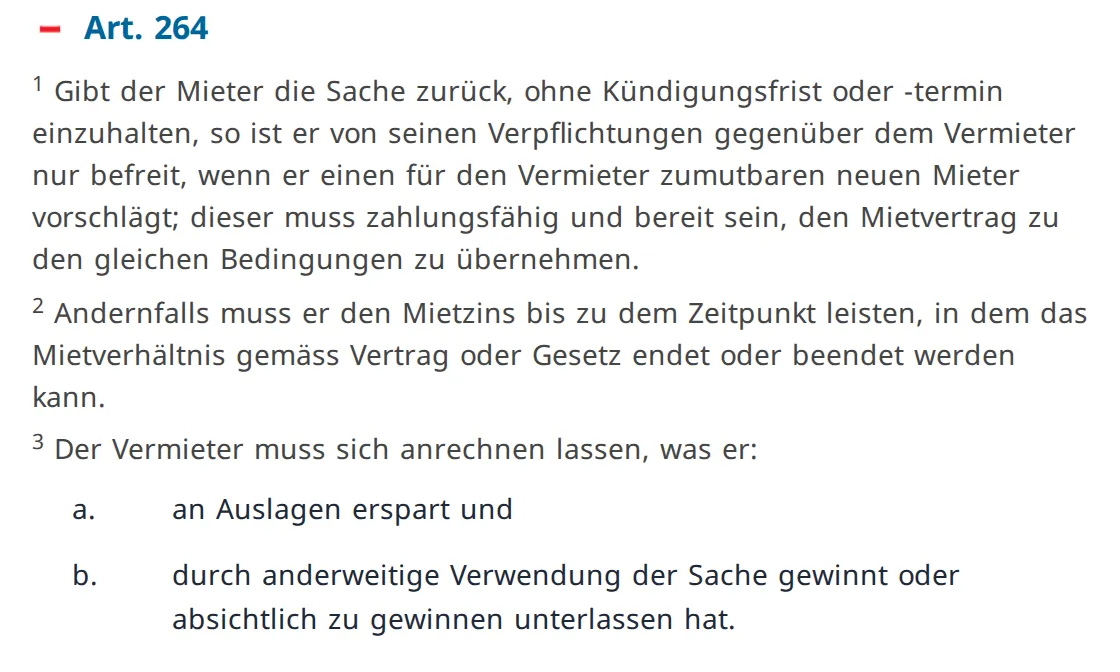
The landlord still can't be forced to sign with your candidate. But a refusal has a price: if the landlord turns down someone who meets the test, you stop owing rent from the day that person would have taken over, as the Zurich courts explain on their rental-law pages. The risk of an empty flat then sits with the landlord, not with you.
Vaud adds a condition of its own. Its binding rental rules (article 34 of the document linked above) say you must announce an early departure at least one month ahead, for the 15th or the end of a month, and Geneva's rules for subsidised housing contain the same line. We found no such minimum elsewhere. Either way, the earlier you write, the more time your candidates have, which brings us to who counts as one.
What makes a replacement tenant suitable?
The courts ask two things: can the person pay, and will they use the flat as the lease intends. The leading Federal Supreme Court ruling on this dates from 1993, and the Zurich courts still cite it. For paying, the Zurich courts use a rule of thumb: rent no higher than a third of net income. It's a rule of thumb, not a cap. In that 1993 ruling, the court warned against a rigid income ratio, noting that many people spend a third of their income or more on rent without anyone doubting they can pay it.
Landlords usually ask for an extract from the debt-collection register (Betreibungsregisterauszug, the official record of whether anyone has pursued a person for unpaid debts), and they can't judge your candidate more strictly than they would judge you, according to the tenants' association's guide to leaving early. Someone on social assistance may qualify too, with a confirmation from the social services that their rent is covered.
Valid reasons to refuse are narrow. The 1993 ruling names hostility between landlord and candidate, business rivalry, a real risk of trouble for the neighbours and well-founded doubts about the person's finances. Vague worries, dislike, or a stance against a whole group of people don't count. A landlord who refuses foreigners as a rule has no valid ground, the association says in its answers on replacement tenants.
"Same terms" means the same flat, the same rent and the same lease. A candidate who will only pay considerably less can be turned down, even if you offer to cover the difference yourself, the Federal Supreme Court held in 1991. Your replacement doesn't have to commit to more than your lease, though. They take it over as it stands, notice periods included.
One suitable candidate is enough, as the Zurich courts point out, whatever you've heard about needing three. But you carry the risk if that person changes their mind: a candidate who backs out of their own accord leaves you owing rent. So Sam doesn't stop at one, and before the first viewing, Sam makes sure the landlord already knows what's coming.
One letter, two jobs
Sam's letter of 15 October announces the early departure and the replacement tenant, and it also works as a safety net. Article 264 caps what you owe at the date the lease could next have been ended. The tenants' association counts that from your first letter, even one that only announces an early move-out; we found no court ruling on the point, so Sam's letter says it in plain words, and that fixes the worst case at 31 March 2027. It doesn't work the other way round: an ordinary notice that says nothing about leaving early can't be turned into an early exit later, although, the association adds, landlords often accept a replacement anyway.
A short letter is enough. Sam's reads like this:
Registered mail
Lease of the 3.5-room flat at [address], [floor]
Dear Sir or Madam,
I will move out early and hand back the flat on 30 November 2026. I will propose one or more solvent replacement tenants who are willing to take over my lease on the same terms from 1 December 2026, and I ask you to release me from the lease as of that date. Should no suitable replacement be found, please treat this letter as notice for the next possible termination date.
Please let me know how you would like viewings to be arranged.
[Place, date, signatures of everyone on the lease, plus your spouse or registered partner if the flat is your family home]
The sentence about the next possible termination date is what makes the letter a notice in its own right, whatever the landlord thinks of the association's reading. With the letter in the post, Sam has six weeks to find someone.
Finding a replacement in six weeks
Sam lists the flat the same day. On apartmentsswitzerland.ch that's free and needs no account: you post a listing with photos, the rent including service charges and the date the lease can be taken over, and you say plainly that you're looking for a replacement tenant. Viewings follow in the second half of October.
The viewing is where most of the work gets done. Ask each serious candidate to sign, there and then, a short statement that they have seen the flat and will take over the lease on the current terms from 1 December; the tenants' association publishes a form for exactly this, and a signed statement is what turns interest into an offer.
Then collect what the landlord will want to see. The tenants' association of French-speaking Switzerland, ASLOCA, lists three months of payslips, an extract from the debt-collection register, a copy of an ID and the agency's application form. The extract costs CHF 17 plus postage and needs a copy of an ID. It covers only the district where it's ordered, going back five years, so someone who moved recently may need one from each place.
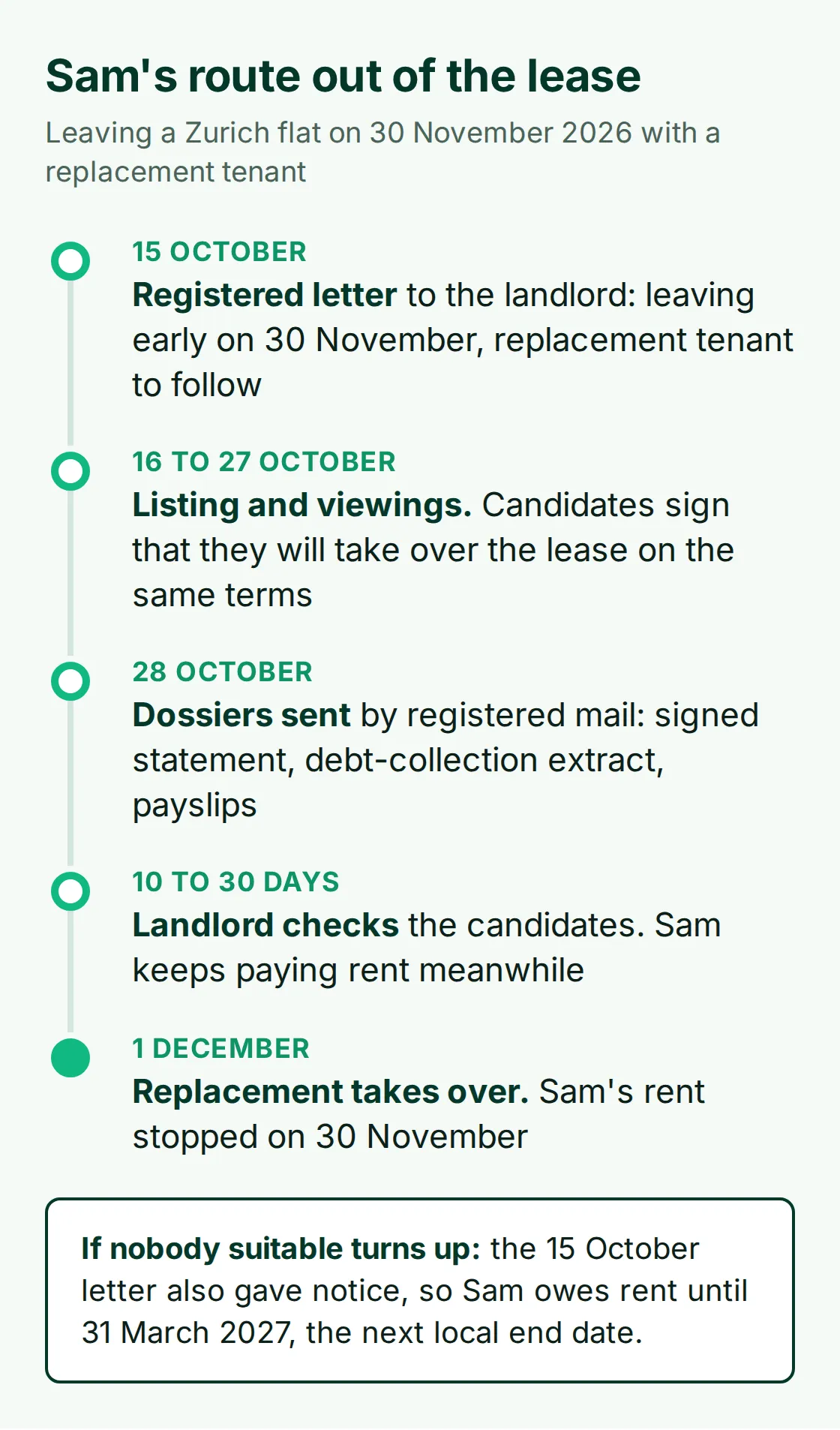
Sam sends the dossiers by registered mail on 28 October, with a cover letter that names each candidate, asks to be released as of 30 November, and asks for written reasons if the landlord refuses anyone. If ten days pass without an answer, Sam asks in writing for confirmation of the release. From here, the dates on the landlord's side decide what Sam pays.
The day your rent stops
Your rent stops on the day your replacement's lease starts, not the day you send the dossier. In between, the landlord gets time to check the candidate, and you keep paying while they do. The Zurich courts put that time at 10 to 30 days for flats, depending on how complete your documents are. The tenants' association says professional managing agencies should manage in 10 to 20 days, while private landlords may take up to 30.
If the landlord accepts, your replacement takes over the lease as it stands and you're out from that day. If the landlord refuses a candidate who meets the test, you're released from the day that person would have moved in. The Zurich courts treat these the same way as a refusal:
- The landlord doesn't answer and won't take back the keys. Send the keys back by registered mail.
- The landlord asks your candidate for a higher rent.
- The landlord offers your candidate only part of the flat.
- The landlord says a tenant of their own choosing will move in after your notice period.
The two bad outcomes are the ones you can't push onto the landlord. If your candidate backs out on their own, you keep paying, unless the landlord kept them waiting too long or put them off. And if nobody suitable turns up, you owe rent until the date your first letter ended the lease. Even then, the law makes the landlord deduct what they save once you've left, such as lower heating costs, and anything they earn by using the flat in the meantime.
For Sam, the gap between these outcomes looks like this:
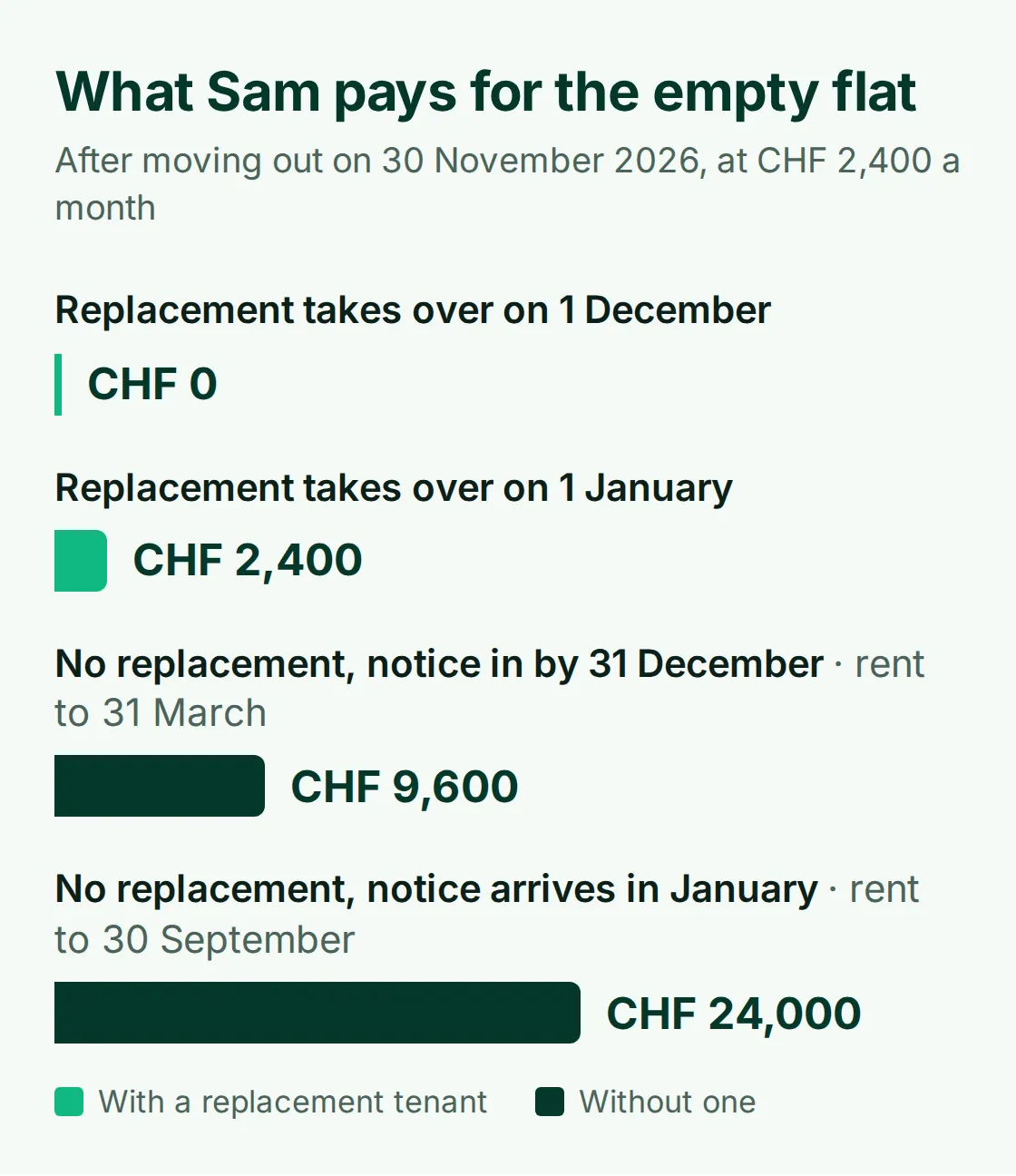
The last bar is what a January letter costs if nobody suitable takes over. It's the reason Sam's letter went out in October: the day it arrives is the one thing on this chart that only you control.
Fees and clauses you can ignore
Some leases or agencies charge a fee for leaving early, often a flat sum: 200 to 300 francs or 1% of a year's rent, according to ASLOCA. If you propose a suitable replacement, you don't owe it. The Federal Supreme Court has called a clause charging a lump sum for an early return void (ruling 4A_75/2015, in French), and the German-speaking association tells a tenant billed CHF 200 for the landlord's extra work that nothing is owed. If the landlord also advertises the flat on top of your search, those advertising costs are theirs.
A fixed-term lease, or one that can't be ended before a certain date, doesn't lock you in either. Such a clause holds against ordinary notice, so you can't give notice for an earlier date. But the replacement route still works: the 1993 ruling above concerned a five-year lease that the tenant wanted out of after less than two years.
Can you break a lease without a replacement?
Yes, in three ways, none of them as dependable:
- An agreement. The landlord may agree to end the lease on a date you both choose. Get it in writing, signed by both sides, with the date your rent stops.
- Subletting. With the landlord's consent you can sublet the flat, and the landlord can only refuse if you won't disclose the terms, if they're abusive compared with your own lease, or if the sublet causes them serious disadvantages. You stay the tenant, and you stay liable.
- Good cause. For serious reasons you couldn't foresee and aren't responsible for, which make it unreasonable to continue, you can give three months' notice to any date. A court then decides what you owe the landlord. A new job doesn't count: the tenants' association cites a Federal Supreme Court ruling from 1994 that a job change is not good cause.
For someone like Sam, moving for work, the replacement tenant is the way out that actually holds.
If you're leaving this winter
Check your dates today. If your next end date is 31 March, your notice has to arrive by 31 December, and the three working days the tenants' association suggests are a minimum. With Christmas in between, aim for mid-December at the latest. Write the letter now, with the early move-out in it, have everyone on the lease sign it, and keep the post office receipt. List the flat the same week, ask candidates to sign at the viewing, and keep copies of everything the landlord sends back.
Sam's own search runs the other way, towards Lausanne, where the Vaud rules above will apply to the next lease:
Common questions
Can one flatmate leave a shared lease alone?
Not if you all signed the same lease. A joint lease can only be ended jointly, so a flatmate who moves out stays liable until the others and the landlord agree to a change to the lease, for example a new flatmate taking your place.
Is the notice period shorter for a furnished room or a parking space?
Yes. A furnished room, or a parking space rented separately from the flat, can be ended with two weeks' notice to the end of a one-month lease period. A room in a shared flat where you also use the kitchen and living room usually doesn't count as a furnished room, so the three months for flats apply.
Does the replacement tenant rule apply to a cooperative flat?
Yes. According to the tenants' association of German-speaking Switzerland, the rule applies to housing cooperatives as well. A cooperative that refuses all replacement tenants as a matter of policy can't hold you to the full notice period that way.
Do I pay rent for the days after I hand back the keys?
As a rule, yes. If you move out on the 20th, the rent for the rest of that month is still due. The exception is a landlord who starts renovating straight after the handover or lets someone else move in early.
More from the blog
All posts
Moving to Switzerland: customs on household goods in 2026
Your used belongings enter Switzerland free of duty and VAT. Form 18.44, the inventory, the two-year limit, cars, alcohol limits and pets, step by step.

Shared flat in Switzerland: leases, deposits and moving out
Main tenant or joint lease? How a Swiss shared flat works: subletting rooms, what you may charge, splitting the deposit and leaving without paying twice.

How to register your new address in Switzerland in 2026
Register at your new commune within 14 days (8 in Vaud). What that one report updates on its own, and who still needs to hear from you directly.