Shared flat in Switzerland: leases, deposits and moving out
Two ways to share
A shared flat in Switzerland runs on one of two setups. Either one main tenant signs the lease and sublets rooms to the others, or everyone signs one joint lease. As a subtenant you can leave on your own, but the main tenant owes the landlord the whole rent. On a joint lease you all owe the whole rent, and nobody leaves alone.
Knowing which setup you're in is the easy part. The questions that cost money come later: what a main tenant may charge for a room, who gets the deposit back, what happens when one flatmate stops paying, and how you get your name off a lease the others want to keep. Swiss law answers most of them, and a few Federal Supreme Court cases show where the lines are. We'll take the two setups one at a time, then the deposit, leaving, and the bills that follow a household around.
Which kind of shared flat are you in?
Look at the names on the lease. If yours is there, next to your flatmates', you're a joint tenant. If only one person signed and you pay your rent to them, you're their subtenant, whether or not anyone wrote that down: the Swiss tenants' association (MV) points out that someone who pays rent without signing the lease automatically becomes a subtenant of the person who did.
The difference decides almost everything that follows. A subtenant has a contract with the main tenant and none with the landlord. Joint tenants all have the same contract with the landlord and the same rights under it.
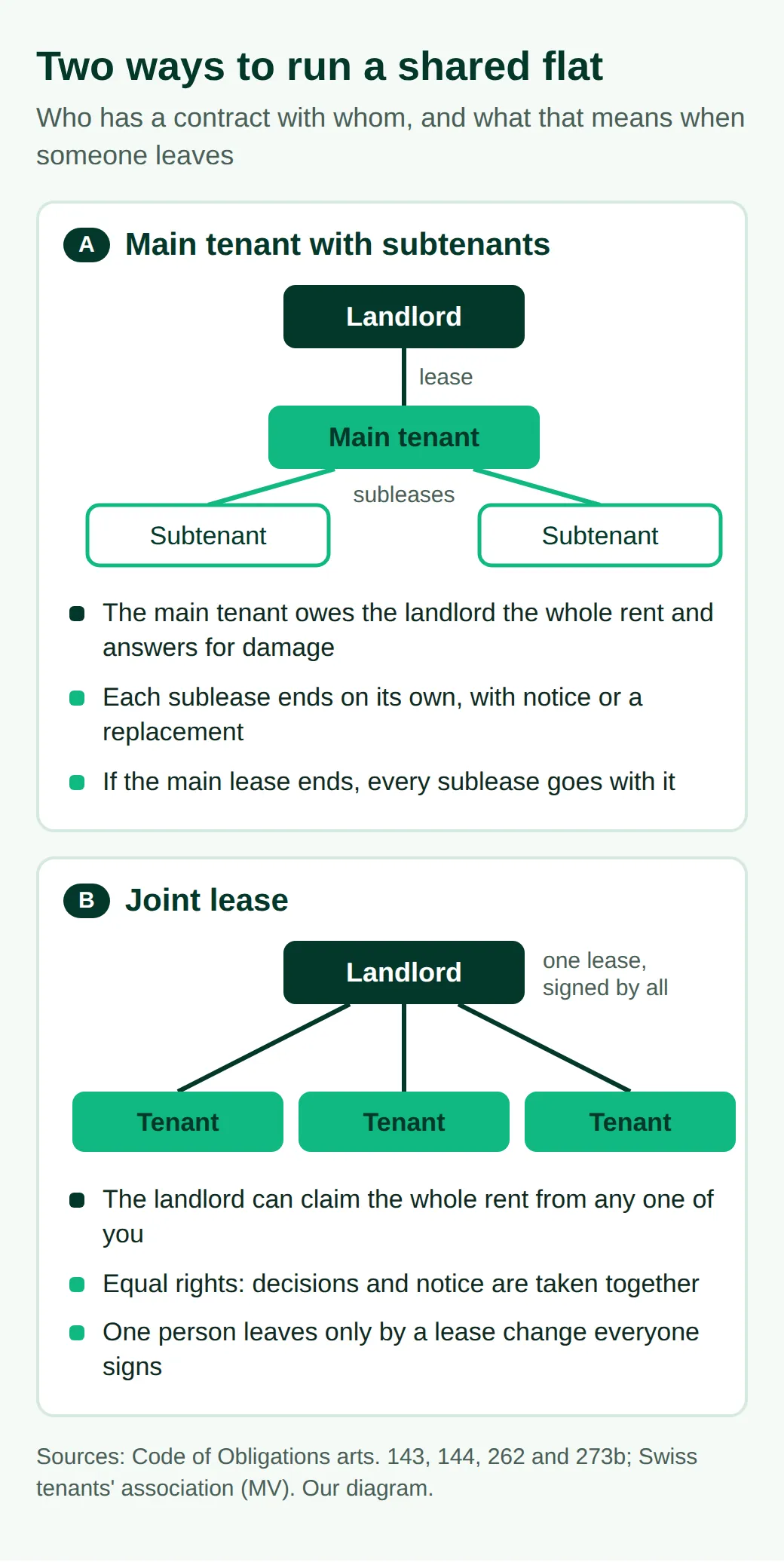
Landlords often ask every flatmate to sign for financial reasons, the association notes, which is how setup B comes about. Setup A is what you get when one person rents the flat and later fills the spare rooms. That person carries most of the risk, so let's start with them.
As main tenant, you're a landlord too
You need the landlord's consent to sublet a room, but the landlord can't refuse it at will. Article 262 of the Code of Obligations allows a refusal for three reasons only: you won't disclose the terms of the sublease, those terms are unfair compared with your own lease, or the sublet causes the landlord major disadvantages. A clause in your lease that bans subletting altogether is not valid, the MV says. A change that would have tightened these rules was rejected by voters on 24 November 2024, so article 262 still reads as it did.
Ask in writing anyway, with the subtenant's name, the rent and how long the arrangement runs. Consent can be given orally or even by silence, but you'll want proof, and the standard lease used in French-speaking Switzerland asks for written consent, according to the tenants' association ASLOCA. Silence can still count, as one Geneva tenant found out.
She had rented a 4.5-room flat in Geneva since 2000. In 2009 she took a job in Zurich, sublet a furnished room for CHF 900 a month plus 75% of the charges, with use of the kitchen, bathroom and living room, and wrote to her landlord to say so. He never replied. Two years later he objected and gave her notice. The Geneva courts annulled the notice, and the Federal Supreme Court confirmed that in 2015: his silence had been consent, she still used the flat herself once or twice a month, and a landlord who wants to withdraw consent once given has to do it formally, on the official form for changing a lease. A notice to get round that was in bad faith.
The flip side is the risk you carry. You owe the landlord the whole rent even when a subtenant doesn't pay you, and you answer for how your subtenants use the flat; the landlord may also remind them directly to behave. Subletting without asking at all is risky: if the landlord could have refused, it can cost you your home, possibly through an early, extraordinary notice, as the Zurich courts note.
You also take on a landlord's duties. A sublease follows the ordinary rules of tenancy law, the Zurich courts explain on their page on the sublease contract. In the canton of Zurich that means the official form for the initial rent when you let a room, and everywhere it means the official cantonal form if you want to end a sublease. A notice that skips the form has no effect. Your subtenant can also challenge your notice and ask for an extension, though never beyond the end of your own lease.
Then there are the terms themselves, and on the rent the law leaves little room for a margin.
How much can you charge for a room?
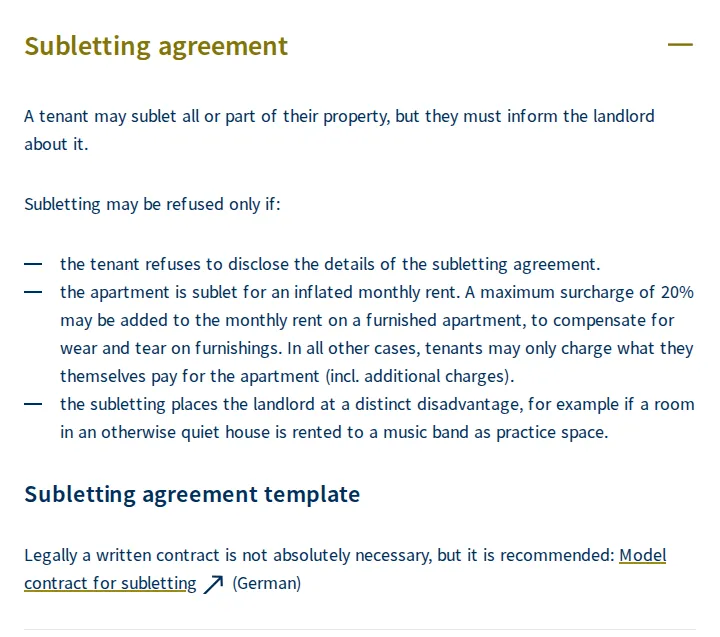
Your subtenants together may pay no more than their fair share of what the flat costs you. The Zurich courts sum up the rule in one line: you may not make a profit from subletting beyond what your own services justify. The federal portal ch.ch puts it in francs: for an unfurnished place you may only charge what you pay yourself, charges included, and for a furnished one you may add up to 20% for wear and tear on the furniture.
A real case shows how the sums work. In 1993 the Federal Supreme Court looked at a tenant who paid CHF 1,575 a month plus CHF 204 in charges for a 4.5-room flat and wanted to sublet two furnished rooms for CHF 535 and CHF 570, charges included. The Geneva court had worked out a fair share for each room and added 20% for furniture and risk. The Federal Supreme Court then took 20% off, because the subtenants could only use the kitchen to make coffee and had no washing machine. The asking rents, plus the extras the tenant charged for phone, electricity and cleaning, came out 30% to 40% above that, which the court called manifestly abusive. The landlord was entitled to refuse consent.
So how do you work out a room's fair share? The MV gives a simple answer: in a 3-room flat with rooms of roughly equal size, a sublet room is worth about a third of the total rent. When the rooms differ a lot, it suggests splitting by floor area. That leaves a choice the law doesn't make for you: do the shared kitchen and living room count?
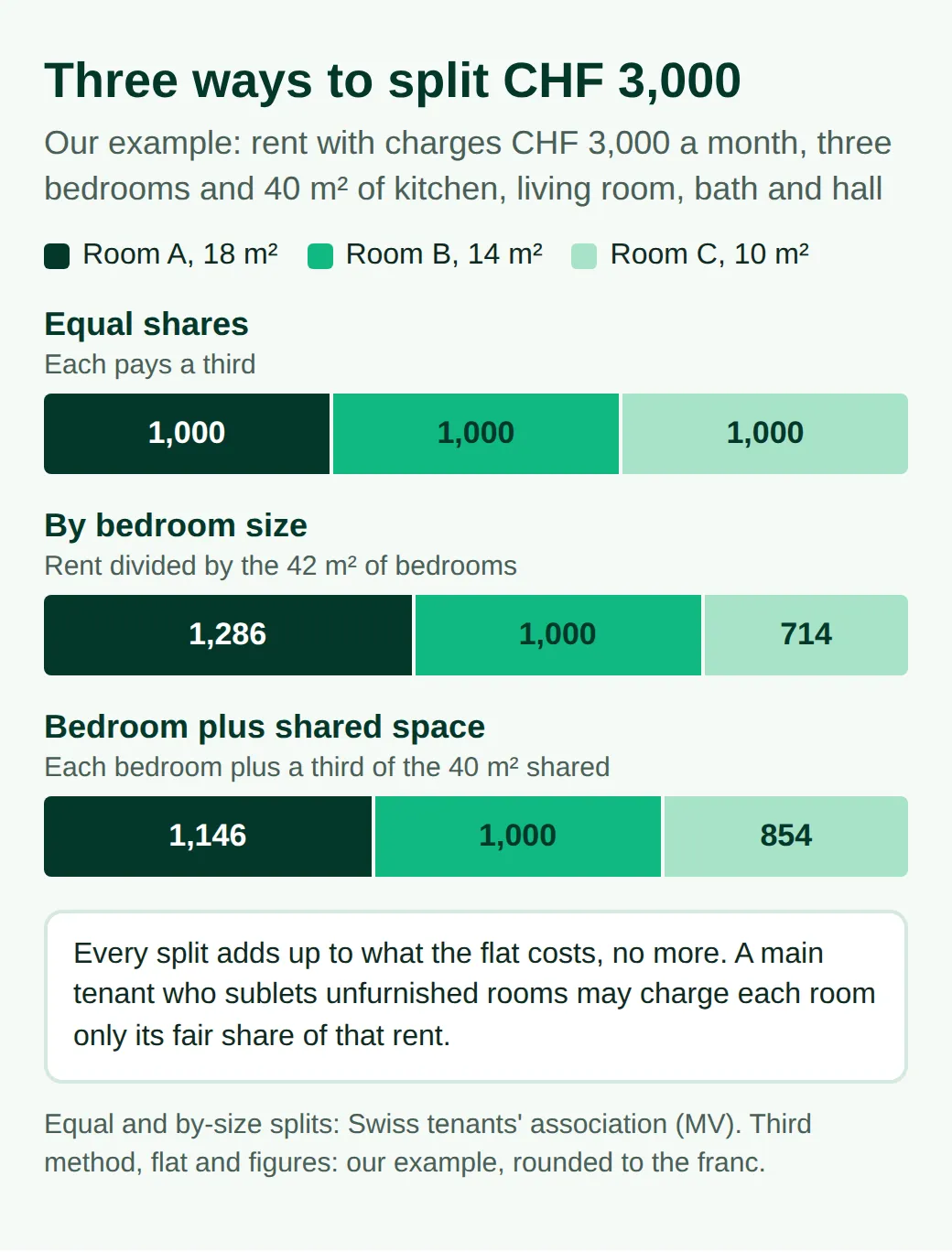
Splitting by bedroom size alone hits the biggest room hard, because everyone uses the kitchen and living room equally. Counting each person's bedroom plus an equal slice of the shared space is the middle way, and it's easy to explain to someone at a viewing. Whatever you pick, the rule doesn't change: the shares add up to what the flat costs, and the room you keep for yourself carries its part. On a joint lease the same arithmetic applies, but the money flows differently.
A joint lease: equal rights, the whole bill
When you all sign, you all owe the whole rent. ch.ch puts it plainly: when a group of people rent a flat, everyone named in the lease is collectively responsible for the monthly rent. In legal terms you're jointly and severally liable, which under article 144 means the landlord can claim part of the debt from each of you, or all of it from whichever of you is easiest to collect from.
That matters the month a flatmate stops paying. The landlord doesn't care whose share is missing. If the rent stays unpaid, the landlord can set a deadline of at least 30 days and then end the lease for all of you, on 30 days' notice to the end of a month. The MV's advice is to cover the missing share yourselves and claim it back afterwards. The law backs that up: unless you agreed otherwise, joint debtors carry equal shares among themselves, and whoever pays more than their part can recover the excess from the others.
Your rights are joint too. You decide together and give notice together. For something urgent, such as a burst pipe, one of you may act alone, though the association notes you may have to show a power of attorney from the others afterwards. There's one exception that protects each of you individually: if the landlord gives notice, any one of you may challenge it at the conciliation authority, within 30 days of receiving it. The Federal Supreme Court ruled in 2014 that a co-tenant can do this without the others, provided the flatmates who don't want to fight are named in the case alongside the landlord.
Any split you agree among yourselves, for instance by room size, binds only you. The landlord can still claim everything from anyone. Write the split down anyway, together with the second thing flatmates argue about: the deposit.
One deposit, several people
The deposit follows the same rules in a shared flat as anywhere else. Article 257e caps it at three months' rent and requires it to sit in a bank account in the tenant's name, never in the landlord's own account. The bank pays it out only with both sides' agreement, a final payment order or a court decision; a year after the lease ends, you can claim it alone if the landlord hasn't taken legal action. Our guide to the rental contract covers the rest.
What the law doesn't settle is how flatmates share one account. On a joint lease the deposit secures the lease as a whole, and the MV says it goes back to whoever paid it in. That works on the day the whole flat moves out. It doesn't help the flatmate who leaves in year three, because the bank won't pay anything out while the lease runs unless the landlord agrees. The practical answer is a deal among yourselves: the newcomer pays the leaver their share directly, and the account stays as it is. Put it in writing. A few lines are enough:
Flat-share agreement, [address]
Rent of CHF [total] is split as follows: [name] CHF [x], [name] CHF [y], [name] CHF [z]. Each of us pays our share by the [day] of each month.
The deposit of CHF [amount] was paid in by [names and amounts]. A flatmate who leaves receives their share from the person who takes their place, minus any damage they caused. The account stays unchanged until the lease ends.
Anyone who wants to leave gives the others [three] months' notice and helps find a replacement.
[Place, date, signatures of all flatmates]
As a subtenant, check where your own deposit went. Because a sublease follows ordinary tenancy law, the same cap and the same bank account in your name apply to what you pay the main tenant. The Zurich courts warn tenants to check that a deposit was placed correctly: cash that sits in someone's own account can end up with their creditors if they go bankrupt. The day you get it back is usually the day you leave, which is where the two setups differ most.
How do you leave a shared flat?
As a subtenant, you end your sublease. On a joint lease, you can only leave with everyone's signature on a change to the lease. The details decide how long you keep paying.
Leaving as a subtenant
Give notice under your sublease, with its notice period and dates. Where the sublease says nothing, the legal minimum for a flat is three months to a local termination date; our guide to termination dates lists them by canton. A furnished room can be ended on two weeks' notice to the end of a one-month period, but whether a room in a shared flat counts as one is not settled in the sources we read. The safe course is to write the notice period into the sublease when you move in.
To leave sooner, propose a replacement who can pay and is willing to take over your sublease on the same terms, the same route as for any early move-out, explained in our guide to breaking a lease. In a shared flat the bar is higher, the MV says, because the newcomer also has to fit in with the people who stay. But that cuts both ways. If your flatmates turn down five or ten reasonable candidates, the association reads that as a sign they don't want to re-let the room at all, and then you no longer owe the rent.
Leaving a joint lease
You can't give notice alone. A lease signed by several people can only be ended by all of them, and until it is changed, you stay liable for the rent even after you've moved out. The association's tip is not to end the lease at all but to have it rewritten: the leaver's name comes off, the newcomer's goes on, and everyone signs, the landlord included.
Two things can go wrong. The landlord may refuse to rewrite the lease, or agree and use the new contract to raise the rent; the MV suggests having a new starting rent checked before anyone signs. And your flatmates may refuse to let you go. They can't keep you forever: the association says flatmates are in principle obliged to help end the current lease by the earliest possible termination date. Forcing that through a court costs money, though, so a replacement everyone likes is usually the cheaper way out.
If two of the joint tenants are married or registered partners and the flat is their family home, a notice from one of them also needs the other's express consent. That matters when a married couple shares a joint lease with friends.
When the main tenant goes
Every sublease depends on the main lease. When the main tenant's lease ends, the subtenants must hand the flat back to the landlord on request, and an extension of a sublease can never run past the main lease.
If you're the main tenant and you're leaving, end the subleases in good time and on the official form. The MV warns that a main tenant who doesn't may owe the subtenants damages. If your subtenants want to stay, ask the landlord early whether one of them can take over your lease, which turns your departure into a handover. Either way, the final inspection is when damage gets counted.
Damage, insurance and the household bills
Damage follows the contracts. A main tenant answers to the landlord for everything the subtenants do in the flat, and claims it back from them. Joint tenants share the risk, and the deposit, held for all of you, is what a landlord reaches for first at the final inspection.
That makes liability insurance more important in a shared flat, not less. One flatmate's policy does not necessarily cover the others, so ask your insurer who counts as part of your household before you rely on anyone else's cover. Our guide to tenant insurance explains what the two policies pay for.
The radio and TV fee works the other way round: one bill per household, not per person. Serafe charges CHF 335 a year per private household, falling to CHF 312 from 1 January 2027, and its FAQ says every adult named on the invoice is jointly liable for it. Serafe bills the household that the residents' registers report to it every month, so register when you move in and deregister when you leave; our guide to moving within Switzerland explains how.
Before you move in
Ask to see the first page of the lease and find out which setup you're joining. If you'll be a subtenant, get a written sublease that names the rent, the notice period and the deposit account, and ask whether the landlord knows about you. ch.ch links a model sublease from the tenants' association. If you'll join a joint lease, make sure the landlord adds your name, and agree the split and the deposit with your flatmates in writing before the first rent is due.
If you're the main tenant with a room to fill, keep the arithmetic above on hand and tell the landlord before the viewing, not after. You can list a room for free, and on our room boards in Bern and other cities you can see what similar rooms ask. If you're looking for a room yourself, these are the ones listed in Lausanne:
Common questions
Can my partner move in if only I signed the lease?
Usually, yes. The tenants' association calls taking in a partner a personal right that a lease cannot exclude, as long as the flat isn't overcrowded. Your partner has no right to be added to the lease, though: that needs the landlord's agreement.
Can a friend stay in my room for two weeks while I'm away?
Yes. According to the tenants' association, a guest who stays for free during your holiday is a visitor, not a subtenant, and the landlord cannot forbid it. The house rules still apply, and the flat must not become overcrowded.
Can I rent out my room on Airbnb?
Only with the landlord's consent, either for each guest or as a general permission. The tenants' association says short-term rentals count as subletting or a change of use, and a landlord may refuse, for example because the tenant would make a profit. Renting without consent can cost you the lease.
Is a sublease valid if nothing was written down?
Yes, an oral sublease is valid, but it is hard to prove in a dispute. The federal portal ch.ch recommends a written contract, and the Swiss tenants' association publishes a model sublease in German that you can fill in.
More from the blog
All posts
Moving to Switzerland: customs on household goods in 2026
Your used belongings enter Switzerland free of duty and VAT. Form 18.44, the inventory, the two-year limit, cars, alcohol limits and pets, step by step.
How to register your new address in Switzerland in 2026
Register at your new commune within 14 days (8 in Vaud). What that one report updates on its own, and who still needs to hear from you directly.
Swiss rental contract: the clauses to check before you sign
Term, notice, ancillary costs, deposit, small repairs, pets and house rules: what a Swiss rental contract may say, and which clauses are void by law.