How to register your new address in Switzerland in 2026
Before you move
You must register at your new commune within 14 days of moving, and within eight days in the canton of Vaud, after telling your old commune you're leaving. That one report updates your household for the Serafe radio and TV fee and, in many places, the tax office. Your health insurer, employer, electricity supplier, Swiss Post and the road traffic office still need to hear from you.
Most guides stop at the first sentence. The trouble starts after it: a Serafe bill for a flat you left, a premium that doesn't match your new region, a payment reminder that went to the old address and never came back. This guide takes them one at a time.
How to register your address in Switzerland
Every canton must make people report a move to the residents' office within 14 days. The rule comes from the federal Register Harmonisation Act, article 11, and the cantons write the details into their own laws. The office is usually your commune's residents' registration office: Einwohnerkontrolle or Personenmeldeamt in German, contrôle des habitants in French. In Geneva, a cantonal office, the OCPM, takes the reports for the whole canton.
The order matters. You deregister at the old commune and then register at the new one. The City of Zurich is blunt about it: without a deregistration from your previous commune, it cannot register you. The old commune also gives back your certificate of origin if you're Swiss (Heimatschein, the document that shows where your family is from), which the new one will want to see.
What to bring depends on the commune, but ch.ch lists the core: the certificate of origin, the family booklet if you have children, and your health insurance card or proof of your current policy. Zurich adds a passport or ID card, your lease or the landlord's move-in form (Einzugsanzeige), the insurance cards of every family member, and CHF 40 per adult. Foreign nationals also bring their residence permit, and pay a migration fee that varies by permit.
Doing it online with eMovingCH
The quicker route is eMovingCH, the online service run for the Confederation, the cantons and the communes. It handles both halves of the move, leaving and arriving, in one form. It costs no more than the counter. You need your 13-digit AHV number, which is printed on your health insurance card, and a card or Twint for any fees.
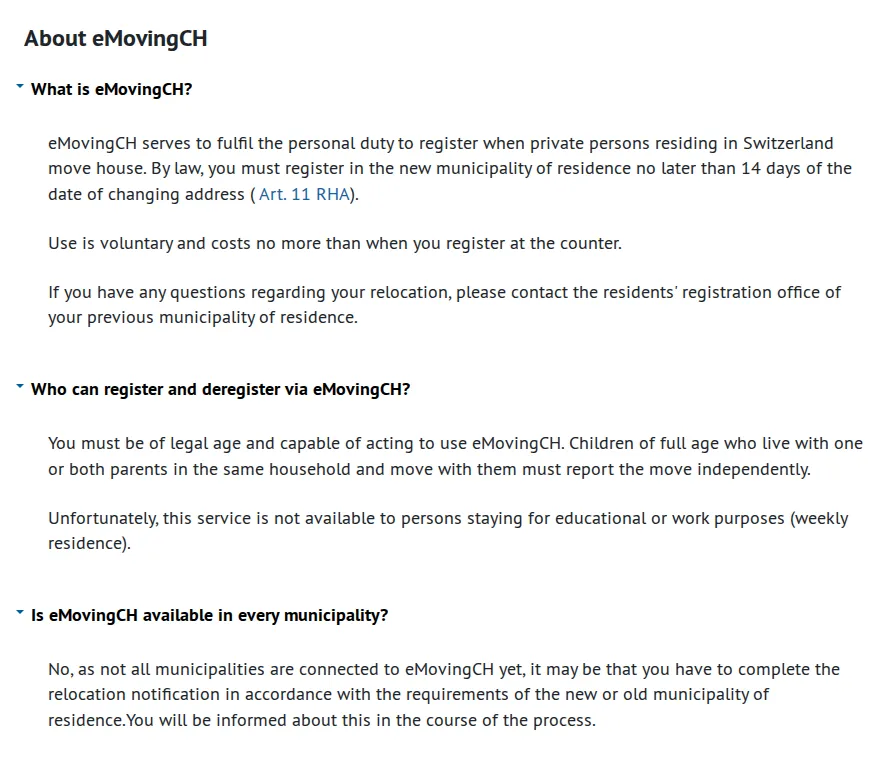
Three limits are worth knowing before you start. You must be 18 or over, and a grown-up child moving with their parents files their own report. Weekly residents, people who rent a flat near work or school but keep their main home elsewhere, can't use it. And when one of your two communes isn't connected, the form tells you so part-way through and sends you to the counter. Foreign nationals upload scans of their passport and permit, and the service warns that not every permit type is accepted online.
Is the deadline always 14 days?
No. Fourteen days is what the federal law requires the cantons to ensure; a canton can be stricter. Vaud is. Its residents' office page says you must announce your arrival in a new commune within eight days, and its law on residents' control (articles 3 and 5) applies the same eight days to any move, even to another flat in the same building. The City of Lausanne's own page gives 14 days. When a city and its canton disagree, aim for the shorter one: you lose nothing by being early.
The other catch is getting an appointment. The City of Zurich sees people at its counters by appointment, and it warns that some of the free slots fall after the 14-day deadline. Its advice is to book the next slot anyway and ask for an extension through its contact form. For a move inside the city, you can report it online from 30 days before moving in, which avoids the queue.
Geneva gives you 14 days to report a move to the OCPM. A change of address within the canton is free, and the canton warned in 2020 that a late notice can bring a penalty of CHF 100 or more. Fines elsewhere are set by each canton, and we found no national list.
Put next to the other dates around a move, the registration deadline is only one of several:
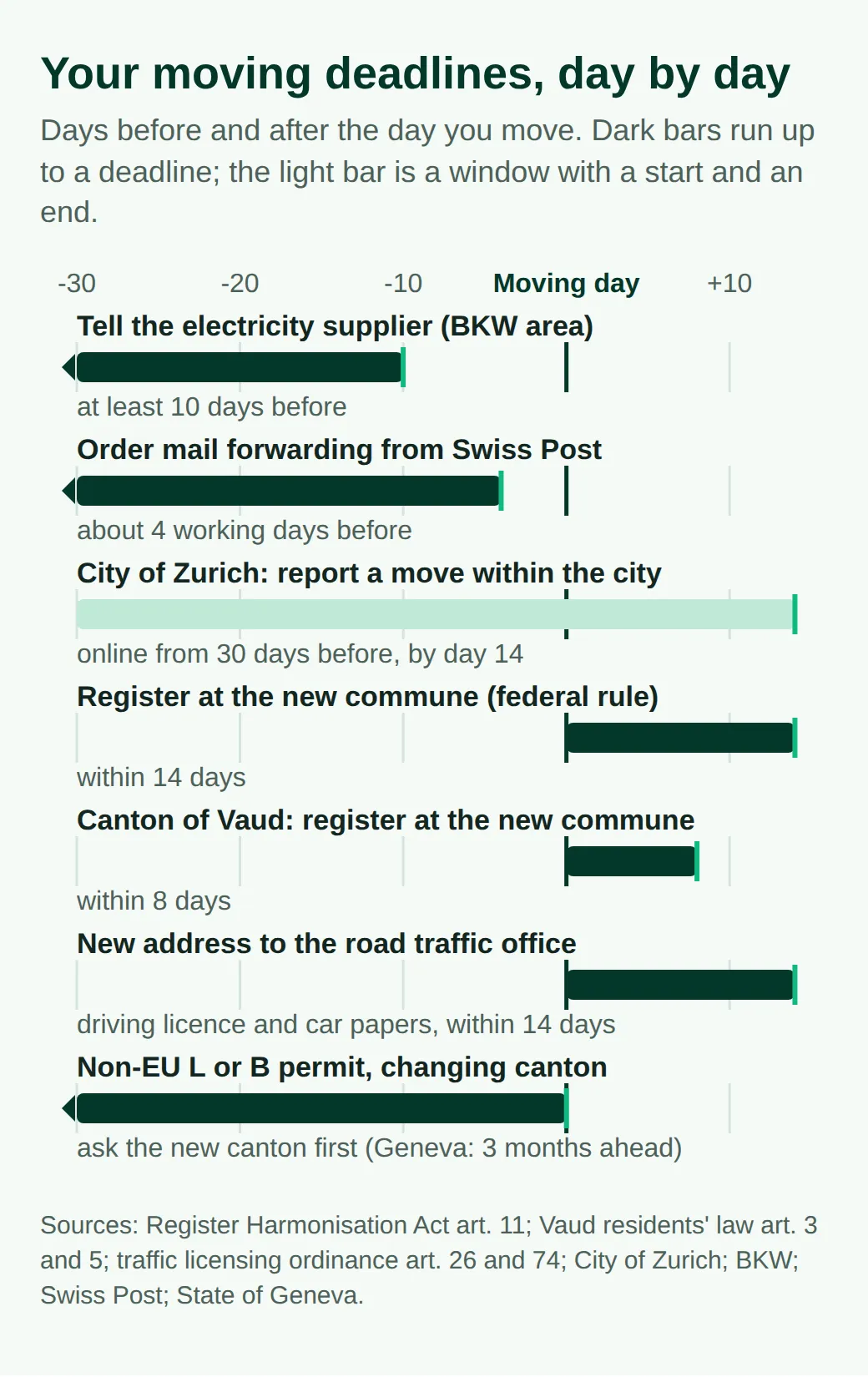
Several of them fall before you move. Those are the ones people miss, because nobody sends a reminder.
Moving within the same commune
You still report it. Ch.ch says a move to another address in the same commune is simply a change of address at the residents' office, and in Vaud even a move within the same building counts. Where your commune offers it online, that takes a few minutes, but it isn't optional. In Zurich, foreign nationals pay a CHF 30 migration office fee for it.
Give the floor and flat number when you report the move. The register doesn't just store your street: it records which flat you live in, and under the federal definition a household is everyone who lives in the same flat. Vaud's law asks for the flat identifier outright. That detail matters for the Serafe bill further down.
What the register passes on, and what it doesn't
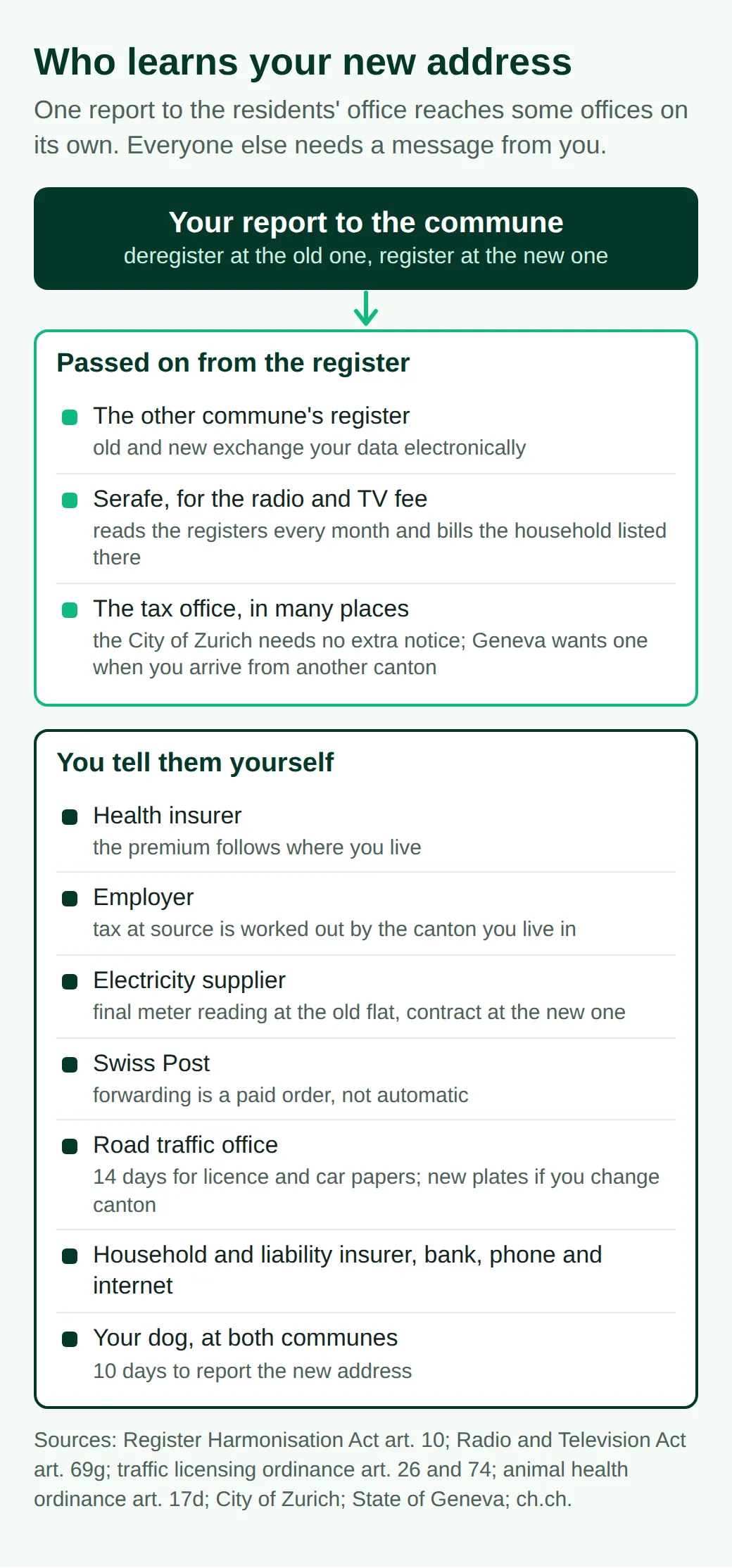
Your report to the commune travels further than you might think. The old and new registers exchange your data electronically, Serafe reads the registers every month, and in many places the tax office works from the same data. The City of Zurich, for example, says that after a move within the city no separate notice to the tax office is needed. Geneva is stricter: if you arrive from another canton, it wants you to deal with the tax administration as well as the OCPM, within 14 days.
Everything else depends on you. The register doesn't send your new address to the companies you have contracts with, and your driving licence and car need a notice of their own.
Serafe follows your household, by the month
The radio and TV fee costs CHF 335 a year per private household, and Serafe, the agency that collects it, says it falls to CHF 312 from 1 January 2027. There is nothing to sign up for or cancel with Serafe. The Radio and Television Act bills whatever household the residents' register shows, and Serafe gets those registers every month.
The law counts in whole months. You owe the fee from the first day of the month after your household is formed, and it ends on the last day of the month in which the household is dissolved. Moving in with a partner merges two households into one, so one of the two fees stops. Moving out of a shared flat into a place of your own starts a new household.
There's a catch for anyone leaving flatmates behind. Each adult in a household is jointly liable for the fee, and that liability covers every billing year that started while you belonged to the household (article 69a). Serafe bills once a year unless you ask for quarterly bills, in one of twelve staggered months, using the household the register reported at the start of your billing year, and the ordinance lets it claim more or refund money when an invoice turns out to be wrong.
If your bill shows the wrong address or the wrong people, Serafe doesn't correct it on its own. Its invoicing page sends you to the residents' office, because the register is the source; a correction you send Serafe instead is passed on to the register the following month. That's why the flat number matters: report it right once and the bill follows.
Health insurance: same policy, new premium
Tell your health insurer the new address yourself. Premiums depend on where you live: the Health Insurance Act makes insurers set them by canton, and the Federal Office of Public Health splits several cantons into two or three premium regions. A move across a canton line, or between regions, can change what you pay.
A higher premium after a move doesn't let you leave early. The federal premium site priminfo says a premium change caused by a move gives you no extraordinary right to cancel, so the usual dates apply: notice by 30 November to switch on 1 January, or by 31 March to switch on 1 July, a date open only to the standard model with the basic deductible. Your notice must reach the insurer by then; the postmark doesn't count.
One exception works the other way. If your insurer doesn't offer basic cover in your new canton and you must leave, your cover with them ends on the day you move, so arrange the new insurer before moving day.
Your household contents and liability insurance needs the new address too, along with the size of the new flat. We explain how those policies work in our guide to household and liability insurance.
Tax: where you live on 31 December
For income tax, the canton you live in at the end of the year taxes the whole year. The Tax Harmonisation Act says so for moves within Switzerland: whoever moves from Zurich to Lucerne in November files one tax return, in Lucerne, for all of that year. A move in late December therefore changes a whole year's bill, in either direction.
If you're taxed at source (your employer deducts the tax from your pay), tell your employer the new address at once. The employer applies the rules of the canton you live in when the pay is due, and the residents' register doesn't tell your employer anything.
Post, electricity and the rest
Swiss Post doesn't forward mail unless you pay for it. The prices for forwarding within Switzerland are below; add CHF 15 for each extra person and CHF 8 for each forwarded parcel. Post suggests ordering about four working days before the move; an express order for CHF 10 more works until 11 p.m. the evening before.
| Forwarding period | Online | At a branch |
|---|---|---|
| 6 months | CHF 35 | CHF 47 |
| 12 months | CHF 45 | CHF 57 |
| 18 months | CHF 55 | CHF 67 |
Forwarding has gaps. Free newspapers, PromoPost advertising and anything from other delivery companies are not forwarded, and debt collection documents are forwarded only within the same debt collection district. If you're expecting one of those, give the sender your new address directly. Post's free notification of move tells partner companies such as banks and insurers for you. Its address update, which passes your new address to companies that already have your old one and ask for it, only runs with your consent.
Electricity is your contract, not your landlord's. BKW, the supplier in much of the canton of Bern, says tenants must register and deregister themselves, at least ten days before the move, so that the meter is read in time and you aren't billed for the next tenant's use. Other suppliers set their own dates, but the principle holds: write down the meter readings at the handover, as ch.ch's moving checklist suggests, and cancel or move your phone and internet line.
Car, licence and dog
Your driving licence needs the new address within 14 days, reported to the licensing office of your new home canton (traffic licensing ordinance, article 26). Missing it can bring a fine.
Your car's registration document runs on the same clock: the same ordinance makes you report within 14 days any change the document has to show (article 74), and your address is printed on it. A car that changes canton also changes plates. The canton of Zug, for example, asks you to register at the commune first, then bring the original vehicle registration document, an insurance certificate showing the new address and your old plates. Within Zug, changing the address on the registration document is free. Registration fees vary by canton; ch.ch puts the document and plates at CHF 50 to 100 in most places, and the road traffic office in the new canton publishes its own fees.
If you own a dog, tell both communes, as ch.ch advises. The animal health ordinance gives you ten days to report the new address to the office for your new home, and the canton you move to updates the national dog database.
If you're not Swiss
Foreign nationals have the same 14 days and one more duty: the federal ordinance also requires you to deregister at the old place within that period. The new address goes onto your permit.
Changing canton is where permits differ. EU and EFTA citizens don't need a new permit; the State Secretariat for Migration says their permits are valid throughout Switzerland, and they only register in the new canton. Everyone else with a short-term (L) or residence (B) permit must ask the new canton for a permit before moving. A B holder has a right to it unless they are unemployed or there are grounds to revoke the permit; a C holder has the right unless there are grounds to revoke. Geneva asks non-EU citizens to apply three months before the date they want to arrive, and EU and EFTA citizens to report between 30 days before and 14 days after.
A sequence that works
Start a month out. Check whether both communes use eMovingCH, and if your new canton is Vaud, count eight days, not 14. Ask your insurer whether it covers the new canton, and if you hold a non-EU L or B permit and are changing canton, apply now. Ten days out, tell the electricity supplier; a week out, order mail forwarding. On moving day, read the meters. Within the week, register, give the flat number, and send the new address to your employer, the road traffic office and your insurers.
If you're still leaving a lease behind, our guides to breaking a lease early and termination dates by canton cover that side. And if your next flat is in Vaud, where the eight-day rule applies, these are the listings there:
Common questions
Do I have to register if I only live there during the working week?
Yes, if you stay there for three months or more in a year. You keep your main residence where your life is centred and register the weekday flat as a secondary residence. Foreign nationals must do this within 14 days when the weekly stay lasts more than three months in a calendar year. The online service eMovingCH is not open to weekly residents, so this is done at the counter.
Does my landlord register me at the commune?
No. In places such as the City of Zurich and the canton of Vaud, landlords must report tenants moving in and out, but the canton of Vaud says plainly that the landlord's notice does not replace yours. The duty to register stays with you.
What happens if I miss the deadline?
Register as soon as you can. The canton sets the penalty, and Geneva warned in 2020 that a late notice can cost CHF 100 or more. If your commune has no appointment free in time, as the City of Zurich says can happen, book the next one anyway and ask in writing for a longer deadline.
Do I get a day off work to move?
Usually, yes. The federal portal ch.ch says you are generally entitled to a day off for a move within your canton, and that you may be given more time when you move to another canton. Agree the date with your employer early.
More from the blog
All posts
Tenant insurance in Switzerland: what it covers and costs
Liability and contents insurance for Swiss tenants: what each pays for, when a landlord can demand it, and real 2026 quotes from about CHF 150 a year.

Moving to Switzerland: customs on household goods in 2026
Your used belongings enter Switzerland free of duty and VAT. Form 18.44, the inventory, the two-year limit, cars, alcohol limits and pets, step by step.

Shared flat in Switzerland: leases, deposits and moving out
Main tenant or joint lease? How a Swiss shared flat works: subletting rooms, what you may charge, splitting the deposit and leaving without paying twice.