Rental deposit in Switzerland: cap, account and refund

A landlord in Switzerland may ask for at most three months' rent as a deposit on a flat, and only if the lease provides for one. The money must sit on a blocked bank account in your name. It comes back with interest once nothing is owed. Cantons may add rules, and Geneva and Ticino have.
How much can a landlord ask?
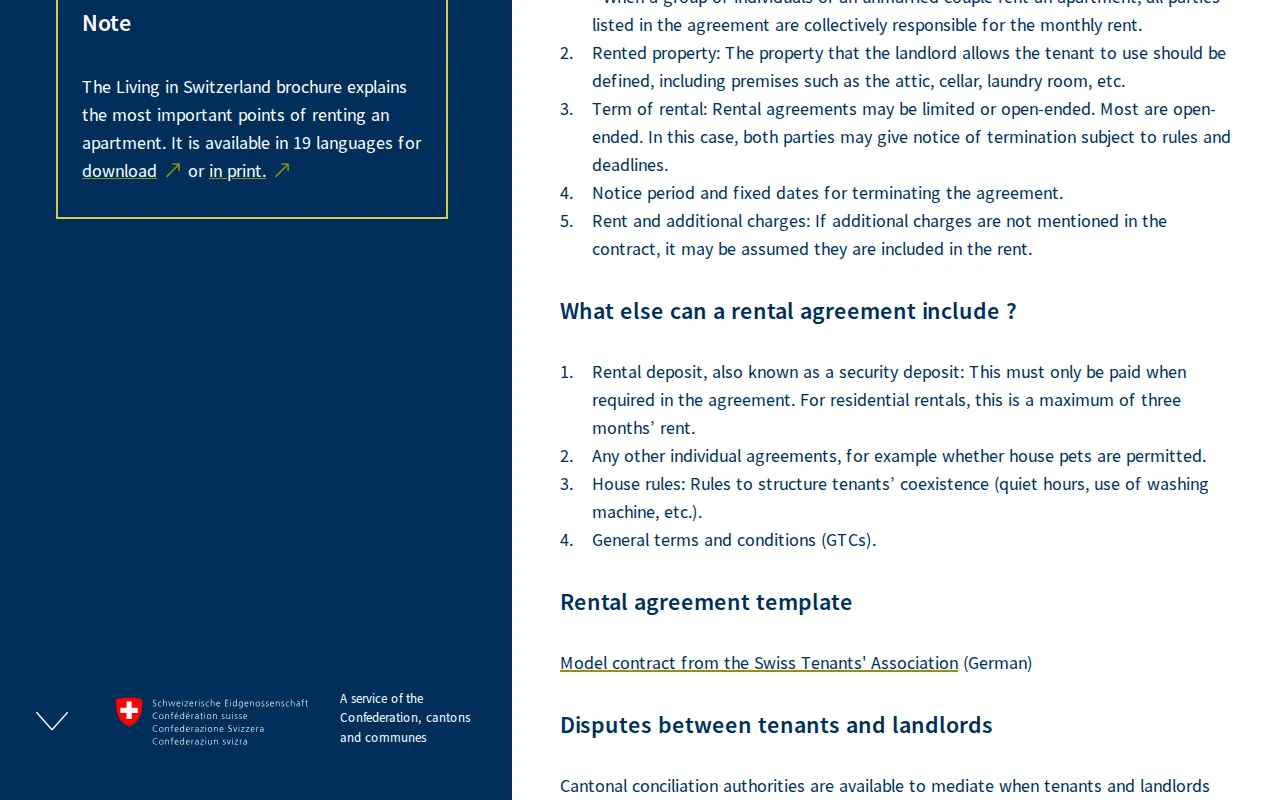
The cap is in the Code of Obligations (CO), art. 257e para. 2: for residential premises the landlord may demand "höchstens drei Monatszinse" as security. We read the German text on Fedlex on 12 October 2026, where the Code is shown as of 1 October 2026. The cap is written for homes. A study the BWO (the federal housing office) commissioned in 1999 says the law sets no cap for business premises.
Two federal sources say the same. ch.ch's page "Rental and leasing agreements", read on 12 October 2026, says the deposit only has to be paid when the agreement requires it and that for residential rentals it is a maximum of three months' rent. The BWO brochure "Living in Switzerland" (edition 09.22, article no. 725.037.eng), read the same day, says "a maximum of three months rent".
Our guide to renting in Switzerland as a newcomer covers the application, the lease and the handover.
Net rent or rent with service charges?
The law text leaves this open. Art. 257e says "Monatszinse", a word for rent. Art. 257a treats Nebenkosten (service charges) as a separate payment, due only if separately agreed, and art. 257b says that for homes they are the landlord's actual costs for things like heating and hot water. On the wording, "rent" could mean the net rent. It could also mean what you pay each month. The sources we read do not settle it:
- The BWO-commissioned study of October 1999, "Mietzinsdepots: Aktuelle Handhabung und mögliche Alternativen", says "Monatsmiete" is not clearly defined and that, depending on the legal reading, rent is counted with or without service charges.
- A directive of the Ticino social-support office (October 2018, on paying deposits for people on social assistance) says a deposit may not exceed three monthly rents "with the related accessory costs" for homes. It is an administrative directive for one benefit, not a ruling.
- The Vaud rules and usages for rentals (RULV), generally binding in that canton from 1 July 2026 per the BWO, say "trois mois de loyer net" (see Vaud below).
- The BWO brochure and ch.ch say only "three months' rent". Geneva's law says "3 loyers mensuels" and does not define it.
Practitioner guides from banks, insurers and landlord associations mostly read it as the gross rent, service-charge instalments included. None is an official source, so we do not rely on them. An example with round numbers: net rent of CHF 2,000 plus CHF 200 of service-charge instalments gives CHF 6,000 on the net reading and CHF 6,600 on the gross one. We found no federal court ruling on the point in the official sources we read, so we do not say which reading wins. The conciliation authority described below is the body that answers such questions.
Planning the cash before you sign
The BWO brochure says rent is in principle paid monthly in advance, so the first rent and the deposit can fall due together. Check what your lease asks and by when: art. 257e sets no payment date.
Where the money must be held
Art. 257e para. 1: when the tenant of residential or commercial premises gives security in money or securities, the landlord must place it at a bank, on a savings account or deposit in the tenant's name. The Zürich courts' tenancy page on security, read on 12 October 2026, adds that the landlord may not mix it with their own assets. It also reports the Federal Supreme Court's view that the tenant should check the deposit was placed correctly (BGE 127 III 273), because otherwise it can fall into the landlord's bankruptcy estate and be shared among all creditors.
In housing cooperatives, the brochure says, tenants do not normally pay a deposit but a membership fee.
The law text does not say who picks the bank or by when the account must be opened. The 1999 study notes that in practice the landlord chooses the bank.
Guarantees and deposit insurance instead of cash
Another product exists: instead of paying money into an account, you pay an annual premium to a company that guarantees the sum to the landlord. We do not name or rank providers.
The 1999 study says such alternatives save the tenant liquidity and are paid for with an amount that is "usually slightly above" what the tenant could earn by investing the deposit elsewhere. It also read surety and bank guarantee as falling outside art. 257e, a 1999 view, not a recent ruling.
The general conditions of one Swiss provider (version of 1 June 2024, read on 12 October 2026) say:
- the tenant pays an annual premium, fixed in the first year and flexible from the second;
- the provider pays the landlord on a signed acknowledgement, an enforceable payment order or a final judgment, which mirrors art. 257e para. 3;
- after paying, the provider can recover the amount from the tenant, who must reimburse it within 30 days;
- on request, the premium already paid for the rest of the calendar year is refunded pro rata minus CHF 20, but if the contract ends in the year after it was concluded, the provider keeps the premium for the running period.
So a premium is a price for the guarantee, not a deposit that comes back, apart from that narrow refund, which other providers may set differently. None of the sources we read says a landlord must accept a guarantee instead of cash. The lease and the landlord decide, so ask before you sign. Geneva's law, below, allows a simple surety for homes at the tenant's request.
Getting it back
Art. 257e para. 3: the bank may release the security only with both parties' consent, or on a legally effective payment order (rechtskräftiger Zahlungsbefehl) or a final court judgment. If the landlord has not asserted a claim against the tenant legally within one year after the end of the tenancy, the tenant may ask the bank for the money back.
Two details matter. First, the text does not define what counts as "rechtlich geltend gemacht". The 1999 study reads it as the landlord turning to the conciliation authority or a court within the year, and says the bank must check the file before paying the tenant. Second, the federal year runs from the end of the tenancy, while Geneva's law counts from the day the tenant left the premises.
Interest: the BWO brochure says the deposit is paid back "together with interest". The 1999 study says the law sets no rate, the bank's terms decide the rate and the tenant's access during the tenancy, and the interest belongs to the tenant. We give no current rate.
What a landlord may deduct, and the handback
The deposit secures the landlord's claims. The Zürich courts' page names rent claims and damage to the flat as examples. On damage, two articles set the frame.
Art. 267: the tenant returns the flat in the condition that results from contractual use, and an advance agreement to pay anything at the end of the tenancy beyond covering actual damage is void. Art. 267a: on handback the landlord must check the flat and report defects the tenant is responsible for immediately. If they fail to, they lose their claims, except for defects that could not be seen in a customary inspection, which must be reported at once when found.
The brochure describes the practice: landlord and tenant check the flat together, record every defect in a written inventory report, even minor ones, and agree who pays for which repairs. Its warning: by signing, "you are confirming that you agree with what has been recorded and will be liable for any costs", so understand every point first. It also says "a certain amount of wear and tear is normal over the years" and points to tenants' associations for which damages tenants pay. We found no federal table of how long fittings last.
If you and the landlord disagree
Every canton has a conciliation authority for tenancy matters. The BWO's page on the procedure (published 16 July 2024, read on 12 October 2026) says it has an independent chair and equal tenant and landlord representation, and links a list of addresses dated 8 July 2026. The brochure says "consultations and negotiations are free of charge".
The Civil Procedure Code (CPC), read on Fedlex on 12 October 2026, adds:
- Art. 197, 200, 201: conciliation precedes court proceedings; in these tenancies the authority also acts as a legal advice office.
- Art. 113: no party compensation is awarded in conciliation, and no court costs in these tenancy disputes.
- Art. 209 para. 4: if conciliation fails, the time to file suit after the authorisation is 30 days in tenancy disputes, in force since 1 January 2025.
- Art. 210 and 212: the authority may propose a decision for money claims up to CHF 10,000 and, if the claimant asks, decide claims up to CHF 2,000.
The Vaud prefectures' conciliation page, read the same day, shows one canton's way: a written request to the prefecture of the district where the property is, with the lease attached, and a hearing within two months. It lists CHF 5,000 as the limit for proposals, while art. 210 in the version in force since 1 January 2025 says CHF 10,000, so rely on the statute.
Where cantons differ
The BWO's page on tenancy law (published 28 August 2026, read on 12 October 2026) says tenancy is regulated by the federal Code and cantons may legislate only where it expressly reserves them room. Its example is art. 257e para. 4 CO: cantons "können ergänzende Bestimmungen erlassen", and the page names the form of the tenant's security as the area. The 1999 study listed supplementary laws in Uri, Fribourg, Ticino, Vaud, Neuchâtel and Geneva. That list is 27 years old. We read the current text for Geneva, Ticino and Vaud.
Geneva
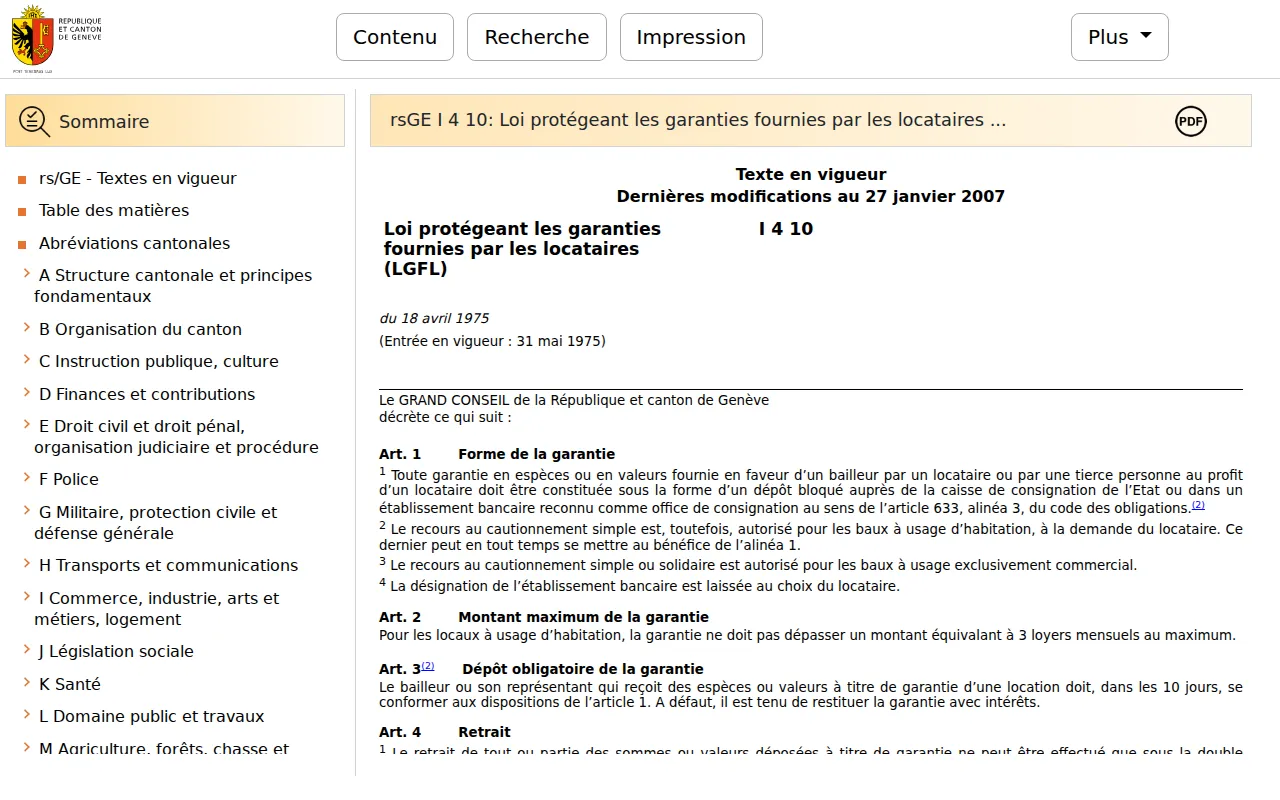
The Loi protégeant les garanties fournies par les locataires (LGFL, rsGE I 4 10, of 18 April 1975; the database page we read on 12 October 2026 shows last amendments on 27 January 2007) puts cash or securities into a blocked deposit at the state's consignment office or a recognised bank, with the bank chosen by the tenant, and caps the guarantee for homes at 3 monthly rents.
Ticino
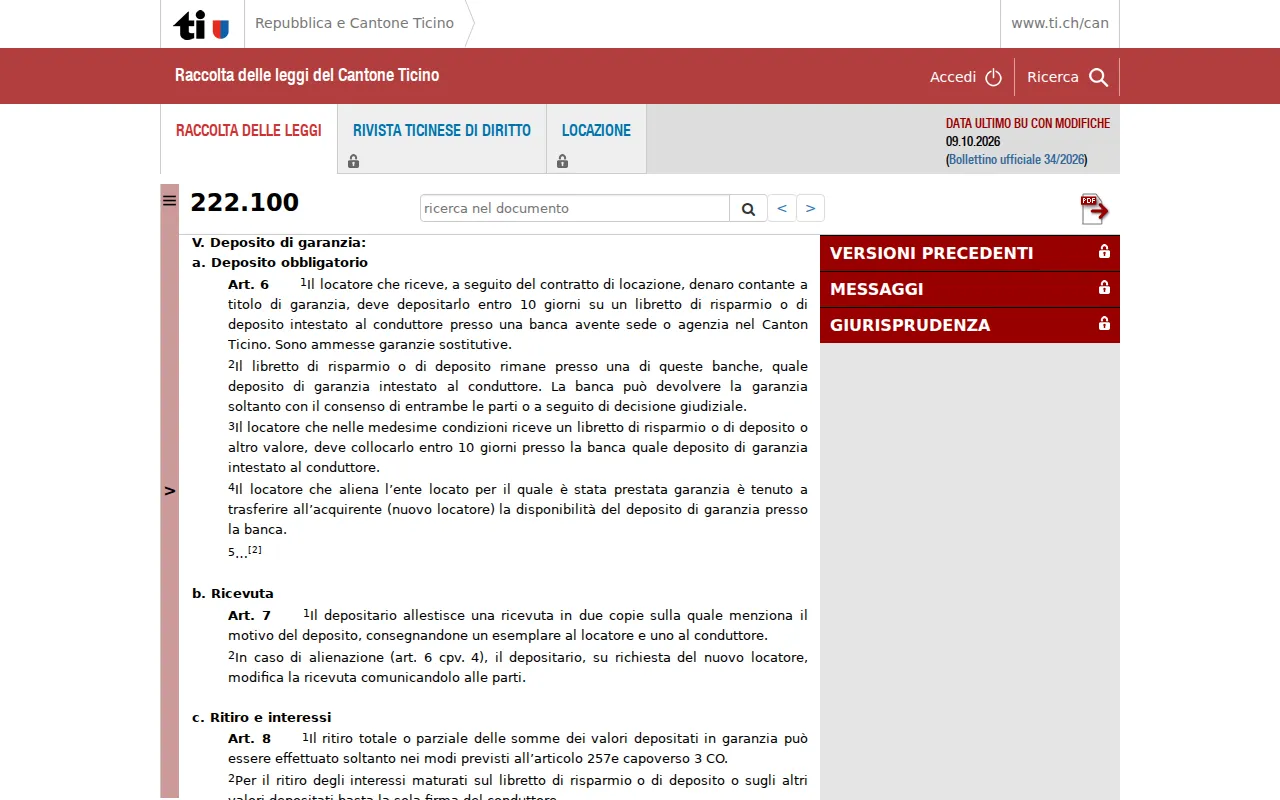
The cantonal law of 24 June 2010 on applying the federal tenancy rules (222.100), read on 12 October 2026 on a page showing changes up to 9 October 2026, requires a landlord who receives cash to put it within 10 days on a savings or deposit book in the tenant's name at a bank with a seat or branch in Ticino.
Vaud
The BWO's page on framework leases (read on 12 October 2026) says the Vaud Council of State declared the RULV generally binding from 1 July 2026 to 30 June 2032, and that the Federal Council approved deviations from mandatory tenancy law in three articles, one on the tenant's security. We read the RULV text the BWO links (dated 11 November 2025), art. 2: a guarantee may not exceed three months of net rent (except for commercial leases); proof that it was set up is due within 30 days of signing and at the latest at move-in; cash the landlord receives goes within 10 days onto a savings book in the tenant's name; the tenant cannot offset it against debts; withdrawal needs both signatures or a court decision; and after a year from the date the tenant left without a court action it is released by law. We did not read the Federal Council's decision, so we cannot say how far this displaces art. 257e.
Side by side
| Point | Federal (CO 257e) | Geneva (LGFL) | Ticino (222.100) | Vaud (RULV art. 2) |
|---|---|---|---|---|
| Cap, homes | 3 monthly rents | 3 monthly rents | None in deposit articles | 3 months of net rent |
| Cash banked | No deadline | 10 days, else returned with interest | 10 days | 10 days |
| Release | Both, or payment order or judgment | Both signatures or court | As CO 257e(3) | Both signatures or court |
| After one year | Tenant may ask the bank | Released by law | Via CO | Released by law |
| Interest | Not specified | At least the cantonal bank's savings rate | Tenant alone may withdraw it | Not stated |
| Surety instead of cash | Not addressed | Simple surety for homes on request | Substitute guarantees allowed | Not stated |
Geneva's law also lets the bank charge the tenant a one-time opening fee and provides fines (arts. 7 and 9). Ticino's says its deposit rules cannot be changed by contract against the tenant (art. 10) and fines breaches up to CHF 2,000 (art. 11). Vaud also has a cantonal law of 1971 on guarantees, listed in the 1999 study, whose current text we did not read. In any other canton, ask the conciliation authority whether a cantonal rule applies.
How we put this together
We read each source named above on 12 October 2026: the Code of Obligations and the Civil Procedure Code on Fedlex, the BWO brochure and its pages on conciliation and tenancy law, ch.ch, the Zürich courts' tenancy pages, the Geneva and Ticino legislation databases, the BWO's framework-lease page with the Vaud RULV text, the Vaud prefectures' page and one deposit-guarantee provider's published terms. Nothing here is advice on an individual lease.
Common questions
How much can a landlord ask as a rental deposit in Switzerland?
For a residential lease, Code of Obligations article 257e, paragraph 2, allows at most three monthly rents (Monatszinse). The federal housing office and ch.ch both say a deposit is only due if the lease asks for it. The law text does not say whether service charges count towards the three months, so read your lease and ask the conciliation authority if the figure looks high.
Where does the Swiss rental deposit have to be held?
Article 257e, paragraph 1, says the landlord must put money or securities in a savings account or deposit at a bank, in the tenant's name. The landlord may not mix it with their own assets. The bank can pay it out only with both parties' consent, or on a final payment order or court judgment.
How do I get my Mietkaution back?
Normally both sides sign the bank's release once the flat has been handed back and nothing is owed. If the landlord has made no legal claim within one year after the tenancy ended, article 257e, paragraph 3, lets the tenant ask the bank for the money directly. Interest on the account is paid out with the deposit.
What can a landlord deduct from the deposit?
The deposit secures the landlord's claims, for example unpaid rent or damage the tenant is responsible for. Under article 267 the tenant returns the flat in the condition that results from contractual use, and under article 267a the landlord must check it on handback and report defects at once. The handback report you sign counts for a lot, so read it before signing.
Do I pay to take a deposit dispute to the conciliation authority?
The federal housing office says consultations and negotiations at the cantonal conciliation authority are free of charge. Civil Procedure Code article 113 also says no court costs are awarded in conciliation for residential and commercial tenancy disputes. Your own adviser's fees are not reimbursed at that stage, because no party compensation is awarded.
More from the blog
All posts
Reference interest rate and rent in Switzerland: the rules
The federal reference rate is 1.25% since 2 September 2025. How it can justify a rent increase or a reduction, the forms, the deadlines and the exceptions.
How to rent an apartment in Switzerland as a newcomer
What a Swiss rental application needs, how to order a Betreibungsauszug, what landlords may ask, and the lease, move-in report and notice rules, with sources.