Reference interest rate and rent in Switzerland: the rules

The federal reference interest rate is the mortgage benchmark that decides whether a landlord in Switzerland may raise your rent, or you may ask for a reduction, during a running lease. It stands at 1.25%. A quarter-point move can shift the net rent by about 3%, but only on leases that follow it.
What the reference rate is
The Federal Office for Housing (BWO) says on its reference rate page, read on 12 October 2026, that the rate has applied to rent adjustments caused by mortgage rate changes since September 2008. It rests on the banks' average mortgage rate and is rounded to the nearest quarter of a percent.
The ordinance on tenancy (VMWG, in French OBLF) says more. Art. 12a para. 1, as shown on Fedlex on 12 October 2026 (version of 1 October 2025), bases the rate on the volume-weighted average rate for domestic mortgage claims, collected every quarter and set by commercial rounding in quarter points. Para. 2 has the economics department announce it every quarter.
BWO adds what goes into the average. The banks required to report send their current mortgage loans to the Swiss National Bank every three months. Because long-running fixed-rate mortgages are included, BWO writes, the reference rate moves slowly in both directions, and the central bank's policy rate has only an indirect, delayed effect on rents. BWO puts mortgages tied to the SARON rate at roughly 20 to 25% of the stock. The number is a smoothed, backward-looking figure, not what your landlord pays the bank this month.
The current rate and the recent announcements
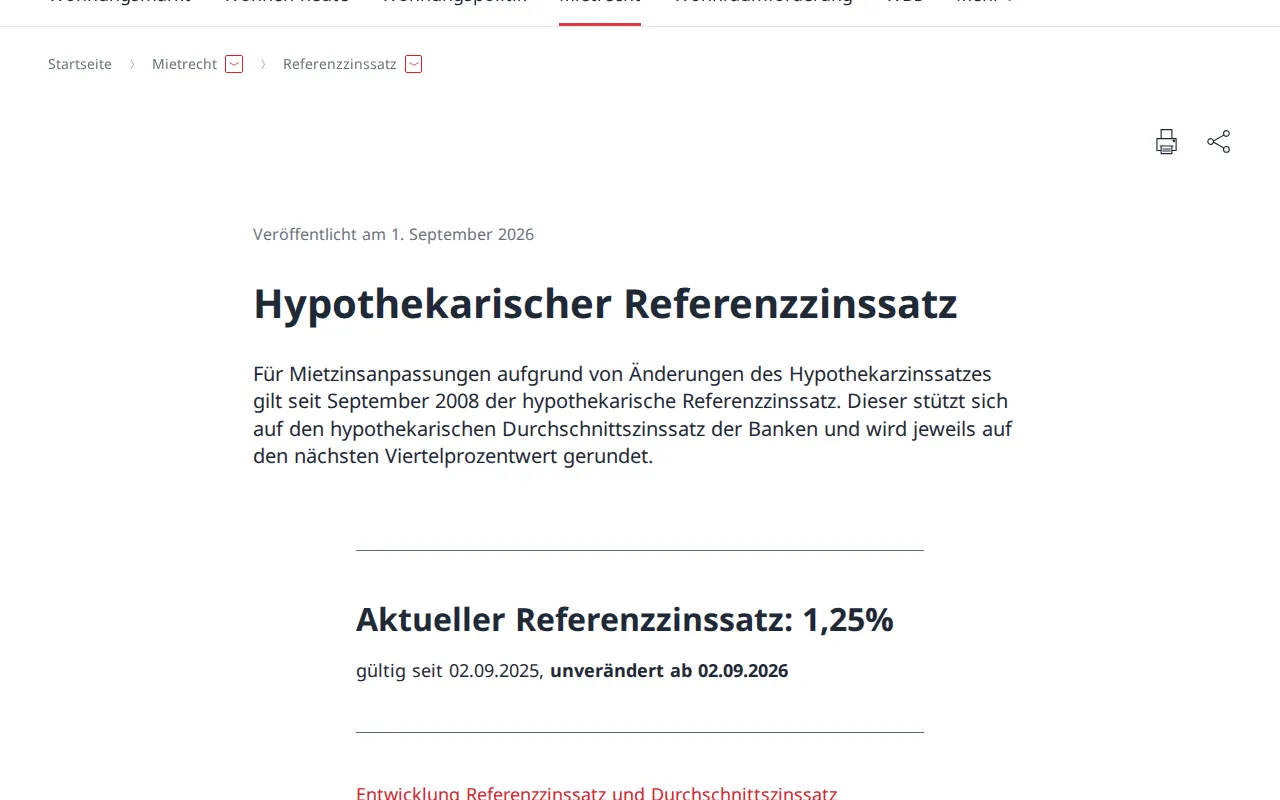
BWO's page, read on 12 October 2026, reads: current reference rate 1.25%, valid since 2 September 2025, unchanged from 2 September 2026. The latest announcement was published on 1 September 2026. BWO's schedule lists the next one for 1 December 2026, then 1 March, 1 June, 1 September and 1 December 2027.
BWO's history page, "Entwicklung Referenzzinssatz und Durchschnittszinssatz", showed no table when we opened it on 12 October 2026, only a PDF on how the average is calculated. The table below is rebuilt from the BWO announcements we could read (bwo.admin.ch and admin.ch, read 12 October 2026).
| Announcement | Reference rate | Average rate at cut-off | What BWO says |
|---|---|---|---|
| 3 June 2024 | 1.75% | not read | Unchanged from the previous rate |
| 3 March 2025 | 1.5% | not read | Down 0.25 points from the previous rate |
| 2 June 2025 | 1.5% | 1.44% (31 March), from 1.53% | Unchanged, valid from 3 June 2025 |
| 1 September 2025 | 1.25% | 1.37% (30 June), from 1.44% | Down 0.25 points, valid from 2 September 2025 |
| 1 December 2025 | 1.25% | 1.33% (30 September), from 1.37% | Unchanged, valid from 2 December 2025 |
| 1 June 2026 | 1.25% | 1.31% (31 March), from 1.32% | Unchanged, valid from 2 June 2026 |
| 1 September 2026 | 1.25% | 1.31% (30 June), unchanged | Unchanged, valid from 2 September 2026 |
BWO's 2026 schedule also lists 2 March 2026; we did not read that release. We have not read announcements from before June 2024, so we do not say when the rate rose to 1.75%.
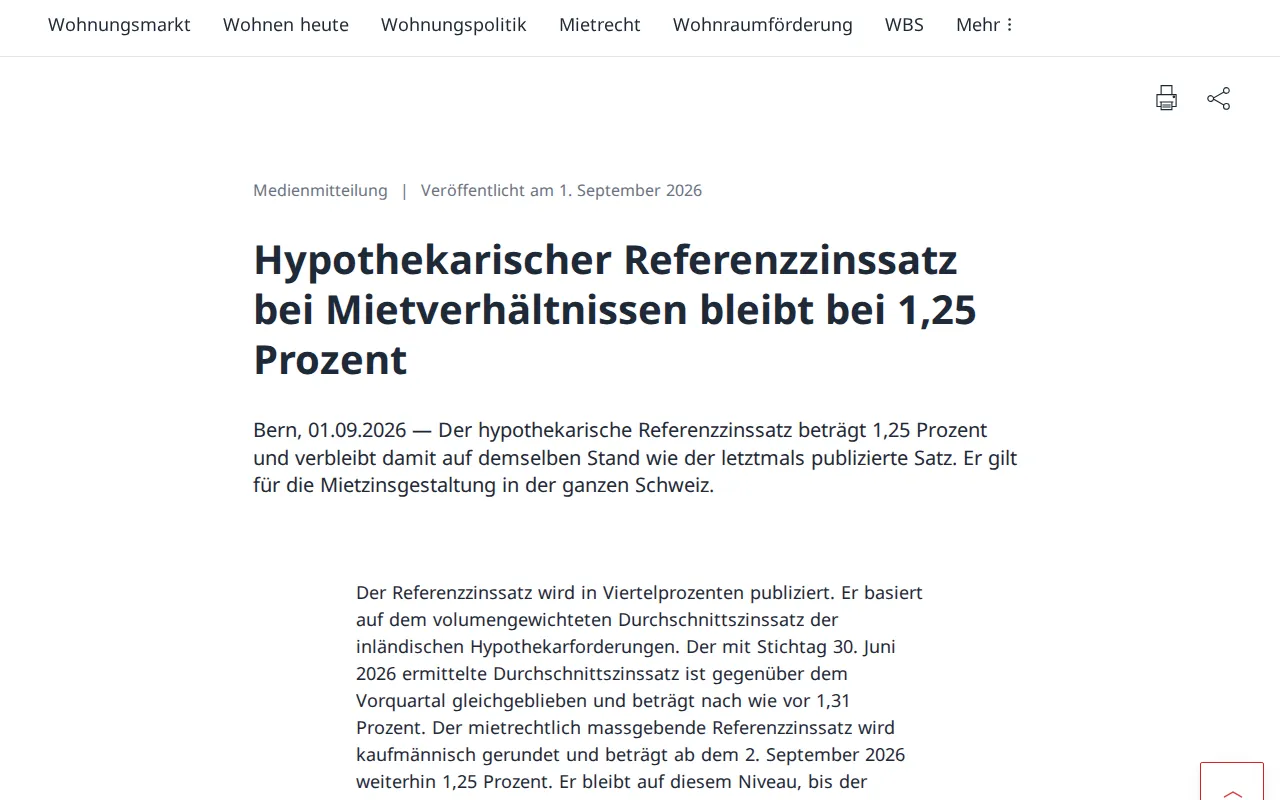
The rate has not changed at the four announcements since September 2025. The September 2026 release says it stays at 1.25% until the average falls below 1.13% or rises above 1.37%. With the average at 1.31% on 30 June 2026, that is 0.18 points of room downwards and 0.06 upwards. BWO publishes the thresholds, not a forecast.
How a change feeds into rent
Art. 269 of the Code of Obligations (CO), read on Fedlex on 12 October 2026, calls a rent abusive if it produces an excessive return from the property or rests on a clearly excessive purchase price. Art. 269a lists cases where a rent is in principle not abusive, among them rents within the local or neighbourhood level (lit. a), rents justified by cost increases or extra services by the landlord (lit. b) and rents that only offset inflation on risk-bearing capital (lit. e).
Mortgage costs are one of those cost factors, and the ordinance puts numbers on them. VMWG art. 13 para. 1, as shown on Fedlex on 12 October 2026, says a mortgage rate rise of a quarter percent generally entitles the landlord to a rent rise of at most:
- 2% where mortgage rates are above 6%
- 2.5% where they are between 5% and 6%
- 3% where they are below 5%
The same paragraph says that when mortgage rates fall, rents are to be reduced accordingly, or the savings set against cost increases that have occurred in the meantime. At today's rate level, the 3% band is the one that applies.
BWO's Q&A on its reference rate page puts the same rule in plain terms. When the reference rate rises by 0.25 points, the rent may go up by 3% (it cites art. 13 para. 1 lit. c). When it falls by 0.25 points, tenants in principle have a claim to a reduction of 2.91%. Only the net rent can change. Heating and ancillary costs agreed separately are not touched.
An illustrative sum, not anyone's case: 2.91% of a CHF 2,000 net rent is about CHF 58 a month. For a gap of more than 0.25 points BWO says other conversion rates apply, and it links tables and calculators from several organisations. We did not read those.
Which rate your rent is based on
The claim depends on the reference rate your rent rests on, not on last quarter's rate. BWO says the rate in force when the contract was signed applies, and the lease often states it. If the rent was later changed because of a reference rate move and not contested, that rate is the new baseline. VMWG art. 13 para. 4 adds that earlier mortgage rate changes that already led to rent adjustments must be taken into account.
That is why BWO's December 2025 and June 2026 releases say that rents still based on a reference rate of 1.5% or higher generally still carry a reduction claim. A lease signed before September 2025 and not adjusted since may still sit on the old number. BWO's September 2025 release says rents already based on 1.25% have no claim.
What can offset the reference rate
A mortgage-based change is rarely the whole picture. Three other factors turn up in BWO's text and the ordinance.
Inflation. VMWG art. 16 lets a rent rise by at most 40% of the increase in the national consumer price index, to offset inflation on the risk-bearing capital (CO art. 269a lit. e). BWO says the landlord may add this to a mortgage-based increase. It also says that in the other direction, up to 40% of a fall in the index can be set against a reduction.
Other cost increases. VMWG art. 12 para. 1, read on Fedlex on 12 October 2026, lists rises in the mortgage rate, fees, property taxes, land-lease payments, insurance premiums and maintenance costs as cost increases within the meaning of CO art. 269a lit. b. BWO gives fees as an example of something a landlord can add to a reference-rate increase.
Past cost increases. VMWG art. 13 para. 1 lets the landlord set a mortgage saving against cost increases that have come in since. A reduction can therefore come out smaller than the mortgage figure alone. BWO says a landlord who declines or offsets has to explain why.
BWO also lists objections open to a tenant against an increase: no approved form or no reasons, a wrong reference rate or conversion rate, an excessive net return, or a new rent outside the local and neighbourhood level. These describe what the rules allow, not whether any fits a given lease.
How a rent increase must be announced
CO art. 269d para. 1, read on Fedlex on 12 October 2026, lets the landlord raise the rent at any time for the next possible termination date. The landlord has to communicate the increase to the tenant at least ten days before the notice period begins, on a form approved by the canton, and give reasons.
For a flat the notice period is three months (CO art. 266c). BWO therefore describes the timing as: at least 10 days before the start of the notice period, which is at least three months for flats, and not earlier than the next possible termination date. Termination dates come from the lease and local custom, so they differ.
Art. 269d para. 2 says an increase is void if the landlord:
- does not use the prescribed form
- gives no reasons
- uses the notice to threaten or pronounce a termination
Para. 4, added by the amendment of 29 September 2023 and in force since 1 October 2025 according to Fedlex, says a mechanically reproduced signature on the form is enough.
The form is cantonal, so it differs by canton. If you have just moved in, our guide to renting in Switzerland as a newcomer covers the related rule for the initial rent: CO art. 270 lets the tenant contest it within 30 days of taking over the flat in two cases, and cantons with a housing shortage may require an official form already at the start of a lease.
How to ask for a reduction
BWO says Switzerland has no general state rent control, so the parties have to act themselves.
CO art. 270a, read on Fedlex on 12 October 2026, sets out the steps:
- The tenant can demand a reduction to the next possible termination date if there is reason to believe the landlord is making an excessive return because of a significant change in the calculation basis, mainly a cost reduction (para. 1).
- The request goes to the landlord in writing. The landlord has 30 days to respond (para. 2).
- If the landlord refuses, agrees only in part, or does not answer in time, the tenant has 30 days to call the conciliation authority (para. 2).
BWO recommends registered mail for the request. It says that if you miss the 30-day window with the conciliation authority, you start again with the landlord, and puts the outer limit at 60 days after the original request. The Zürich courts' page on rent reductions, read on 12 October 2026, describes the same two steps and offers a sample letter and a form for the conciliation authority.
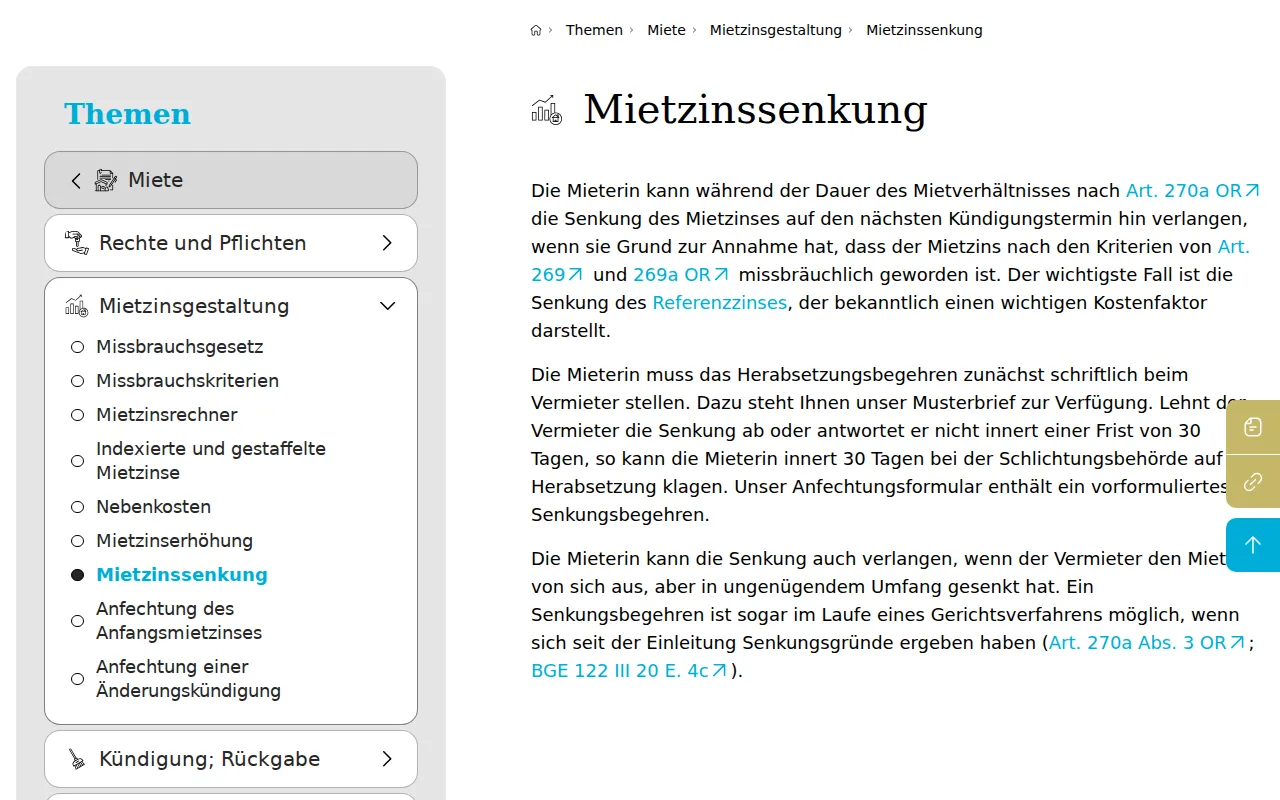
Under para. 3, the two-step route does not apply when a tenant files a reduction request together with contesting an increase. The Zürich page adds that a tenant can still ask for more if the landlord lowered the rent by too little.
The conciliation authority is cantonal. BWO publishes a list of their addresses, which we did not reproduce. What happens after a failed conciliation depends on the cantonal procedure, which this post does not cover.
How to contest an increase
CO art. 270b para. 1, read on Fedlex on 12 October 2026, says a tenant can contest a rent increase as abusive within 30 days of it being communicated, before the conciliation authority. Para. 2 extends this to other one-sided changes that work against the tenant, such as cutting existing services or introducing new ancillary costs.
Under CO art. 270e, the existing lease continues unchanged while conciliation is pending and, subject to interim measures by the judge, during court proceedings.
Leases the reference rate does not govern
BWO's Q&A, read on 12 October 2026, says the reference rate decides rent changes in existing leases, but not in all of them. It names four exceptions.
Indexed rents
CO art. 269b makes an index clause valid only if the lease runs for at least five years and the index is the national consumer price index. BWO says other ways to adjust the rent are in principle excluded during that fixed term. VMWG art. 17 caps each increase at the rise in the index, requires a reduction when the index falls, and allows an increase on at least 30 days' notice to the end of a month. Under CO art. 270c, a party before the conciliation authority can only argue that the increase or reduction requested is not justified by a corresponding change in the index.
Graduated rents
CO art. 269c makes an agreement to raise the rent by set amounts valid only if the lease runs at least three years, the rent rises at most once a year and the increase is fixed in francs. Para. 5 of art. 269d lets such an increase be announced in writing instead of on the official form. CO art. 270d says the tenant cannot contest a graduated rent, apart from the initial rent.
Subsidised and luxury homes
BWO says a home supported by public money is under official control during the subsidy period and follows those rules, often with the rent calculated on cost. It adds that rents for luxury flats and for single-family houses with six or more rooms (kitchen not counted) can be freely agreed.
If you are about to sign a lease
BWO says the reference rate behind a rent is often stated in the lease. It becomes your baseline for later claims, so look for it before you sign.
How we put this together
On 12 October 2026 we read BWO's reference rate page and its releases of 3 June 2024, 3 March 2025, 2 June 2025, 1 September 2025, 1 December 2025, 1 June 2026 and 1 September 2026, the VMWG (version of 1 October 2025) and CO art. 269 to 270e on Fedlex, and two Zürich courts pages. We did not look at cantonal forms or at other cantons' authorities.
This post describes the rules, not what applies to your lease. BWO names conciliation authorities, tenants' associations and landlords' associations as places to ask.
Common questions
What is the reference interest rate in Switzerland today?
The Federal Office for Housing (BWO) lists it at 1.25%, valid since 2 September 2025 and unchanged at the announcement of 1 September 2026. The next announcement is scheduled for 1 December 2026. We read the BWO page on 12 October 2026.
How much can my rent go down if the reference rate falls?
BWO says that a fall of 0.25 percentage points gives tenants in principle a claim to a reduction of 2.91 percent of the net rent. The ordinance sets different rates for larger gaps, and other cost factors can be set against the reduction. BWO adds that any adjustment can only be calculated for the individual lease.
Can my landlord raise the rent when the reference rate rises?
Yes, by up to 3 percent per quarter point at today's level, under art. 13 of the ordinance on rents (VMWG). The increase must be announced on the form approved by the canton, with reasons, at least 10 days before the notice period starts. Without the form or the reasons it is void under CO art. 269d.
How long do I have to contest a rent increase?
CO art. 270b gives you 30 days from the day the increase was communicated to you to go to the conciliation authority. The conciliation authority is the cantonal body for tenancy disputes. The existing lease stays unchanged while the dispute is pending (CO art. 270e).
Does the reference rate apply to indexed and graduated rents?
BWO says it does not. An indexed lease follows the consumer price index and needs a term of at least five years (CO art. 269b), and a graduated lease raises the rent by fixed francs amounts at agreed dates (CO art. 269c). Subsidised and luxury homes follow their own rules.
More from the blog
All posts
Rental deposit in Switzerland: cap, account and refund
How much a Swiss landlord may ask as a rental deposit, where it must be held, how to get it back and where cantons such as Geneva and Ticino add rules.

How to rent an apartment in Switzerland as a newcomer
What a Swiss rental application needs, how to order a Betreibungsauszug, what landlords may ask, and the lease, move-in report and notice rules, with sources.