Dieser Artikel ist nur auf Englisch verfügbar.
How to rent an apartment in Switzerland as a newcomer
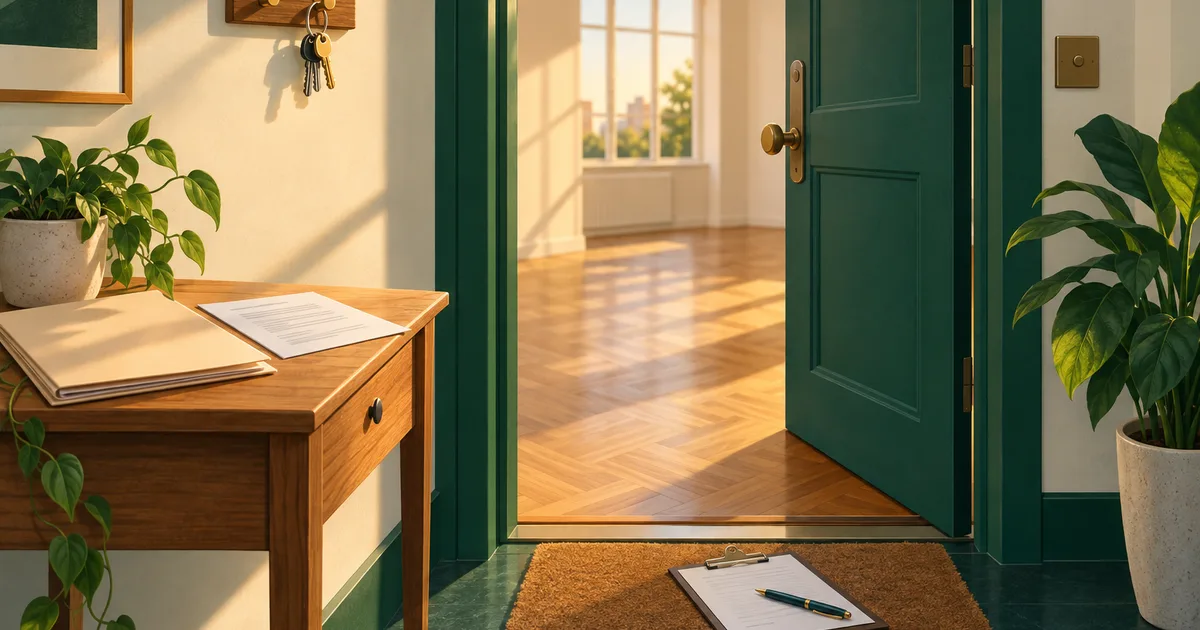
Renting in Switzerland usually runs in this order: you view the flat, fill in an application form, supply a debt-collection register extract and a few proofs, sign a written lease, pay a deposit and walk through the flat with the landlord, who records every defect in a handover report. Cantons and landlords differ on details, which we flag below.
What goes into an application file
The federal housing office (BWO) publishes a brochure, "Living in Switzerland", published with 13 partner organisations, among them the Federal Commission on Migration and landlord and tenant associations. The English edition we read, dated September 2022, says that once you find a flat you usually fill in an application form giving your profession, monthly salary, number of children, nationality or residence permit and employer. It adds that you will probably need an excerpt from the debt enforcement register as proof that you can pay your bills.
So the file usually has four parts:
- the completed application form
- the debt-collection register extract
- a copy of your ID and, if you are not Swiss, your residence permit
- proof of income, plus references
The order matters, and the federal data protection commissioner (EDÖB) has a view on it. Its leaflet on rental application forms, updated 15 July 2025 and read on 12 October 2026, describes a two-step process. In step one you hand in the form. In step two, only candidates who are still in the running are asked for proof: an ID copy, payslips or a salary certificate, and references. The leaflet calls it disproportionate to demand every proof from every applicant. The leaflet is the commissioner's position, not something that binds a letting agent, and it notes that some landlords say incomplete forms are not considered. Still, it is a fair reason to hold back original documents until you know you are being considered.
BWO's brochure also says a landlord may not charge any fee linked to finding a flat, for example to reserve it or to withdraw an application, even if the form says a fee is due.
Salary proof when you have just arrived
Newcomers rarely have Swiss payslips yet. ch.ch's page on working in Switzerland, read on 12 October 2026, says an EU/EFTA citizen starting a job of more than three months applies for a residence permit at the commune with a valid ID or passport and confirmation of employment, such as an employment contract. So you will have an employment contract in hand, but none of the sources we read says whether a given agency accepts it as salary proof. Ask before you apply.
Some agencies use a rule of thumb that rent should stay around a third of gross income. That is trade practice. None of the federal sources we read gives a figure.
Permit and ID
The EDÖB leaflet says a landlord may ask whether you hold Swiss or foreign nationality, which permit you have and when it expires, because the permit duration can affect how long a tenancy lasts. It says a copy of the ID or permit can be requested once you are the final candidate and the lease is being drawn up. Which permit you need, and when, depends on your nationality and your canton. ch.ch's page for foreign nationals who work says a self-employed EU/EFTA arrival must register within 14 days and apply for a permit at the commune. Start with that page and your cantonal migration office.
References
Landlords may call a current landlord or employer, but the EDÖB leaflet says the form must make clear that giving those contact details can lead to a reference call, giving a reference is voluntary, and references may only be requested for candidates who are seriously in the running and only to confirm what you wrote in the form.
The debt-collection register extract (Betreibungsauszug)
The extract is the document that surprises newcomers most. ch.ch's page on ordering it, read on 12 October 2026, says it lists the debt-collection proceedings opened against you in the past five years, that landlords often ask for it, and that it costs "in der Regel" CHF 17 plus postage. You can order by filling in an online form and sending it by post or e-mail to the debt-collection office in your canton of residence, or in person at the counter of that office. For your own extract you need a copy of an ID.
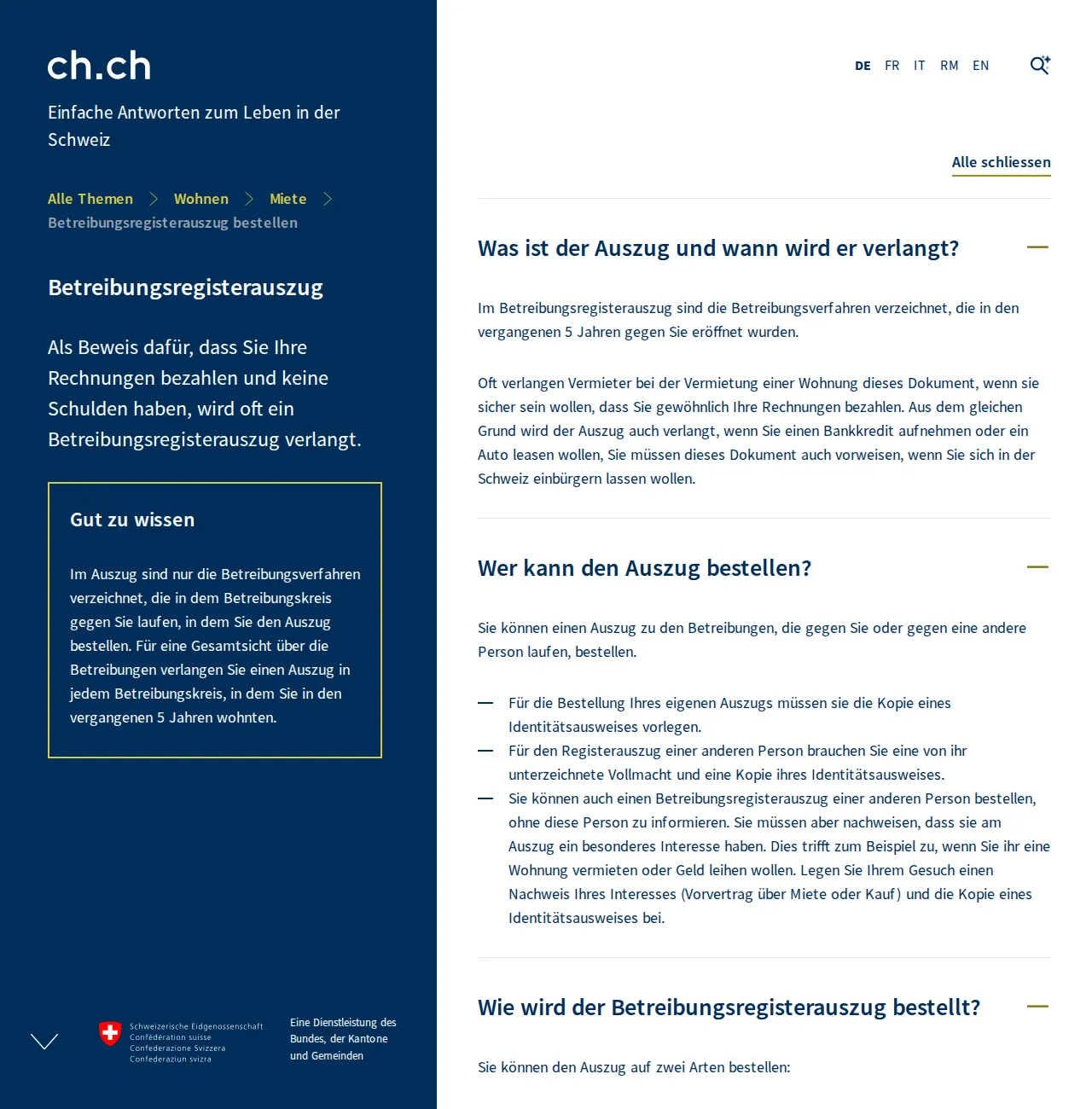
The same page has a box that matters if you have moved around. It says an extract only shows proceedings in the collection district (Betreibungskreis) where you order it. For an overview you order one in each district where you lived in the past five years.
What it shows if you are new
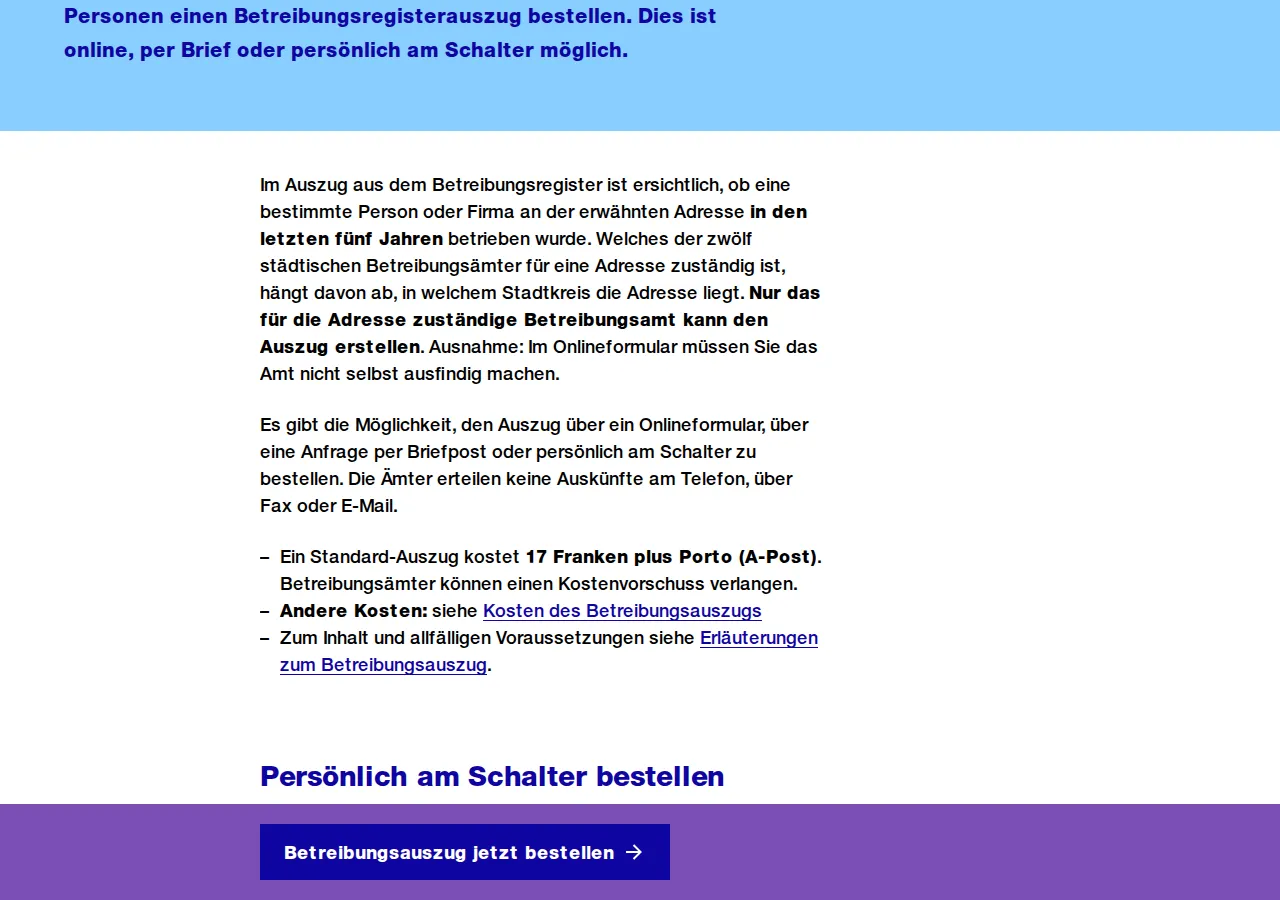
The registers are local, so an extract from a Swiss office says nothing about debts abroad. The canton of Geneva's page, read on 12 October 2026, says that if you have no proceedings and no certificates of loss (actes de défaut de biens) in Geneva, the extract is blank and counts as a "non-poursuite" certificate. The Zürich city page says that for people who lived in a district only briefly or not at all, the extract states the length of stay or that the person did not live there. Whether a landlord also wants a record from your home country is the landlord's call. We found no federal rule either way.
The EDÖB leaflet says a copy of the extract may be requested from every applicant and the original from the chosen candidate. Copies for applicants who are not chosen must be destroyed after the flat is let.
No official validity period for the extract appears in the ch.ch, Zürich or Geneva pages. Landlords set their own limit, so ask what age they accept before you pay.
Zürich
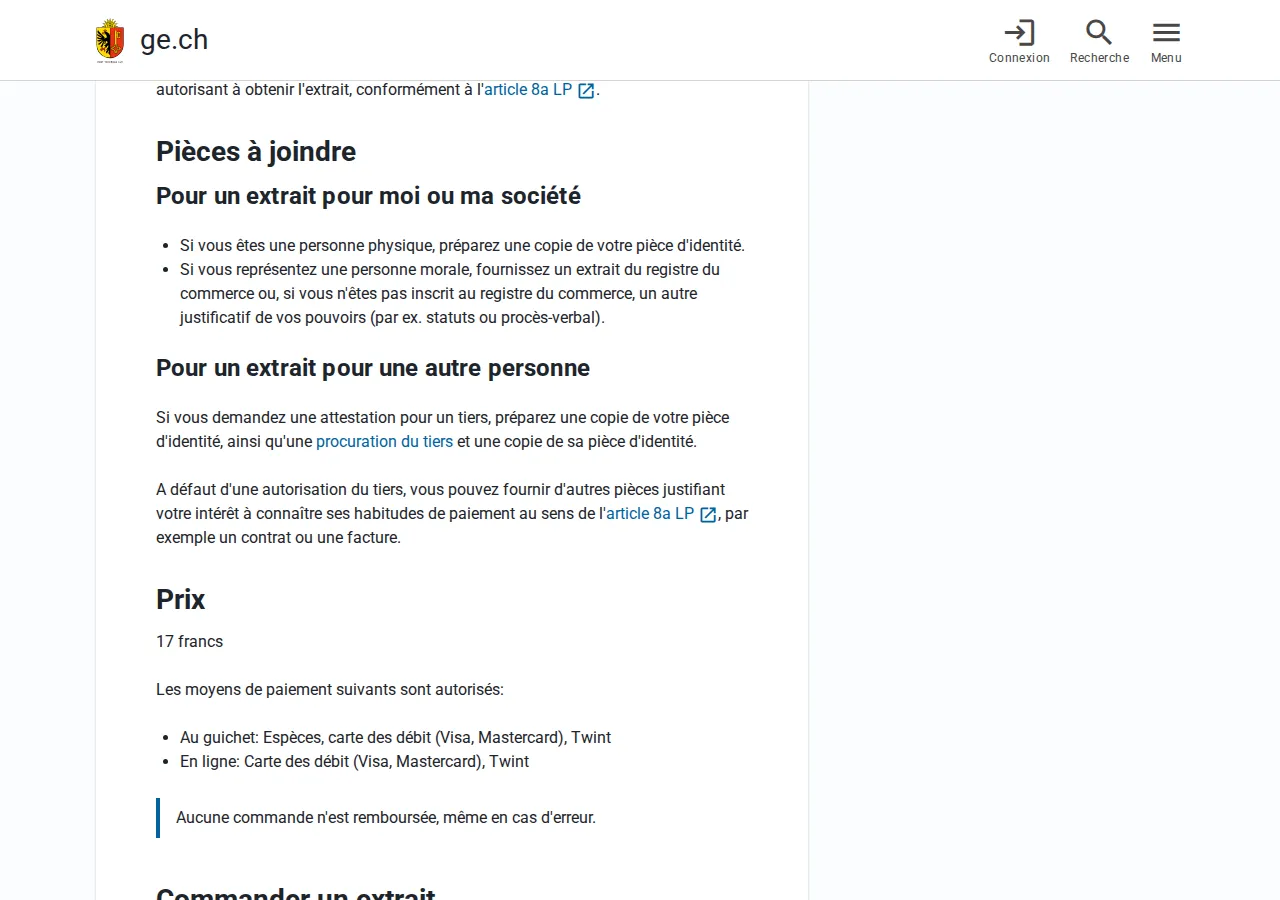
The Stadt Zürich page, read on 12 October 2026, says only the debt-collection office responsible for your address can issue the extract, and the city has twelve of them depending on the Stadtkreis. The online form finds the right office for you. A standard extract costs CHF 17 plus A-Post postage, and offices may ask for an advance payment. It says written extracts are sent only to addresses in Switzerland, so if you have no Swiss address yet, ask the office before you order. The offices do not answer by phone, fax or e-mail, so the form or the counter is the route.
Geneva
The canton of Geneva's page, read on 12 October 2026, lists the price as CHF 17, paid by debit card or Twint online and by cash, debit card or Twint at the counter. You order online with a personal account and get a reference number by e-mail, then download the document with the same account. Counter visits are by appointment and, the page says, rarely needed. No order is refunded, even if you made a mistake.
A federal route, and a national extract that is not here yet
The federal debt-collection portal at betreibungsschalter.ch, read on 12 October 2026, offers an information request: you print the form, sign it and send it to the competent office, which checks your reasons. The same site helps you find the competent office. It is a way into the canton's process, not a national register.
The federal justice office (BJ) page on modernising debt collection, read on 12 October 2026, lists a bill on a nationwide debt-collection information as a referendum bill (BBl 2026 1767). The page gives no date for when you could order a national extract, and it is not in force, so plan on local extracts for now.
What landlords and agencies check
The EDÖB leaflet lists what it considers proportionate, so you can tell a normal question from an overreach.
| Topic | Allowed according to the EDÖB leaflet | Not allowed or restricted |
|---|---|---|
| Identity | Name, date of birth, address, phone | |
| Status | Swiss or foreign, permit type and expiry | Marital status, religion, wider nationality questions |
| Money | Job, employer, approximate income, extract, pending proceedings | Leasing contracts, small-credit contracts, wage garnishments |
| Housing history | Whether the last tenancy was ended by the landlord, and why; number of occupants | Length of current tenancy, current rent |
| Lifestyle | Pets, and instruments where noise protection requires it |
The leaflet says income questions can use categories with an upper limit that should not exceed CHF 150,000 apart from very high rents. It also says an agency may not ask whether you are willing to take out an insurance policy with it, because art. 254 CO makes such a tied deal void. The leaflet notes that proof of a household contents insurance can be requested when the contract is drawn up.
Landlords may choose among applicants, but BWO's brochure says they may not select on discriminatory criteria, and that if you have experienced discrimination you can seek advice through a cantonal integration programme.
Viewings and the application
The EDÖB leaflet says the application form is usually filled in after the viewing. So bring ID, but hold the full dossier until you are asked, as the leaflet describes the two steps above. At the viewing, three questions are worth asking.
- Whether the handover report of the previous tenant exists. CO art. 256a para. 1 says that if a return protocol was drawn up at the end of the previous tenancy, the landlord must show it to the new tenant on request when handing over the flat.
- The rent of the previous tenant. Art. 256a para. 2 says you can ask to be told it.
- Whether pets are allowed, since BWO's brochure says to check before you apply.
Housing cooperatives work differently. BWO's brochure says you usually have to become a member, which involves a financial outlay, and that tenants normally pay a membership fee instead of a deposit.
Renting a room first
A room is a different legal case from a flat. CO art. 266e, read on fedlex on 12 October 2026, sets a notice period of two weeks, to the end of a one-month rental period, for furnished rooms and separately let parking spaces, whereas flats get three months under art. 266c.
The lease, the initial rent form and the deposit
ch.ch's page on rental agreements, read on 12 October 2026, says a lease is normally in writing and must name the parties, define the rented property including cellar or attic, state whether it is fixed-term or open-ended, give the notice period and dates, and state the rent and additional charges. If additional charges are not mentioned, ch.ch says they can be assumed to be included in the rent. If you rent as a couple or group, ch.ch says everyone listed in the lease is jointly responsible for the monthly rent.
Check the initial rent form. CO art. 270 lets a tenant contest the initial rent with the conciliation authority within 30 days of taking over the flat in two cases: a personal or family hardship or the local market forced them to sign, or the landlord raised the rent substantially compared with the previous rent. Art. 270 para. 2 lets cantons with a housing shortage make an official form showing the previous rent compulsory. BWO's list for 2026, a PDF dated 16 September 2026 and read on 12 October 2026, shows the form as compulsory in Basel-Stadt, Bern, Fribourg, Geneva, Luzern, Zug and Zürich, partly in Neuchâtel and Vaud, and not in Valais. Cantonal status changes with the vacancy rate, so check the current list.
Also read the house rules, any pet clause and what the lease says about insurance.
The deposit gets its own post, Rental deposit in Switzerland, so here is the short version. CO art. 257e says the landlord may ask at most three months' rent for a flat, must put it on a savings account or deposit in the tenant's name at a bank, and the bank releases it only with both parties' consent or on a final payment order or court judgment. If the landlord has made no legal claim within a year after the tenancy ends, the tenant can ask the bank for it back.
The move-in inspection report
Before you move in, BWO's brochure says, landlord and tenant check the flat together and write down every defect, including minor ones such as a defective socket. ch.ch's page on rented accommodation, read on 12 October 2026, says to insist on a list of defects if you see obvious ones, and that the list should be part of the handover report. For defects that surface shortly after moving in, it says to tell the landlord in writing within the first 10 to 30 days, depending on the lease.
On what signing means, the brochure is plain about the move-out report: by signing you confirm you agree with what is recorded and you will be liable for any costs. Treat the move-in report the same way, and read every line before you sign. We found no federal text saying how long you have to ask for amendments after signing, so do not count on one.
The end-of-tenancy check has a legal rule too. CO art. 267a says that at return the landlord must examine the flat and report defects the tenant is responsible for immediately. If the landlord fails to, they lose their claims for defects that a customary inspection would have revealed.
Notice periods and official moving dates
CO art. 266c sets the minimum notice for a flat at three months, to a locally customary date or, where there is no local custom, to the end of a three-month rental period. Art. 266a lets the parties agree a longer period or other dates. If a party gives notice that misses the date, the notice counts for the next possible date.
The "official moving dates" you hear about are those locally customary dates, and they are not uniform. The Zürich courts' tenancy page, read on 12 October 2026, simply says "ortsüblich" for flats. We found no official federal list of the dates, so we do not list any. Your lease will usually name them, and the cantonal conciliation authority can confirm local custom.
ch.ch's page on rental agreements says that if the tenant ends the lease, all signatories must sign the letter, a married or registered couple needs both partners' approval even if only one signed the lease, the letter should go by registered mail, and no reason is needed. If you want to leave outside the agreed dates, BWO's brochure says you can put forward a new tenant willing to take over, whom the landlord has about one month to check. If the proposed tenant does not meet the conditions, you owe rent until the contractual date.
Household and liability insurance
BWO's brochure, English edition 2022, says it is highly recommended that tenants take out household contents insurance and liability insurance, and that some rental agreements make this compulsory. It gives examples of covered damage such as an overflowing bathtub harming the floor or a cracked washbasin. The EDÖB leaflet says proof of a household contents policy can be requested once the contract is being drawn up. It also says an agency may not make the lease depend on buying a policy from it. Read the lease for any such clause and bring a certificate to the signing if it asks for one.
The Swiss room count
Ads quote sizes like "3.5 rooms". The federal register is stricter. The Federal Statistical Office's catalogue for the Federal Register of Buildings and Dwellings, version 4.1 from 2018 (a newer version exists, which we did not read) and read on 12 October 2026, defines the number of rooms as all habitable rooms such as living room and bedrooms, and states that kitchen, bathrooms, showers, toilets, storage rooms, corridors, half rooms and verandas are not counted. So the register has no half rooms at all.
The half in an advert is a market convention that we could not source to any federal text, so ask the agency what it counts as the half room, and check the floor plan and the floor area in square metres rather than relying on the number. The room count also has a legal edge: CO art. 253b para. 2 excludes luxury flats, and single-family homes with six or more rooms not counting the kitchen, from the rules on abusive rents. Neuchâtel's partial form obligation on BWO's list is also tied to flats of two to five rooms.
How we put this together
We read the sources named above on 12 October 2026: the Code of Obligations text on fedlex, the BWO brochure and form list, the EDÖB leaflet, ch.ch's pages, the Stadt Zürich and Geneva extract pages, the federal debt-collection portal and the BJ page on debt-collection reform. We did not use rental portals as sources, and we did not order an extract or sign a lease for this article.
This article describes rules in general terms. It is not advice on an individual tenancy. For a specific dispute, the cantonal conciliation authority for tenancy matters, free of charge according to BWO's brochure, is the body to ask.
Häufige Fragen
What documents do I need to rent an apartment in Switzerland?
The federal housing office says you usually fill in an application form with your job, salary, household size, employer and nationality or permit, and you will probably need a debt-collection register extract. The federal data protection commissioner says proof such as an ID copy and payslips can be asked for once you are the selected candidate. Agencies differ, so ask which papers they want at which stage.
What is a Betreibungsauszug and how do I get one?
It is an extract from the debt-collection register listing proceedings opened against you in the past five years. You order it from the debt-collection office for your address, online, by post or at the counter, with a copy of your ID. Zürich and Geneva both list a standard price of CHF 17, with postage added in Zürich.
Can a landlord ask for my nationality or marital status?
The federal data protection commissioner's guidance says questions about marital status, religion and nationality are in principle not allowed on a rental application. Asking whether you are Swiss or foreign, the type of permit and its expiry date is allowed. This is the commissioner's position, not a ruling on any single case.
How long is the notice period for a rented flat in Switzerland?
Under Code of Obligations art. 266c the statutory notice for a flat is three months, to a locally customary date or, where none exists, to the end of a three-month rental period. Your lease can set a longer period or different dates, so read it before you sign. Customary dates differ between cantons and communes.
Mehr aus dem Blog
Alle Beiträge
Reference interest rate and rent in Switzerland: the rules
The federal reference rate is 1.25% since 2 September 2025. How it can justify a rent increase or a reduction, the forms, the deadlines and the exceptions.
Rental deposit in Switzerland: cap, account and refund
How much a Swiss landlord may ask as a rental deposit, where it must be held, how to get it back and where cantons such as Geneva and Ticino add rules.